
20 m³/h Solar-powered Ultrapure Water System in China
The enterprise is mainly engaged in the production of high-efficiency photovoltaic cells. The preparation processes such as wafer texturing and etching have extremely high requirements for the purity and stability of ultrapure water. At the same time, in response to the national “dual carbon” policy, it is required to reduce production energy consumption and realize the transformation to green production. Previously, traditional electricity-driven ultrapure water equipment was used, which had a high proportion of energy consumption costs and could not meet the water demand after the expansion of production capacity.
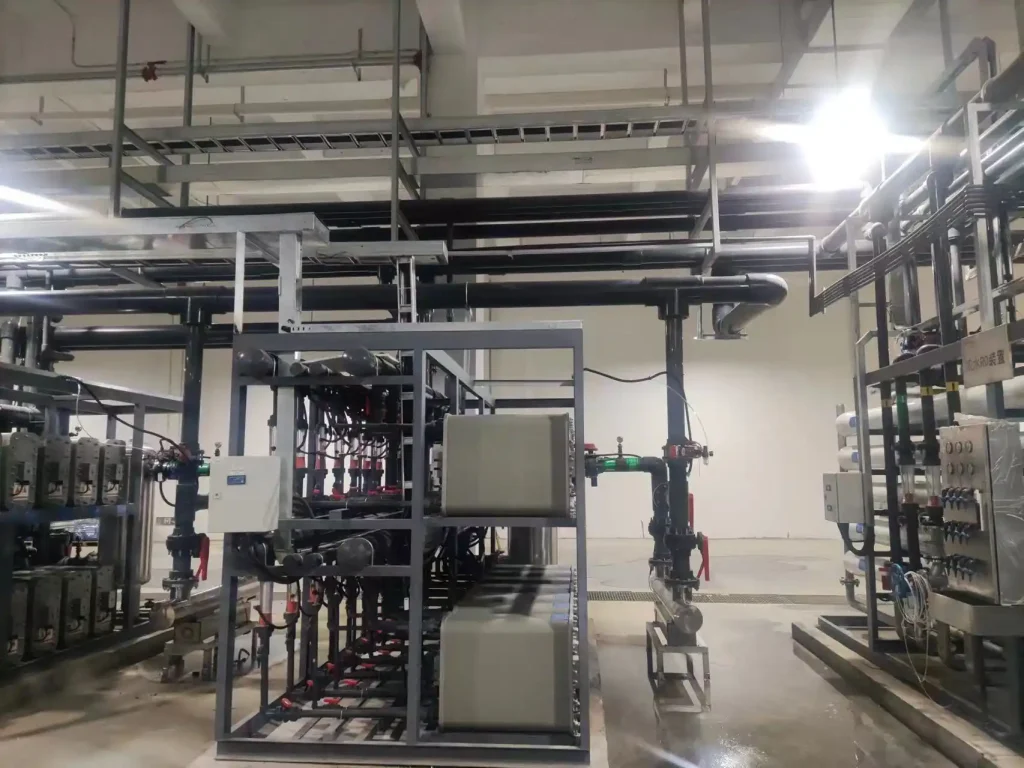
Project Challenges:
- Conflict between Cost and Production Capacity: The equipment has high energy consumption and a large proportion of costs, and cannot meet the water demand after the expansion of production capacity.
- Strict Requirements for Production Water Quality: The original texturing and etching links have extremely high standards for the resistivity (≥ 18.2 MΩ·cm) and TOC content (≤ 3ppb) of ultra – pure water.
- Environmental and Operational Pressure: The factory has a large temperature difference between winter and summer, which easily leads to the performance attenuation of membrane elements and affects the stability of water quality; The raw water contains boron and iodine ions, which need to be deeply removed to prevent damage to battery performance.
Process Flow:Mole Water Treatment has customized an ultra-pure water system for the enterprise. Through the coordinated operation of core units, stable water production is ensured.
- Pretreatment Unit: It adopts multi – stage pretreatment filtration, including a multi – media filter to remove suspended solids and turbidity in water, an activated carbon filter to adsorb residual chlorine and organic pollutants, a water softener to reduce the hardness of raw water and prevent scaling risks, and a 5 – micron precision filter for terminal pretreatment. This unit can extend the service life of core components.
- Reverse Osmosis Unit: A double – stage reverse osmosis + EDI configuration is adopted to maximize the improvement of pollutant removal efficiency. The double – stage reverse osmosis removes more than 99% of ions and organic matter, and the EDI further increases the water resistivity to more than 15 MΩ·cm.
- Polishing Mixed Bed: A polishing mixed bed is added after the EDI to further deeply remove residual trace ions, colloids, and other impurities in the water, ensuring that the produced water resistivity stably reaches the highest standard of 18.2 MΩ·cm, which fully meets the extreme requirements of photovoltaic cell production for ultra – pure water.
Project Effects:
- Water Quality Compliance and Stability: The system can stably produce ultra – pure water with resistivity ≥ 18.2 MΩ·cm and TOC ≤ 3ppb, and has the ability to resist environmental temperature fluctuations, ensuring the process stability of photovoltaic cell production.
- Reduction in Both Energy Consumption and Costs: Solar power drive replaces traditional electricity, significantly reducing production energy consumption; The optimized design of pretreatment and membrane elements reduces equipment blockage and loss, and greatly reduces annual operation and maintenance costs.
- Production Capacity Adaptation and Green Upgrade: The system meets the water demand of the enterprise after the expansion of production capacity, helps the enterprise achieve the “dual carbon” goal, realizes the transformation to green production, and improves the market competitiveness of the enterprise.