
Export of Dialysis Pure Water Machines to Africa
In the healthcare industry, a reliable water treatment system can be regarded as a key guarantee for sustaining lives. A dialysis center in West Africa, in order to ensure the quality of patient diagnosis and treatment and operational efficiency, contacted engineers from Molewater and consulted them about a pure water machine that could supply pure water to dialysis machines. After the engineers understood the needs of the dialysis center and the information about the equipment room, Molewater engineers deployed a set of customized medical – grade dialysis pure water purification systems, which also strictly complied with dialysis medical standards, laying a solid foundation for the dialysis diagnosis and treatment of the center.
Hemodialysis is a life – sustaining method for patients with end – stage renal disease. It has extremely high requirements for the quality of pure water. It is necessary to thoroughly remove pollutants in the water to avoid harmful impurities from entering the patient’s blood and causing complications. For this dialysis center, to achieve stable and safe diagnosis and treatment services, it is necessary to overcome three core challenges:
- Great Fluctuations in Raw Water Quality: The turbidity, residual chlorine content, and mineral indicators of municipal water supply change frequently, which is a common problem in urban water supply in Africa. This not only damages the dialysis equipment but also directly threatens the safety of patients.
- Harsh Power and Environmental Conditions: Power outages, high – temperature environments, and dust accumulation affect the stable operation of the equipment. At the same time, the lack of local professional and technical personnel brings great challenges to the daily maintenance of the equipment.
- Strict Compliance Requirements: The produced water must meet the international standards of AAMI/ISO 13959 and local medical regulatory requirements to maintain the qualification for diagnosis and treatment.
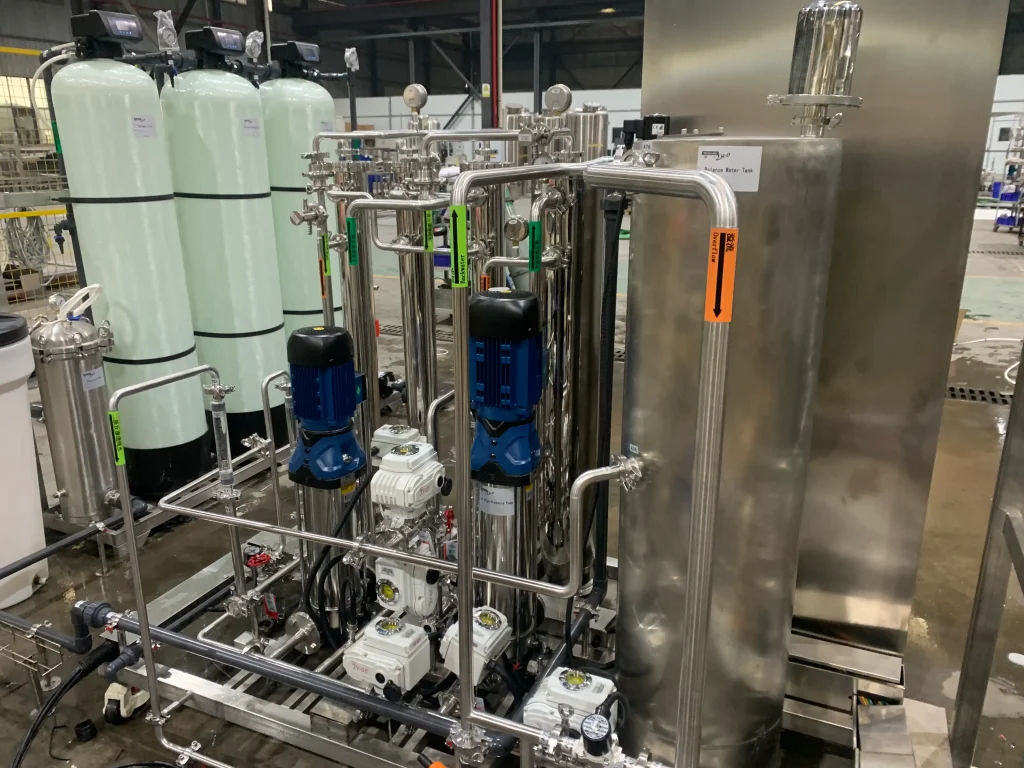
Process Flow
Molewater has created a set of customized modular dialysis pure water purification systems for this dialysis center. All components are optimally designed according to local working conditions, taking into account both durability and high performance. The core units of the system work together to continuously produce stable pure water. The specific process is as follows:
Pretreatment Unit: A multi – layer filter structure is adopted, including a multimedia filter to remove suspended solids and turbidity in the water, an activated carbon filter to adsorb residual chlorine and organic pollutants, a water softener to reduce the hardness of the incoming water and prevent scaling risks, and a 5 – micron precision filter for terminal pretreatment. This effectively protects the reverse osmosis membrane from damage and significantly extends the service life of core components.
Reverse Osmosis Unit: A configuration of a balance water tank and double – stage reverse osmosis is adopted to maximize the efficiency of pollutant removal. The first – stage reverse osmosis unit can remove more than 95% of dissolved salts, heavy metals, and microorganisms, and the second – stage reverse osmosis further performs deep purification. Finally, the produced water has a conductivity of < 5 μS/cm (at 25°C). Molewater uses reverse osmosis membranes with low energy consumption, high flux, and resistance to wear, and is equipped with an energy – saving high – pressure pump with overpressure protection function, which can flexibly adapt to scenarios with power fluctuations. A balance water tank is configured to stabilize the water supply pressure and provide water cutoff protection.
Disinfection Unit: A thermal disinfection method is adopted, equipped with a thermal disinfection pump and an electric heater to perform high – temperature disinfection on the reverse osmosis produced water and the delivery pipeline. Finally, the produced water meets the standards of bacteria count < 100 CFU/mL and endotoxin < 0.25 EU/mL and is delivered to each water use point.
Intelligent Control Unit: The system adopts a Siemens PLC and an intelligent control cabinet, which can display the system operation status and water quality online. It provides an alarm for critical status and can quickly shut down with one button, improving the operation and maintenance efficiency.
Project Results
After the system was put into operation, the dialysis center achieved excellent results in terms of patient safety, operational efficiency, and cost control:
Compliant and Stable Water Quality: The effluent indicators continuously meet the AAMI/ISO 13959 standards, avoiding diagnosis and treatment complications related to water quality.
Stable Operation: The design of the backup power supply and the wear – resistant structure ensure that the system has an operation stability of 99.5%. Even in the event of a power outage, the system can continue to operate, ensuring that the dialysis center can smoothly provide dialysis treatment for patients.
Significant Reduction in Operating Costs: The service life of the reverse osmosis membrane is 30% longer than the industry average. Combined with the automated maintenance program, the annual operation and maintenance cost is reduced by 40%.Empowering the Local Operation and Maintenance Team: Molewater provides remote operation training and after – sales guidance to help local staff master daily maintenance and fault diagnosis skills, reducing the cost of consulting technical personnel.