
Pure Water System for a Dental Hospital in China
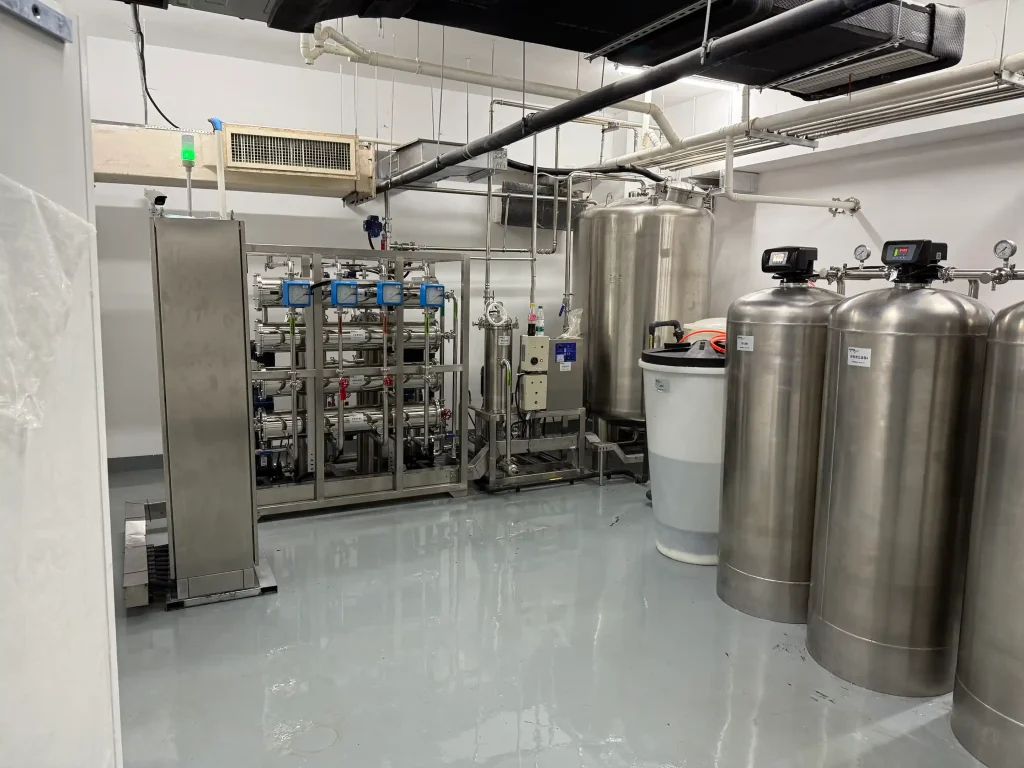
In the scenario of dental diagnosis and treatment, stable high – purity water is the core support for ensuring the safety of diagnosis and treatment and the service life of instruments. A dental diagnosis and treatment institution in a Chinese city, in order to avoid problems such as instrument corrosion and increased risk of oral infections in patients after diagnosis and treatment, contacted Molewater. After the engineers understood the water source, water production volume, distribution of water use points, and site conditions, a set of dedicated pure water systems adapted to the actual situation of the dental hospital was customized and deployed, which not only meets the water standards for the entire process of diagnosis and treatment but also adapts to the local operating environment.
Project Challenges
Dental diagnosis and treatment involve multiple water – using links such as instrument cleaning, root canal irrigation, and denture preparation, which have strict requirements for “low impurities, low hardness, and sterility” of water quality. The institution needs to overcome three core challenges:
High Requirements for Water Quality Compliance: It is necessary to meet both the “Discharge Standards for Water Pollutants from Medical Institutions” and the “Technical Specifications for Cleaning and Disinfection of Dental Diagnosis and Treatment Instruments”. The produced water must meet the standards of “conductivity < 5 μS/cm, bacteria count < 10 CFU/mL, and no heavy metal residues”, while the original equipment cannot stably meet these standards.
Difficulties in Coordinating Water Use in Multiple Scenarios: The three types of water use points, including dental chair flushing (pure water), implant surgery cooling (ultra – pure water), and dental laboratory denture printing (deionized water), are scattered. The original equipment has a chaotic pipeline layout, resulting in the risk of cross – contamination.
High Operation and Maintenance Costs and Pressures: The original equipment has a low degree of automation, requiring special personnel to monitor the water quality daily. Moreover, the RO membrane is frequently blocked due to insufficient pretreatment, resulting in an annual operation and maintenance cost of more than 50,000 yuan.
Process Flow
Pretreatment Unit: A combination of “self – cleaning multimedia filter + silver – loaded activated carbon filter + automatic water softener + 0.5 μm precision security filter” is adopted. The self – cleaning filter solves the problem of fluctuations in raw water turbidity. The silver – loaded activated carbon simultaneously removes chlorine and inhibits bacteria. The water softener reduces the hardness of the raw water to below 0.01 mmol/L, reducing the risk of scaling and microbial growth from the source.
Double – Stage RO + EDI + Terminal Precision Filtration Unit: The first – stage RO removes 99% of impurities. The second – stage RO purifies the water to a conductivity of < 2 μS/cm. The EDI unit further improves the water quality to a conductivity of < 0.1 μS/cm (meeting the ultra – pure water requirement for implant surgery). The terminal is equipped with a 0.22 μm sterile filter to ensure that the bacteria count of the produced water fully complies with the specifications.
Water Quality – Based Supply and Circulation Unit: Independent pipelines are used to accurately deliver “pure water (for dental chair flushing), ultra – pure water (for implant surgery), and deionized water (for dental laboratories)” to the corresponding water use points. At the same time, a closed – loop circulation pipeline is configured to avoid bacterial growth in stagnant water, meeting the requirements of hospital infection prevention and control.
Intelligent Control Unit: It is equipped with a PLC control cabinet that complies with the “Medical Equipment Data Interface Specification”. It uploads water quality data to the hospital’s HIS system in real – time and supports “automatic alarm for exceeding standards, remote operation and maintenance debugging, and reminders for consumable replacement”, adapting to the intelligent management needs of third – grade A hospitals.
Results
After the system was put into operation, the dental hospital achieved good results in terms of diagnosis and treatment compliance and operational efficiency:
100% Water Quality Compliance: The produced water continuously meets the water standards for dental diagnosis and treatment. In the hospital infection testing, the residual impurities and microbial indicators of the instruments are within the standard range, and the postoperative infection rate of implant surgery is 0.
Efficient Coordination in Multiple Scenarios: The water quality – based supply pipelines cover 12 dental chairs and 2 dental laboratories. There is no water supply interruption or cross – contamination during the peak water use period.
Controllable Operation and Maintenance Costs: The self – cleaning pretreatment and intelligent reminders for consumables extend the service life of the RO membrane to 3 years. The annual operation and maintenance cost is reduced by 60%, and no special personnel are required to monitor the water quality on duty.Adapting to the Intelligent Management of the Hospital: The water quality data is connected to the system in real – time. The water use records of each batch can be traced through the quality control platform, meeting the requirements of the grade evaluation of third – grade A hospitals.