Water touches nearly every stage of drug manufacturing — as an ingredient, a cleaning agent, and a solvent for injectable products. Yet raw water, whatever its source, is never pure enough on its own. It carries dissolved salts, microorganisms, organic matter, and endotoxins that can compromise product safety and regulatory compliance. Let’s walk through how pharmaceutical water treatment transforms raw water into purified water and Water for Injection (WFI), the standards that govern the process, and what to consider when selecting a system.
Why Raw Water Needs Multiple Treatment Stages
No single technology can take raw water all the way to pharmaceutical-grade quality. Municipal or well water typically contains dissolved minerals, chlorine or chloramine residues, suspended solids, bacteria, and trace organics — none of which are acceptable in a finished drug product. Left untreated, these contaminants can cause microbial contamination, generate bacterial endotoxins (pyrogens), or interfere with drug stability and efficacy.
This is why pharmacopeial bodies impose strict, quantifiable limits. The United States Pharmacopeia (USP), European Pharmacopoeia (EP), and Japanese Pharmacopoeia (JP) all define acceptance criteria for conductivity, Total Organic Carbon (TOC), and microbial bioburden in pharmaceutical water. Meeting these limits reliably requires a sequence of complementary technologies, each removing a different class of contaminant — which is exactly what a multi-stage treatment train is designed to do.
Key Steps in Pharmaceutical Water Treatment
Pretreatment
The process begins with pretreatment, which protects downstream membranes and equipment from fouling and damage. This typically includes multi-media filtration to remove suspended solids, water softening to reduce hardness ions, and activated carbon filtration to eliminate free chlorine. Without this stage, chlorine alone can rapidly degrade reverse osmosis membranes, shortening system life and increasing operating costs.
Reverse Osmosis (RO)
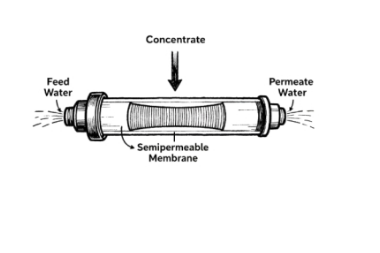
Reverse osmosis pushes pretreated water through a semi-permeable membrane under pressure, rejecting the majority of dissolved salts, organic molecules, and microorganisms. RO systems commonly achieve over 95–99% salt rejection, making them the primary desalination step in nearly every pharmaceutical water system. However, RO alone rarely meets the strict conductivity limits pharmacopeias require, which is why a polishing step follows.
Electrodeionization (EDI) and Ultrafiltration (UF)
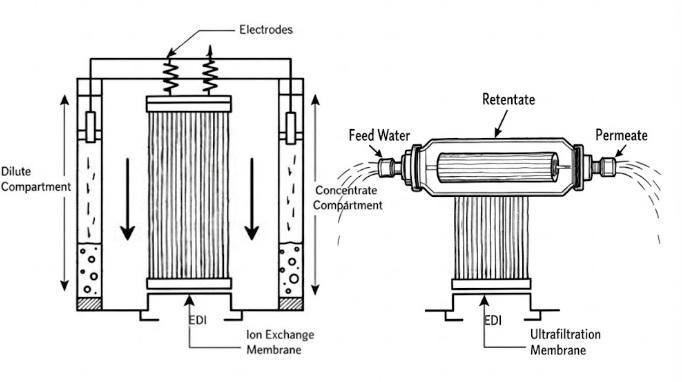
Electrodeionization uses electrical current combined with ion-exchange resin to continuously remove residual ions — without the chemical regeneration that traditional ion exchange requires. This produces consistently high-purity water while avoiding the acid and caustic waste streams associated with older methods. Ultrafiltration, meanwhile, uses a finer membrane barrier to remove bacteria, endotoxins, and large organic molecules, adding an additional layer of microbial control before storage.
Purified Water (PW) Generation, Storage, and Distribution
Once water passes through RO, EDI, and UF, it qualifies as Purified Water (PW) under USP and EP monographs — suitable for oral and topical drug formulations, as well as general cleaning applications. But generating PW is only half the challenge; storing and distributing it without recontamination is equally critical. PW storage and distribution systems typically use continuously circulating loops, sanitary stainless-steel piping, and periodic sanitization (thermal or chemical) to prevent biofilm formation, since stagnant water is one of the most common sources of microbial excursions in pharmaceutical facilities.
Multi-Effect Distillation for Water for Injection (WFI)
Injectable drug products demand an even higher purity standard: Water for Injection. WFI must meet tighter limits, including a bacterial endotoxin limit of ≤0.25 EU/mL under USP. While reverse osmosis-based methods are now permitted by some pharmacopeias, multi-effect distillation remains the most widely trusted method globally, using multiple evaporation-condensation stages to achieve near-total removal of pyrogens and dissolved solids through repeated phase changes. A well-designed multi-effect distillation generator also recovers heat between stages, significantly reducing energy consumption compared to single-effect stills.
Pure Steam Generation (PSG)
The final piece of the pharmaceutical water system is pure steam, generated from purified water and used to sterilize equipment such as autoclaves, tanks, and piping. Because pure steam directly contacts product-contact surfaces, it must meet the same non-condensable gas and pyrogen-free standards applied to WFI, closing the loop on a facility’s overall contamination control strategy.
Key Standards and Regulations to Follow
Every stage described above is ultimately governed by pharmacopeial and regulatory requirements. USP <1231>, EP monographs, and JP standards define specific limits for conductivity, TOC, and microbial counts at each water grade. Good Manufacturing Practice (GMP) further requires that systems be designed, installed, and validated with documented evidence — including Installation Qualification (IQ), Operational Qualification (OQ), and Performance Qualification (PQ) — before water can be released for production use. Regulatory inspections frequently focus on water systems specifically because they represent an ongoing, rather than one-time, compliance risk.
How to Choose the Right Pharmaceutical Water Treatment System
Selecting a system starts with understanding your facility’s raw water source, required production capacity, and target water grade (PW, WFI, or both). Facility layout also matters, since piping runs and loop design affect both cost and long-term sanitation performance. Beyond equipment specifications, the manufacturer’s track record matters just as much: experience designing systems that pass GMP audits, familiarity with USP/EP/JP requirements, and the ability to provide validation documentation and after-sales support can significantly reduce compliance risk down the line.
FAQ
What is the difference between Purified Water (PW) and Water for Injection (WFI)?
PW is used in oral and topical formulations and general cleaning, while WFI meets a stricter endotoxin limit and is required for injectable products.
How often should pharmaceutical water systems be validated?
Systems typically undergo periodic revalidation, along with continuous monitoring of conductivity, TOC, and microbial counts, as part of an ongoing GMP compliance program.
Why is distillation still used for WFI when RO technology has improved?
Multi-effect distillation offers an established, highly reliable method for endotoxin removal through repeated phase changes, which is why many manufacturers and regulators continue to favor it for WFI production.
Turning raw water into pharmaceutical-grade water is a carefully engineered sequence — pretreatment, RO, EDI/UF, distillation, and pure steam generation — each stage addressing a specific class of contaminant while meeting USP, EP, and GMP requirements. Because water quality directly affects product safety and regulatory standing, the system design and manufacturer experience behind it matter as much as the technology itself. If you’re evaluating a GMP-compliant pharmaceutical water system for your facility, exploring a manufacturer with proven design, validation, and support experience is a practical next step.