Clear water does not always mean safe water. Tap water and well water may contain bacteria, viruses, and other microorganisms that cannot be seen with the naked eye. This is one reason people ask whether a reverse osmosis system can remove these contaminants.
Yes, a properly designed RO system can remove bacteria and many viruses from water. The RO membrane works as a physical barrier, allowing water to pass through while retaining many microorganisms and other contaminants.
The membrane is an important part of the process, but it is not the only factor that matters. The condition of the membrane, system design, water pressure, pretreatment, and regular maintenance all affect how well an RO system performs.
What Are the Contaminants in Drinking Water?
Drinking water can contain different types of contaminants, including physical, chemical, biological, and radiological contaminants.
Physical contaminants include sediment, sand, rust, and other suspended particles. They may make water look cloudy or leave visible particles in the water.
Chemical contaminants include dissolved salts, heavy metals, pesticides, and some disinfection byproducts. Many of these substances cannot be detected by looking at, smelling, or tasting the water.
Biological contaminants include bacteria, viruses, protozoa, and other microorganisms. Some can cause gastrointestinal infections and other health problems, making microbiological safety an important part of drinking water treatment.
Radiological contaminants include naturally occurring radioactive materials. Whether they are present depends largely on the local geology and the source of the water.
RO systems can address several of these contaminants at the same time. The membrane can reduce many dissolved substances and also acts as a barrier to bacteria, viruses, and other microorganisms. However, the actual removal performance depends on the membrane, operating conditions, and overall system design.
How Does a Reverse Osmosis System Work?
Reverse osmosis uses pressure to push water through a semi-permeable membrane. In natural osmosis, water moves toward the side with a higher concentration of dissolved substances. RO uses external pressure to reverse this movement. Water passes through the membrane, while many dissolved substances and other contaminants are rejected.
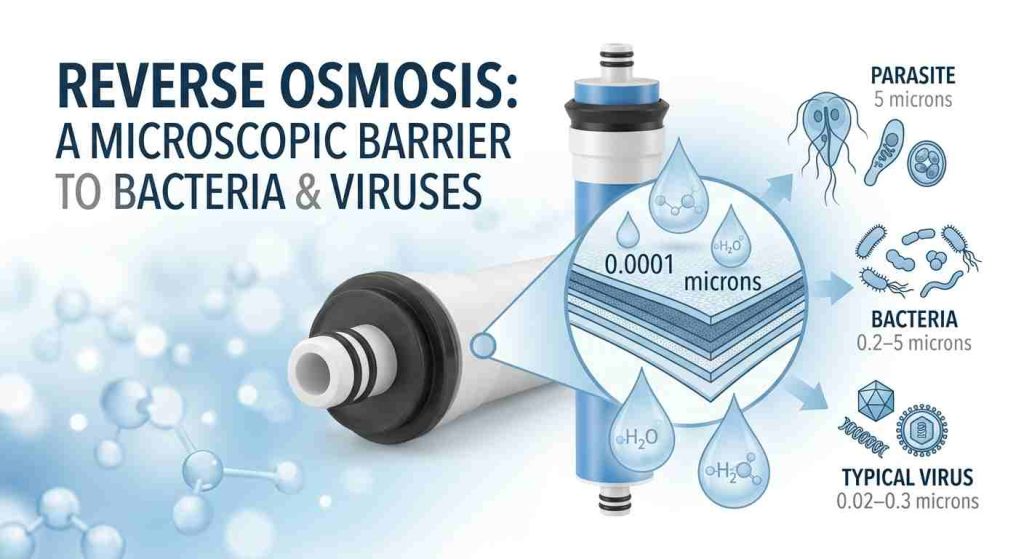
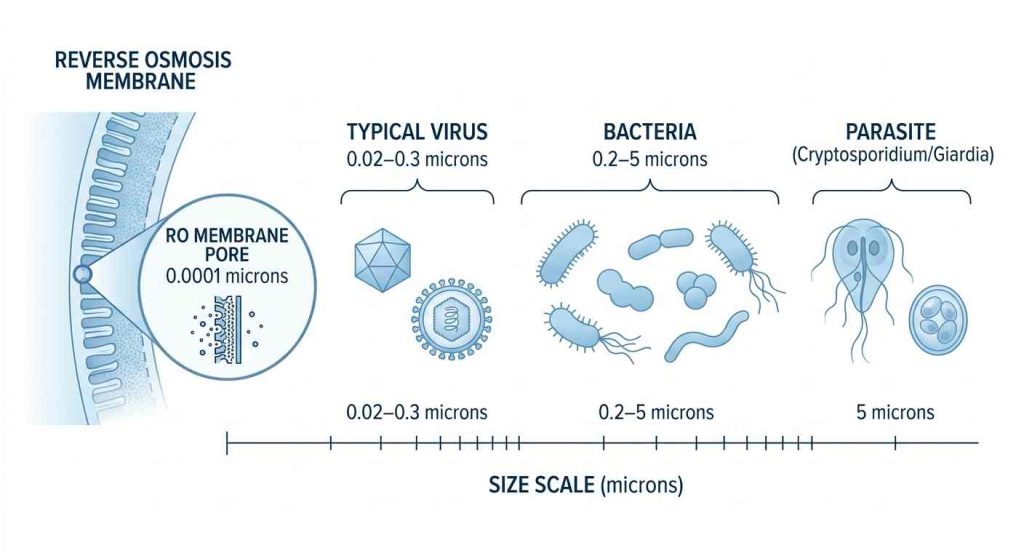
RO membranes have extremely fine separation capabilities. A commonly cited nominal pore size is around 0.0001 microns. However, RO membranes are better described by their contaminant rejection performance than by pore size alone, since they do not work like a conventional filter with clearly defined openings.
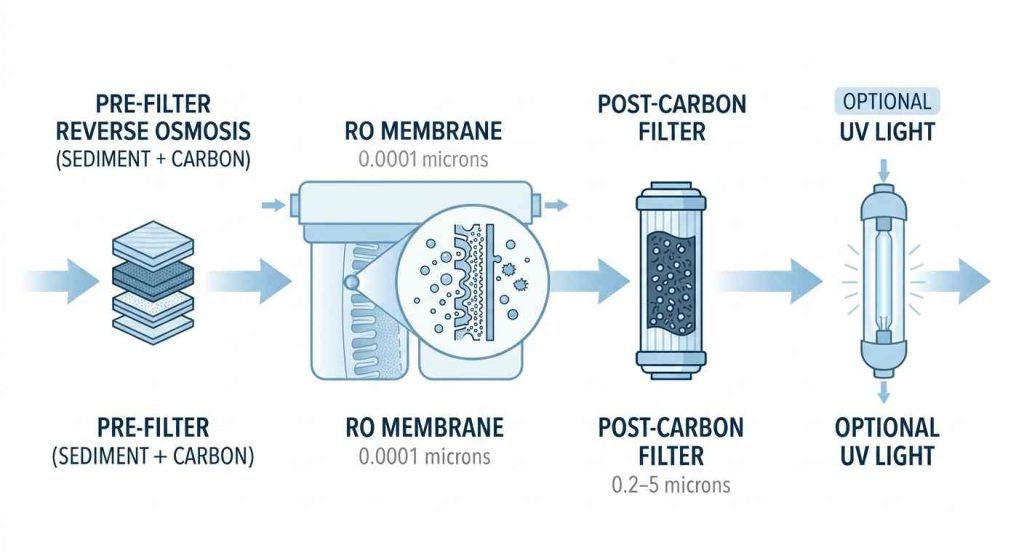
A typical RO system has several treatment stages:
Pre-treatment → RO membrane → Post-treatment
Pre-treatment removes sediment and, depending on the membrane type, can also reduce chlorine and other substances that may damage the membrane. The RO membrane handles the main separation process. Post-treatment may include activated carbon to improve the taste and odor of the treated water.
Each stage has a different role, and the RO membrane is the main barrier for dissolved contaminants and microorganisms.
Does RO Remove Bacteria and Viruses? The Science Explained
Yes. A properly designed and maintained RO system can achieve a high level of removal for bacteria and many viruses.
RO membranes have a very fine separation capability. Many bacteria are about 0.5–5 microns in size, while viruses are much smaller, often around 0.02–0.3 microns, depending on the type. Despite their smaller size, viruses can also be rejected by a properly functioning RO membrane through a combination of size exclusion and other separation mechanisms.
This is one of the main differences between RO and ordinary sediment filtration. A sediment filter is mainly used to remove larger particles such as sand, rust, and suspended solids. It does not provide the same level of contaminant rejection as an RO membrane.
There is also an important distinction between removing microorganisms and killing them. RO does not normally kill bacteria or viruses. Instead, the membrane rejects them from the permeate water. They remain on the feed side and are discharged with the concentrated reject water.
How well an RO system removes microorganisms depends on the membrane, operating pressure, feed water quality, system design, and maintenance. A damaged membrane or poorly maintained system may not perform as expected. Therefore, it is more accurate to discuss RO performance in terms of specific contaminant-reduction rates rather than claim that every RO system removes 100% of all bacteria and viruses.
Why Multi-Stage Filtration Matters
The RO membrane is the main separation stage, but a complete RO system usually includes other treatment steps as well.
Pre-treatment comes first. A sediment filter removes larger particles such as sand, rust, and suspended solids. Activated carbon may also be used to reduce chlorine and certain organic compounds that can damage some types of RO membranes.
The RO membrane then performs the main separation. It can reduce dissolved salts, many heavy metals, microorganisms, and a wide range of other contaminants.
Some systems use a post-activated carbon filter after the RO membrane. Its main purpose is to improve the taste and odor of the treated water.
For applications with stricter microbiological requirements, UV disinfection can be added as another treatment step. UV does not physically remove microorganisms. Instead, it inactivates them. This makes UV and RO useful for different purposes and allows the two technologies to work together.
The condition of the other system components also matters. Storage tanks, tubing, fittings, and old filters can provide places for microorganisms to grow if they are not properly maintained. Regular cleaning and timely filter replacement help keep the entire system working as intended.
Conclusion
Reverse osmosis is one of the most effective membrane-based technologies for producing cleaner water. Its very fine separation capability allows it to remove bacteria and viruses along with many dissolved contaminants.If you are looking for an RO solution for drinking water, commercial use, or industrial water treatment, Molewater provides RO systems designed for different water qualities, capacities, and treatment requirements. Choosing the right membrane and supporting treatment stages is the key to achieving reliable long-term performance.