

The best feed water for a Water for Injection (WFI) system is not necessarily the purest water available. In most cases, WFI production starts with compliant drinking water or purified water, while the pretreatment train is designed around the source water’s actual chemistry and microbiological characteristics. The most important question is not just “How pure should the feed water be?” But “Can the feed water be consistently conditioned for reliable WFI production?”. We will explain the most important requirements for feed water, as well as the significance of pretreatment and how to select the best water to begin the WFI system.
What Is Feed Water in a WFI System?
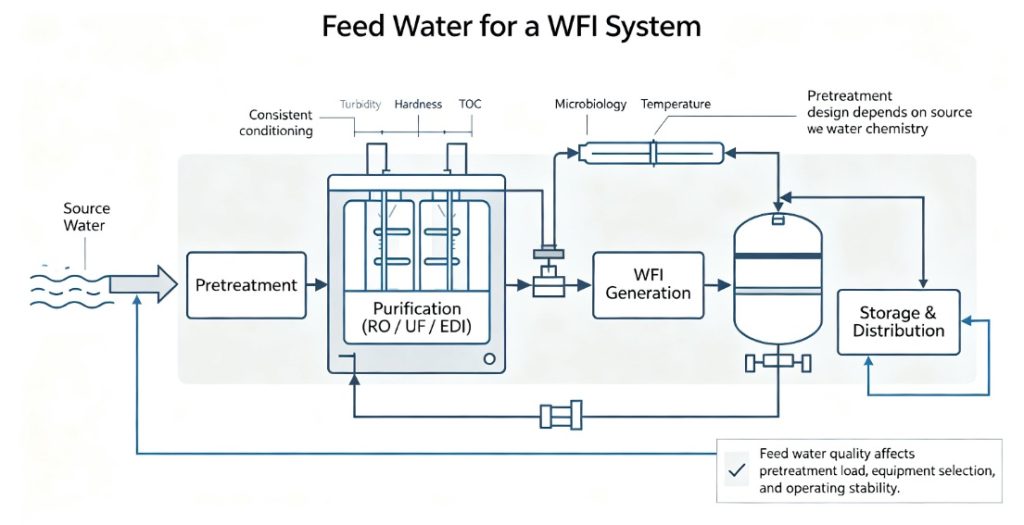
Feed water is the water to a process that is supplied to the purification or generation process prior to being converted into the necessary pharmaceutical-grade water. In the case of a WFI system, the quality of the water directly affects needs for pretreatment, the selection of equipment as well as operating stability and downstream purification efficiency.
It is helpful to differentiate various phases:
Source water → Pretreatment → Purification → WFI generation → Storage and distribution
The source water could be municipal water or another source approved by the government. After pretreatment, the water can undergo technologies like reverse Osmosis (RO), ultrafiltration and electrodeionization (EDI) or other processes that are certified prior to taking the last WFI generation process.
The precise configuration is based on the analysis of source water and the capacity required, as well as the appropriate pharmacopoeia and system design.
What Water Can Be Used as Feed Water for WFI?
Potable Water as the Starting Source
For bulk WFI, compliant drinking water can be an appropriate starting source. WHO guidance states that bulk water for injections should be prepared from drinking water, usually with further treatment, or from purified water as the minimum-quality feed water.
This does not mean that untreated tap water can simply be connected to a WFI generator. The drinking water supply is just the beginning point. Its hardness, chlorine content, organic amount, particle load, microbial quality, and other factors must be assessed prior to the design of the treatment plan is developed.
Does WFI Require Purified Water as Feed Water?
Not necessarily.
There is an important difference between a minimum regulatory starting-water requirement and a practical engineering configuration. Some facilities may produce purified water first and then use it as feed for the WFI generation stage. Other systems may use appropriately treated drinking water, depending on the technology and applicable requirements.
WHO specifically identifies both drinking water and purified water as possible minimum-quality feed waters for bulk WFI.
Therefore, the better approach is not to assume that one feed-water grade works for every facility, but to design the system around the actual water source and intended WFI process.
What Feed Water Quality Does a WFI System Need?
There is no single number that describes whether feed water is “good enough.” Several characteristics need to be considered together.
Chemical Parameters
Important parameters can include:
- Hardness
- Conductivity or TDS
- Silica
- Chlorine and chloramine
- Iron and manganese
- TOC and other organic matter
- Suspended solids
These parameters determine if carbon treatment, softening, RO, filtration, or any other steps prior to treatment are necessary.
For example, hardness that is high increases the chance of scaling and chlorine or chloramine can impact certain elements of downstream processing. Organic and silica contaminants can affect the performance of membranes and cleaning requirements.
Microbiological Quality
Microbiological control is equally important.
A feed-water system that has the highest microbial burden can make it more difficult for downstream purification, and cause more difficulties for sanitation of the system as well as biofilm control.
WHO guidelines emphasize the control of the quality of chemical and microbiological water throughout storage, production and distribution, rather than focusing on WFI quality as something restricted to the last generation stage.
Seasonal and Source-Water Variation
Feed-water quality should not be evaluated from a single laboratory report alone.
Municipal and other water sources can change over time. Changes in temperature, rainfall, disinfectant levels, hardness, or organic content can affect treatment performance.
For this reason, a robust WFI system should consider the expected range of feed-water conditions, not just an ideal average value.
Why Feed Water Quality Matters in a WFI System
Poorly characterized feed water can create problems long before the final WFI quality is tested.
Pretreatment Requirements
The more challenging the source water, the more carefully the pretreatment train needs to be designed.
Depending on the analysis, a system may incorporate:
Filtration → Softening → Activated Carbon → RO → EDI or Other Purification
Not every facility needs every technology. The appropriate combination should be based on actual water quality and system requirements.
Scaling and Fouling
Hardness, silica, suspended solids, and organic contaminants can contribute to membrane scaling or fouling.
That can result in:
- Reduced membrane performance
- More frequent cleaning
- Higher operating costs
- Shorter component life
- Greater maintenance requirements
Microbial Control
Temperature, stagnant sections, inadequate circulation, and inadequate sanitation can all increase the risk of microbiological contamination.
WHO guidance suggests the design of a facility, including keeping adequate flow, regulating the temperature, ensuring adequate sanitation, and using equipment that are regularly cleaned.
System Reliability and Operating Cost
Feed-water quality ultimately affects more than water purity.
A well-defined feeding source could allow engineers to choose the appropriate equipment for pretreatment and avoid unnecessary stages of treatment. This could prolong the life of membranes also reduce chemical and cleaning demands, and make system operation more reliable.
What Pretreatment Is Needed Before WFI Generation?
There is no universal pretreatment train for every WFI system.
Common technologies include:
- Multimedia or cartridge filtration
- Water softening
- Activated carbon
- Dechlorination
- Reverse osmosis
- Ultrafiltration
- Electrodeionization
- UV treatment
The purpose is to reduce the contaminants that could interfere with downstream purification or compromise system performance.
WHO guidance specifically recommends considering feed-water quality, required water-quality specifications, quantity, and generator sizing when designing a WFI purification system and defining the user requirement specification (URS).
That leads to an important engineering principle:
A WFI system should be designed from a water analysis, not from a generic equipment package.
Can RO Water Be Used as Feed Water for a WFI System?
Yes, RO water can be part of the feed-water strategy, but whether it is appropriate for a specific WFI generation stage depends on the complete system design and applicable requirements.
A typical treatment sequence might look like:
Potable Water → Pretreatment → RO → Further Purification → WFI Generation
RO can substantially reduce dissolved salts and other contaminants, helping condition water for downstream treatment. Depending on the system, additional technologies such as EDI or ultrafiltration may be incorporated.
The important point is that RO water should not automatically be considered WFI. WFI is a defined pharmaceutical water grade with its own quality requirements and system controls. WHO also notes that some pharmacopoeias prescribe or limit the permitted final purification stage, while newer approaches allow qualified non-distillation technologies under applicable standards.
What Is the Best Feed Water for a WFI System?
The best feed water for a WFI system is consistent, compliant source water that can be reliably conditioned through an appropriately designed pretreatment and purification train.
In regulatory terms, drinking water can serve as the starting source for bulk WFI, while purified water can also be used as a minimum-quality feed water. From an engineering perspective, however, the right choice depends on the source-water analysis, required WFI quality, production capacity, generation technology, and overall system design.
For pharmaceutical manufacturers, the goal should therefore be simple: characterize the feed water first, then design the WFI system around it.
For facilities evaluating a new pharmaceutical water system, Molewater provides pharmaceutical water solutions that can be configured around feed-water characteristics, required water quality, production capacity, and facility requirements. Molewater Pharmaceutical Water Solutions.