An EDI module can replace acid, caustic and regeneration downtime with a quiet, continuous process, but only when it suits your water. Most failures trace back to a mismatch, not a bad brand. The right choice depends on your feed water, purity target, flow rate and industry rules. Following, we cover seven selection factors, a five-step process and industry-specific advice. Get these right and your electrodeionization stage will deliver stable, chemical-free, high-purity water for years.
How to Select the Correct EDI Module for Your Industrial Water Treatment System
An EDI module can replace acid, caustic and regeneration downtime with a quiet, continuous process – but only if it’s right for your water. Most failures are not due to a bad brand, it’s a mismatch. The best choice will depend on your feed water, purity goal, flow rate and industry regulations. Then we go over seven selection criteria, five-step process, and industry-specific tips. Get these right and your electrodeionization stage will produce stable, chemical-free, high purity water for years to come.
Do You Need an EDI Module, or Will RO or Mixed Bed Do?
Start by ruling out options.
- RO alone is sufficient if low microsiemens conductivity is acceptable, such as in many cooling and general process applications.
- Mixed bed still suitable for small or intermittent demand.
- EDI fits continuous, higher-volume duty. It can replace mixed ion exchange in many applications through a chemical-free process, but the feed is generally RO permeate.
So EDI is a polishing step after RO, not a stand alone treatment. The performance of your industrial reverse osmosis system is the ceiling for everything else that follows.
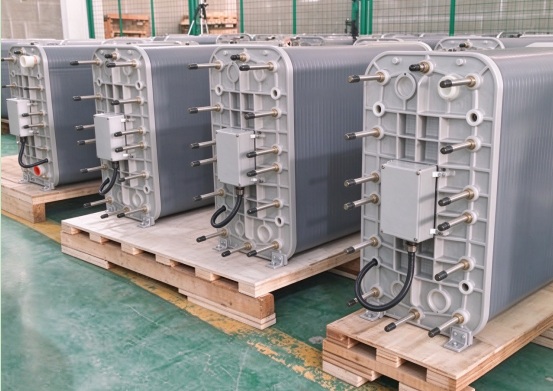
7 Things to Consider When Selecting an EDI Module
1. Quality of feed water
This is the most common cause of module failure. The Ionpure LX datasheet indicates feed conductivity (including CO₂ and silica) of less than 40 uS/cm, total chlorine of less than 0.02 ppm, hardness of less than 1.0 ppm and feed temperature up to 45 °C. Design is the tolerance. A high tolerance module can handle up to 4 ppm hardness, 2 ppm silica and 100 µS/cm whereas a standard module is limited to 1 ppm hardness, 1 ppm silica and 40 µS/cm.
| Parameter | Typical standard module limit |
| Feed conductivity equivalent | < 40 µS/cm |
| Total chlorine | < 0.02 ppm |
| Hardness (as CaCO₃) | < 1.0 ppm |
| Max feed temperature | 45°C |
Two hidden risks deserve attention:
- CO₂: For some EDI devices, 10 ppm CO₂ in the feed can be enough for the system not to meet boiler makeup specifications.
- Chloramines: Total chlorine, including chloramines, can cause irreversible damage to modern EDI modules so a system designed for free chlorine alone requires additional treatment.
The module is protected with good pretreatment filters and an industrial water softener
2. Required product water quality
Set a resistivity target before you order. ASTM D1193 lists 18.0 MΩ·cm as the minimum for Type I and 1.0 MΩ·cm for Type II. Keep in mind that 18.2 MΩ·cm is the limit expected for very pure water. It is not the ASTM requirement by itself. In real industrial setups, many modules often run above 16 MΩ·cm. Still, confirm what the supplier can guarantee with your actual feed conditions.
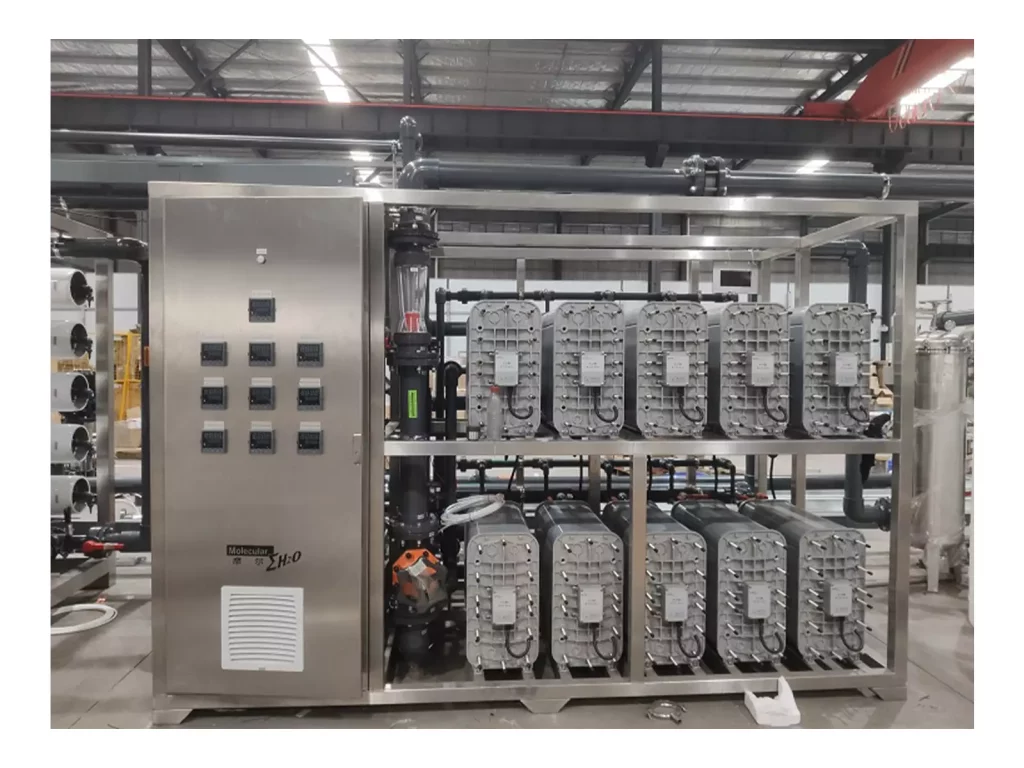
3. Capacity and Flow Rate
Size to peak demand, not average. Industrial modules are nominally sized at 6.8 m³/h and 10 m³/h, so bigger plants will have several in parallel. You have a lot of room to grow up.
4. Recovery and Concentrate Handling
Higher recovery cuts water cost. Some modules are optimized for single-pass RO feed with up to 90% recovery. Plan where the concentrate goes, usually back to the RO feed.
5. Module Design
Heavier cell builds can react more when the feed water changes. A thinner option may feel steadier in some setups. If your feed fluctuates, pick a design meant to handle that.
6. Materials, Compliance and Sanitization
If this is for pharma, food, or electronics, ask for the material certificates. Also check that the materials match your planned sanitization approach.
7. Total Cost of Ownership
Look at more than the buy price. Include power use, expected module life, and what a replacement will cost. A low-priced module can end up costing more after about five years.
A 5-Step Process to Select Your EDI Module
1.Confirm with the supplier: request a written performance guarantee.
2.Collect data: water source, test reports and daily demand.
3.Set targets: product resistivity and the standard you must meet.
4.Check the permeate quality at the RO stage. RO permeate (first few minutes) can be worse than RO feed after being on standby. Consider a break tank or divert-to-drain step.
5.Match capacity and design: flow, recovery and feed tolerance.
EDI Selection by Industry
- Pharmaceutical: compliance, documentation and sanitisation.
- Semiconductor and electronics: highest resistivity, low silica, often feeding an ultrapure water system.
- Power and boiler feed: CO₂ control and stability.
- Food and beverage: hygienic design and continuous operation.
- Laboratory: small flow and easy maintenance.
Keeping Your EDI Module Healthy
Falling conductivity performance can signal fouling or feed changes, and flow and current should stay consistent. Log voltage, current, product resistivity and concentrate flow daily, and investigate trends early.
How Molewater Helps
Molewater follows a five-stage process: analysis, design, production, delivery and after-sales service. It starts with your water source, quality report, application and production targets. With 20+ years of experience and 500+ global projects, the team can size your RO-EDI train around your actual water. Explore our RO pure water system or request a free quote.
FAQ
What is the difference between EDI and mixed bed?
Both polish RO permeate. EDI regenerates continuously with electricity, while mixed bed needs periodic chemical regeneration or resin exchange.
What feed water does an EDI module need?
Typically RO permeate with low conductivity, hardness and chlorine. Confirm limits in your chosen module’s datasheet.
Can I raise pH after RO to remove CO₂?
Not effectively. pH adjustment must be done in the RO feed, because raising the pH of RO permeate does not improve EDI product quality.
How do I know my module needs attention?
Rising voltage, falling product resistivity or changing differential pressure are early warnings.