

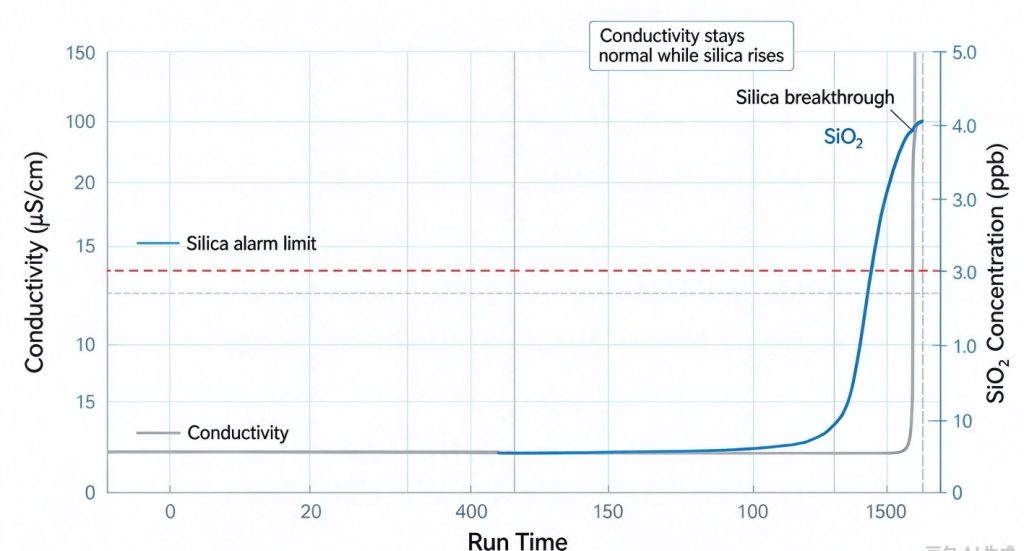
Your conductivity meter reads normal, but silica is already slipping through. That is the rub with silica breakthrough. It’s a weakly ionised species and often goes undetected until it deposits on turbine blades or shows up as defects on wafers.In most high purity water systems the cause can be classified into one of four categories; exhausted or fouled anion resin, weak regeneration, pretreatment or RO decline, and poor monitoring. Knowing each one of them allows you to notice problems early.
What Is Silica Breakthrough, and Why Is It Hard to Catch?
Silica breakthrough is when the silica concentration in the treated water goes over your set limit suddenly or slowly. Silica is the last ion to be taken up by a strong base anion resin and the first released as the resin approaches exhaustion. Dissolved silica has little electric charge, so its leakage has little effect on conductivity. A purpose built silica analyser will normally give an alarm long before a conductivity cell.
Silica has two different forms and it’s important to be able to tell them apart. Ion exchange removal is responsive to dissolved reactive silica. Colloidal silica is particulate instead – it will go straight through resin and usually needs filtration, coagulation or membrane systems. One common cause of misdiagnosis is confusing one for the other.
Why Silica Control Matters
Silica causes headaches differently in different industries. In power plants it vaporises in high-pressure steam and deposits on turbine blades, hurting performance and leading to expensive outages. Trace silica in ultrapure water leads to surface defects and lower yields in semiconductor fabs. It forms hard insulating scale in boiler systems.
Required limits leave little margin for error. EPRI and VGB recommend that power plants reduce the silica in the feedwater and steam to low parts per billion. Electronics‐grade and reagent water also have tight limits under ASTM D5127 and ASTM D1193 . Verify the silica specification that is correct for your particular process and equipment supplier.
The Main Causes of Silica Breakthrough
Fouled or exhausted Anion Resin
This is the most common culprit. As the resin approaches exhaustion, stronger-binding anions displace silica, which leaks first. Aged resin, or resin contaminated with organic matter such as humic and fulvic acids, has lost its exchange capacity and kinetics. The resin that is fouled usually will have a longer rinse time, silica rise between regenerations, and a shorter service run.
Incomplete or bad regeneration
Silica is hard to displace from the resin, so regeneration should be done carefully. Too little caustic, too cold caustic, or too short contact time leaves silica on the resin which then leaks early in the next cycle. Most operators heat the caustic to around 40 to 50 °C to improve silica removal, but follow the specification of your resin maker. Poor caustic quality, such as silica contamination in the chemical, can also cause problems.
Cation Leakage Upstream
When the cation bed leaks sodium, the anion bed converts it to sodium hydroxide, which raises the pH inside the resin and pushes silica back into the water. A rise in sodium upstream can therefore look like an anion problem. Checking sodium at the cation outlet saves a lot of guesswork.
Channeling, High Flow, and Poor Distribution
If water bypasses part of the bed through channels, or flows faster than the design rate, contact time drops and silica slips through. Damaged distributors, uneven resin levels, and clogged underdrains are typical causes. The pattern is usually a sudden, unexplained rise rather than a slow drift.
Mixed Bed Problem
Backwash in a mixed bed does not completely separate the cation and anion resin and this results in cross-contamination during regeneration. Caustic contaminated cation resin gives up sodium and acid contaminated anion resin loses its capacity. If you don’t rinse well enough after regeneration, you can leave residual ions that show up as silica or sodium spikes at startup.
RO Problems and Pretreatment
Reverse osmosis will usually remove most of the dissolved silica, but performance will decline as membranes foul or age. High recovery may also force silica to exceed its solubility limit, which is normally considered to be around 100-120 mg/L at neutral pH and room temperature (although this is influenced by temperature, pH and metals like aluminium and iron). The silica then scales on the surface of the membrane, reducing the rejection and sending more silica downstream. Some of the colloidal silica is not removed in pretreatment and may be passed on to polishing units.
Monitoring Gaps
Many sites track conductivity and resistivity only. Without regular silica measurement, breakthrough goes unnoticed until a quality failure or a deposit-related shutdown. Grab samples once a day cannot catch fast changes either.
Quick Diagnosis: Symptoms and Likely Causes
| Symptom | Likely cause | Check first |
| Silica rises slowly over weeks | Resin aging or organic fouling | Resin capacity test |
| Early leakage right after regeneration | Incomplete regeneration | Caustic dose, temperature, contact time |
| Sudden spike | Channeling or pretreatment upset | Flow rate, distributors, RO permeate |
| Conductivity normal, silica high | Anion bed nearing exhaustion | Online silica analyzer |
| Sodium and silica both elevated | Cation leakage | Cation outlet sodium |
How to Prevent and Fix Silica Breakthrough
Start with regeneration, since it is the cheapest variable to correct. Verify caustic dose, concentration, temperature, and rinse volume against the resin supplier’s guidelines. Next, test your resin periodically for capacity and fouling, and plan replacement before performance falls off a cliff, rather than after.
On the membrane side, keep RO recovery within a safe range for your feedwater silica level, and consider antiscalant programs designed for silica control. Clean membranes on a schedule driven by normalized flux and salt rejection data, not just by calendar.
Finally, install online silica monitoring with alarm set points below your limit. The goal is to change the bed or begin regeneration before silica exceeds specification, not after.
Designing a Reliable High-Purity Water System
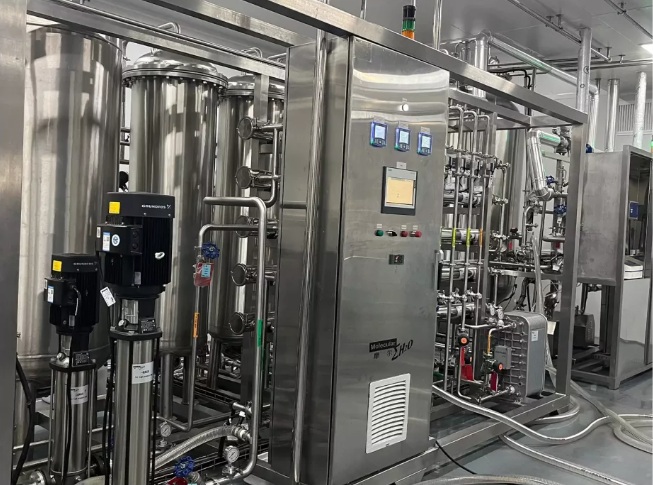
A robust high purity water system is built in layers, so each stage protects the next. Good pretreatment, such as multimedia filtration, activated carbon, and softening or antiscalant dosing, protects the RO. RO removes the bulk of dissolved solids and much of the silica. Then EDI or mixed bed polishing brings water to final quality.
Design starts with the feedwater. Source water silica, organics, and variability should drive technology selection and sizing. Adding redundancy, such as duplicate trains or standby beds, lets you regenerate or service one unit without compromising supply. Sampling points between stages also make troubleshooting far faster.
Need Help Evaluating Your Water System?
Silica breakthrough usually traces back to resin condition, regeneration, pretreatment, or monitoring, and a systematic check finds the cause faster than guessing. To get a practical evaluation, gather your feedwater analysis, system flow diagram, resin and regeneration data, required outlet quality, and a description of the problem you are seeing. Contact us today.