Agricultural wastewater is one of the hardest effluent streams to treat. This stream is carrying organic loads that may be tens or even hundreds of times greater than municipal sewage. Left untreated, it takes oxygen from rivers. It leads to fines. It wastes valuable resources without treatment. The good news is that a staged approach will reliably reduce COD and BOD. In this guide, we will look at sources of pollution, the most effective ways and how to build an efficient agricultural wastewater treatment process.
Why COD and BOD is high in agricultural wastewater ?
Chemical Oxygen Demand (COD) is the total amount of oxygen required to chemically oxidise all material in the water including biodegradable compounds and compounds resistant to degradation. BOD (biochemical oxygen demand) is nothing more than a measure of what micro-organisms are able to degrade, usually over a period of five days at 20°C. A good tip is to look at the ratio between them. The higher the BOD/COD ratio (above about 0.5) the easier the waste is to treat biologically. If the ratio is low, then it is needed to carry out additional physico-chemical or advanced treatments.
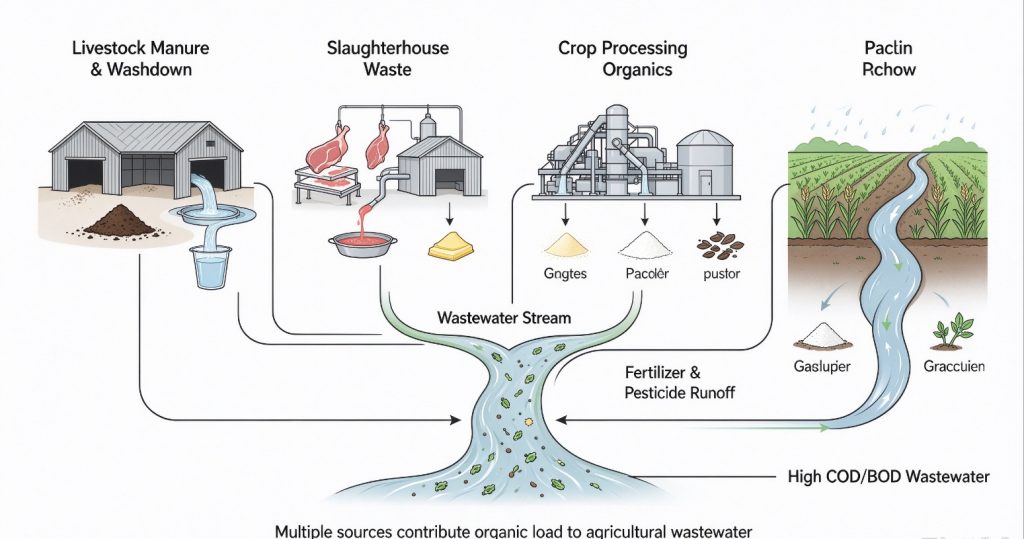
The organic load comes from a variety of sources. Manure, urine and washdown water are produced by livestock operations. Protein, blood and fat, from slaughterhouses. Food and crop processing provides sugars, starches, and oils. It transports nutrients and sometimes toxic compounds from runoff of fertiliser and pesticide.
Very variable are the concentrations. The COD for dairy wastewater is reported in the published literature in the low thousands of mg/L (e.g. the standard reference Wastewater Engineering, Metcalf & Eddy). Wastewater from pig farms often has a COD of 10,000 mg/L or more. Slaughterhouse effluent is typically in the range of thousands to tens of thousands. In contrast, treated effluent is generally subject to strict limits. For example, China livestock discharge standard GB 18596-2001 has 400 mg/L for COD and 150 mg/L for BOD5 . Each local regulation is different, always check your own permit.
Why Reducing COD and BOD Matters
The environment stakes are real. When organic matter enters a river, bacteria use up dissolved oxygen as they break it down. Fish and other aquatic life begin to die when oxygen drops below about 2 mg/L. Agriculture is on the list of leading sources of impairment to the nation’s rivers and streams, according to the U.S. EPA. The primary offenders are nutrients and organic pollution.
There’s a financial argument too. Exceeding limits results in penalties and may stop operations. meanwhile, good treatment can recover biogas as energy, and produce reusable water and nutrient-rich residues, turning a liability into a resource.
A Step-by-Step Approach to Agricultural Wastewater Treatment
The best systems are staged so that each stage reduces the load on the next stage .
Step 1. Pre-treatment to Remove Solids and Fats
Start with screens, separators (solid/liquid) and grease traps. Coarse solids, hair and fat should be removed early to protect pumps and biological reactors from clogging. An equalisation tank is just as important because of the wide variation in farm and plant flows between washdown cycles. Each downstream process is stabilised with a constant supply.
Step 2: DAF Physico-Chemical Treatment
Dissolved air flotation (DAF) floats suspended solids, oils, and other colloids to the surface. DAF is often used with coagulation and flocculation . It is especially helpful when dealing with waste water from slaughterhouses and food processing. Depending on the wastewater, a large share of fats and suspended organics can be removed, plus some phosphorus which noticeably lowers the COD entering biological stages.
Step 3: High Strength Waste Anaerobic Treatment
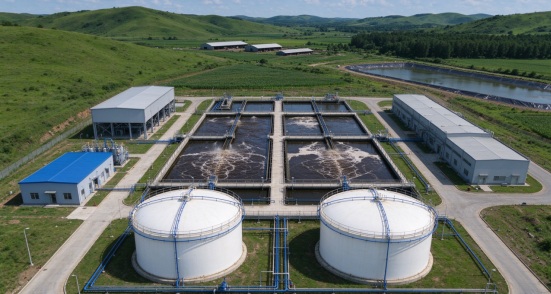
Wastewater that has COD above about 2,000 mg/L is commonly treated in anaerobic reactors. UASB, IC, and CSTR are used as the main treatment units. In these systems, microorganisms break down organic pollutants without oxygen. Well operated plants can achieve a reduction of COD by 70-90% and produce biogas containing on the average 50-70% methane. The biogas can be used to fire boilers or power generators to reduce operating costs. Anaerobic reactors need to be operated in steady conditions, especially a constant temperature of about 35°C and pH.
Step 4: Biological process aerobic
Residual COD, BOD and ammonia are still present in the output from anaerobic units. Further purification is obtained by aerobic processes such as activated sludge, SBR (sequencing batch reactor), A/O (anoxic/oxic) and MBR (membrane bioreactor). These processes can remove more than 95% BOD. If an anoxic section is built in the design, nitrogen removal can be done.
Step 5: Further Treatment and Disinfection
In case the treated water has to be used for irrigation, washing reuse or for stringent discharge standards, sand filtration, membrane separation or advanced oxidation can be used followed by disinfection. This step removes the last residues of refractory COD and pathogenic microorganisms.

Treatment Methods Comparison: Which One Suits Your Operation?
No one technology is right for every site. This comparison highlights where each one shines.
| Method | Best Used For | COD/BOD Removal | Main advantage | Main disadvantage |
| DAF | Flows high in fatty solids | Moderate | Quick removal of oils and solids | Limited for dissolved organic |
| IC / UASB | High strength wastes | High | biogas recovery Low energy | Slow to get going, shock sensitive |
| SBR / A/O | Medium to low strength | Good | effluent quality High | Higher energy and sludge production |
| MBR | Tight limits or reuse | Very high | Stable effluent, compact | Higher cost, maintenance of membrane |
There are five factors to consider when making your selection: strength of the wastewater, daily flow, available land, budget, and the discharge or reuse standard you will be required to meet. In practice, combined processes are better than single processes. A common and effective chain is pretreatment, DAF, anaerobic then aerobic. This balances cost and reliable compliance.
Mistakes That Can Cause High COD & BOD
There are some repeated errors in real projects. The first is to avoid the pretreatment that overloads the biological stages and reduces the life of the equipment. The second is that flow variations are disregarded, with slugs of strong wastewater upsetting the microbe. Anaerobic reactor failure can also occur if loading rate, pH or temperature exceed the safe range. BOD in the aerobic effluent is caused by poor aeration or poor sludge age control. Finally many sites do not have on-line monitoring and problems are not detected until a failed discharge test. Routine sampling for COD, BOD, pH and dissolved oxygen is good insurance.
Real-World Application: Treatment Solutions for Agricultural Projects
A full setup for a farm or an agri-processing site often needs several parts. The modules must match the project’s flow rate and the water quality tests. This way, the plant does not run with the wrong strength or schedule. Integrated agricultural wastewater treatment systems combining pretreatment, biological treatment and advanced polishing are easier to design, install and operate and are offered by suppliers such as Molewater. The best results are obtained when the system is tuned to the measured water quality, not a copy of another site.