You ran the CIP, flushed the skid, and restarted the plant, but permeate flow is still low, or the pressure drop creeps back within weeks. Sound familiar? RO membrane cleaning rarely fails because the chemicals are bad. It fails because the actual issue lies upstream, the cleaning parameters were incorrect, or the fouling was misdiagnosed. We describe the seven most frequent CIP errors, when cleaning is actually necessary, and how to correct each one. Get the diagnosis and procedure right, and cleaning restores performance instead of wasting a shutdown.
When Does an RO Membrane Actually Need Cleaning?
Clean based on normalized data, not gut feeling. Normalization corrects raw readings for temperature, pressure, and recovery, so you see real membrane change rather than seasonal noise. DuPont’s FilmTec guidance gives these triggers:
| Indicator | Cleaning trigger | Watch-out |
| Normalized permeate flow | Drops by 10% | Colder feed water lowers flux without any fouling |
| Normalized salt passage | Rises by 5–10% | Check pressure control and recovery first |
| Normalized pressure drop | Rises by 10–15% (feed minus concentrate pressure) | Measure it stage by stage |
Timing matters. Waiting too long can prevent cleaning from restoring performance, and the intervals between cleanings then get shorter as elements foul or scale faster. Also, a pretreatment malfunction, pressure control issue, or higher recovery can mimic fouling, and these causes should be checked first. Trigger values differ by manufacturer, so confirm them in your membrane datasheet.
Why Does RO Membrane Cleaning Fail? The 7 Most Common CIP Problems
1. Cleaning the wrong foulant, or in the wrong order
Fouling is usually a mix of scale, organics, colloids, and biofilm. We strongly advises starting with alkaline cleaning and using acid only if you are certain that the deposit is merely iron oxide or calcium carbonate. The explanation is that acid can react with organics, biofilm, and silica to worsen performance and occasionally necessitate a “extreme” cleaning that goes beyond typical bounds.
Fix: Diagnose before you mix chemicals. Review feed water analysis, run history, and, if possible, a membrane autopsy.
2. Wrong pH, temperature, or contact time
Chemistry only works in its window. Calcium carbonate is best removed with hydrochloric acid at pH 1–2, while biofouling is best removed at around pH 12. Cleaning below 20 °C is not recommended because chemical kinetics are very slow. Soak time counts too: about an hour can be enough, but difficult fouling benefits from 10–15 hours overnight.
Fix: Log pH, temperature, and time at every step. If pH drifts more than 0.5 units, add acid or caustic to bring it back.
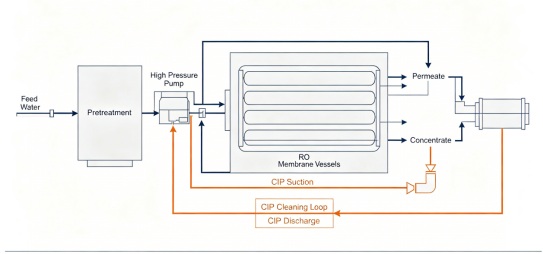
3. Weak or uneven flow in the CIP loop
Low velocity leaves foulant on the membrane, and one pump for all stages can starve the first stage or overdrive the last. DuPont recommends cleaning stages separately so foulant from stage 1 is not pushed into stage 2. For 8-inch elements, the high-flow step runs about 30–45 gpm per vessel for 30–60 minutes.
Fix: Size the CIP pump for your array, and keep pressure drop within limits: 15 psi per element or 50 psi per vessel.
4. Skipping steps or rushing the flush
Short recirculation with no soak, or a sloppy rinse, invites redeposition. The recommended sequence is six steps: make up solution, low-flow displacement, recycle, soak, high-flow pumping, and flush-out. Flush with RO permeate or deionized water rather than raw or pre-filtered feed, which can react with residual chemicals and precipitate foulants. After restart, send permeate to drain for at least 30 minutes or until clear.
Fix: Turn the procedure into a checklist and sign off each step.
5. Biofilm that is never fully removed
Biofilm returns fast if only the surface layer is cleared. Alkaline cleaning at high pH is the preferred route, and acid should not lead when organics are present. Even the choice of acid matters: citric acid can contribute to biofouling if not rinsed out properly.
Fix: Pair alkaline cleaning with a sanitization plan, and inspect tanks and piping dead legs as possible biofilm sources.
6. Cleaning too late
Compacted, aged deposits resist even the right chemistry. For example, sulfate scale older than a week is doubtful to clean successfully.
Fix: Trend normalized data weekly and act at the trigger, not at the alarm.
7. Aggressive cleaning that damages the membrane
Pushing pH or temperature beyond limits can cause permanent loss of rejection. Good facility allowable pH narrows as temperature rises, from pH 1–13 at 25 °C to pH 1–10.5 at 45 °C. Sulfuric acid should not be used because of calcium sulfate precipitation risk.
Fix: Follow your membrane maker’s limits, and stop repeating aggressive cleans when performance no longer recovers.
Is It Really a CIP Problem? Check Pretreatment and Design First
If you’re cleaning every few weeks, chemistry is not the root cause. Look upstream: high SDI, residual chlorine, iron, or a mismatched antiscalant will keep re-fouling clean membranes. Read our guides on what causes high SDI in RO feed water and what pretreatment an industrial RO system needs. Design matters too: an undersized CIP skid is a hidden cause of failure. A rule of thumb is to size the cleaning tank to roughly the empty vessel volume plus piping, about 550 gallons for ten 8-inch vessels with six elements each.
A Practical CIP Checklist and Prevention Tips
- Before: normalize data, confirm the foulant, check chemical compatibility, and prepare safety gear.
- During: record pH, temperature, flow, pressure, and time; replace turbid solution with a fresh batch.
- After: flush with permeate, then compare normalized flow, salt passage, and pressure drop against baseline.
- Prevent: keep cartridge filters and pretreatment in good order, and log data from commissioning onward. If the system will be idle over 24 hours, store elements in 1% sodium metabisulfite.
For pharmaceutical and food plants, add validation records to every cleaning event.
When to Call a Water Treatment Specialist
Bring in engineers if two or more cleanings fail, pressure drop stays high, or permeate quality misses spec. Molewater has spent 20+ years designing and building RO systems for pharmaceutical, medical, and industrial users, from design to installation and training. We can review your data, CIP system, and pretreatment. See our Industrial Reverse Osmosis System and Pretreatment Water Filters.
FAQs
Three factors are typically responsible for failed RO membrane cleaning: incorrect parameters, incorrect diagnosis, or an upstream issue. Utilise normalised data, adhere to the manufacturer’s instructions, and address the underlying issue. Are you dealing with persistent fouling? For a system review, get in touch with our engineers.