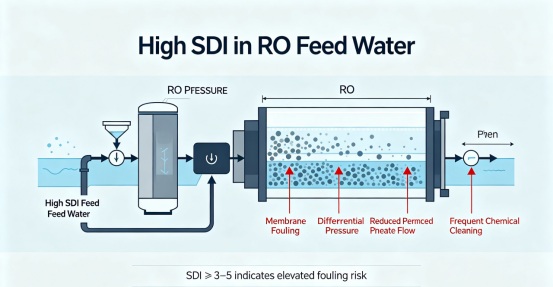
You measure your feed water and the number comes back high — now the real question is why. The high Silt Density Index (SDI) reading is among the most evident early warning indicators that reverse Osmosis (RO) process is headed towards membrane fouling, a higher differential pressure and frequently chemically cleaned. Before troubleshooting can begin it is essential to understand the what SDI is actually measuring and what it means, what a “normal” number looks like and, most importantly, the exact conditions that cause the number higher.
What Is SDI (Silt Density Index) in Water Treatment?
SDI is a test that has been standardized established by ASTM D4189 which determines the speed at which colloidal and suspended particles can block the nanofiltration membrane or RO. The test works by passing feed water through a 0.45-micron filter at a constant 30 psi and comparing how long it takes to collect a fixed sample volume at the start versus after 15 minutes. If particles are clogging the filter, the flow slows down measurably — and that rate of slowdown becomes the SDI value. It’s not a measure of dissolved solids or salinity; it’s specifically a measure of particulate and colloidal fouling potential.
Why SDI Matters for RO Membrane Performance
SDI matters because it’s one of the few tests that directly predicts fouling behavior rather than just describing water clarity. Turbidity isn’t enough to make this determination – water that has less than 1 NTU of turbidity can still have an extremely high SDI when it has fine colloidal material that is invisible by the naked eyes. As particulate matter accumulates on the membrane’s surface, they increase feed pressure and reduce the flux of permeate and reduce the time between the cleaning-in place (CIP) cycles all of which increase the operating costs and risk of downtime.
How Is SDI Measured, and What Counts as “High”?
The majority of manufacturers of membranes provide clear benchmarks, as well as the market has come to a consensus on the same amounts:
| SDI15 Value | Interpretation |
| Below 3 | Good — low fouling risk for most RO membranes |
| 3–5 | Acceptable but marginal; many manufacturers set 5 as the warranty limit |
| Above 5 | High fouling risk; pretreatment is typically inadequate |
These thresholds are frequently referenced in membrane manufacturer guidelines as well as peer-reviewed studies on desalination leading to SDI among the top widely used indicator of fouling in the market.
What Causes High SDI in RO Feed Water?
A high SDI reading rarely comes from a single source. It’s usually one or more of the following.
1. Suspended Solids and Turbidity from the Source Water
Surface water sources — rivers, lakes, and reservoirs — naturally carry fine suspended solids that raise both turbidity and SDI, and they typically require more extensive pretreatment than groundwater to reach acceptable levels. Well water is generally more stable, but is not automatically low-SDI, especially in shallow or poorly cased wells.
2. Colloidal Silica, Iron, and Manganese Particles
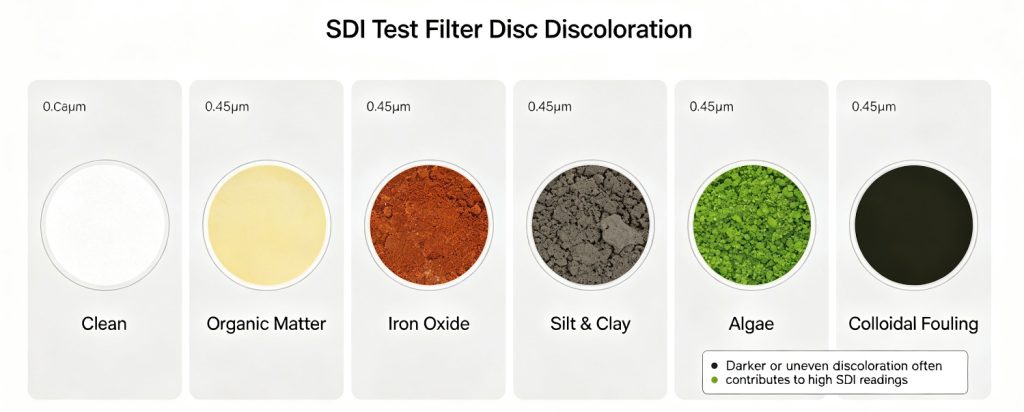
Colloidal foulants — including silt, silica, clay, and iron or manganese oxides — are among the most common inorganic contributors to membrane fouling, and they are often too fine to be caught by standard turbidity readings. These particles pass straight through basic filtration and only show up once they start plugging the SDI test filter or the RO membrane itself.
3. Biological Growth and Biofilm
Bacteria, algae, and other microbial material are recognized as a direct source of silt-forming fouling potential in feed water. Warm weather, stagnant piping, and organic-rich source water all encourage biological growth that can spike SDI seasonally, even when the underlying water source hasn’t otherwise changed.
4. Inadequate or Failing Pretreatment
This is one of the most common root causes in operating plants. Multimedia filters that have channeled or lost media, cartridge filters left in service past their rated capacity, or undersized pretreatment for the actual raw water quality will all let particulate load pass through to the RO stage.
5. Coagulation or Flocculation Dosing Problems
Coagulants like ferric and aluminum salts are the most widely used chemicals for removing colloidal foulants ahead of RO — but incorrect dosing works against you. Dosing too much can result in flocs of coagulant that can contaminate the membrane, whereas the wrong dose can leave colloidal particles not removed; both situations result in the appearance of an SDI spike.
6. Seasonal and Source Water Fluctuations
Rainfall events, spring runoff, and algae bloom seasons can shift raw water quality quickly, even at sites with historically stable SDI. Pretreatment systems designed around average conditions can be caught off guard by these short-term swings.
7. System Design or Piping Issues
Dead legs, low flow zones, and prolonged durations of pretreatment pipe let biofilm and particles that have settled to disperse in the stream of feed, resulting in SDI readings that aren’t in line with the water source in the raw in any way.
How to Diagnose the Root Cause
Perform the process by order, starting at the source to membrane. Check the quality of water in the raw first, then examine the condition of the cartridge filter and multimedia as well as coagulant doses in relation to current water quality and then check for biofilms or stagnant zones in the pretreatment pipes. This sequence usually isolates the cause faster than testing SDI at the RO inlet alone.
How to Reduce SDI Before RO: Pretreatment Solutions
Pretreatment that is conventional, such as flocculation, coagulation and sand filtration or multimedia is the most common procedure for meeting SDI goals ahead of RO. When the quality of the raw water is less stable or more difficult to control ultrafiltration (UF) as an option for pretreatment has been demonstrated to bring SDI lower than 2.5 while eliminating the majority of turbidity. This makes it an ideal choice for locations that have fluctuating source water. The ideal combination depends on the nature of the water source and seasonal variations, as well as the your desired SDI for the particular membrane being used.
What Happens If High SDI Is Ignored?
Left unaddressed, elevated SDI accelerates particulate and colloidal fouling on the membrane surface, increases differential pressure across the RO train, and forces more frequent CIP cycles. Over time, this shortens membrane life and raises both chemical and energy costs — turning a manageable pretreatment issue into a much larger capital expense.
FAQ
What SDI value is acceptable for RO membranes?
Most manufacturers recommend SDI15 below 3 for reliable long-term operation, with 5 commonly cited as the maximum warranty limit.
Can ultrafiltration replace multimedia filtration for SDI control?
UF can outperform conventional filtration in variable or challenging source water, often achieving SDI below 2.5, though the right choice depends on raw water characteristics and budget.
How often should SDI be tested in an RO system?
SDI should be tested regularly at the RO inlet — daily in many industrial plants — and immediately after any change in source water, weather event, or pretreatment upset.
High SDI is a symptom, not a diagnosis — the real work is tracing it back to its source, whether that’s raw water quality, failing pretreatment media, dosing errors, or biological growth in the system. Getting this right protects membrane life and keeps operating costs predictable. With more than 20 years designing pretreatment and industrial RO systems for pharmaceutical, medical, and industrial clients, Molewater’s engineering team can help evaluate your feed water and recommend a pretreatment configuration built for your specific source water conditions.