
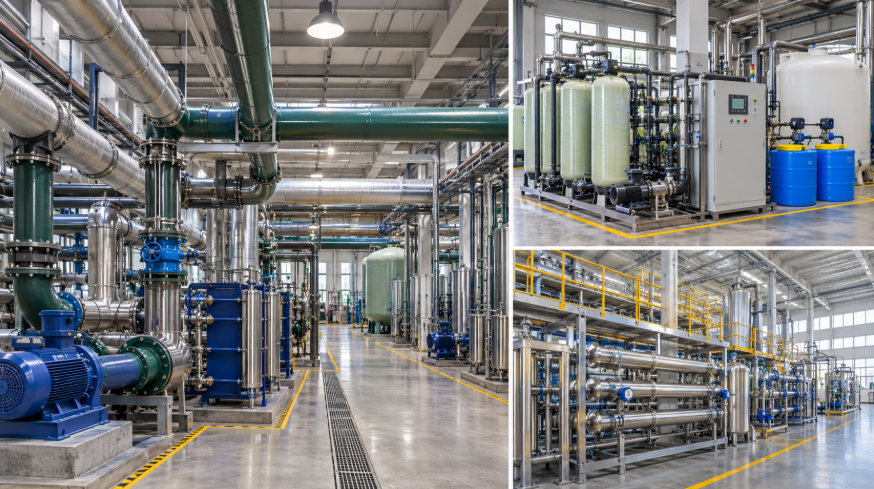
Nobody thinks about water in a data center until it’s time to size up the chiller, or the heat exchanger clogs up. U.S. data centers used about 17 billion gallons of water for cooling in 2023, and AI workloads are pushing that number higher. A good water treatment system for data centers includes makeup water, blowdown recovery, closed loop protection and ultrapure supply. So let’s take a look at what each system does, when you need it and how to choose.
Why Water Treatment for Data Centers Matters
Cooling accounts for most of a data center’s water use. Evaporative systems pump cold water through the data center, absorbing heat from the servers and exiting as steam. A big campus can use one to five million gallons a day.
The footprint is larger than the metre indicates. The U.S. data centers used another 211 billion gallons indirectly in 2023 from the electricity that powers them, according to the Lawrence Berkeley National Laboratory (LBNL). Operators are now rated on Water Usage Effectiveness (WUE), measured in litres per kWh of IT load. The average U.S. WUE is often cited as approximately 1.8 L/kWh. Water treatment for data centers, done properly, is one of the most pragmatic ways to reduce that number.
Poor water quality costs money in four ways:
- Unplanned downtime costs far more than any treatment skid.
- Scale acts as insulation on heat exchangers, so chillers work harder and use more power.
- Corrosion shortens the life of pipes, pumps and cold plates.
- Biofilm shelters bacteria such as Legionella. ASHRAE Standard 188 treats this as a risk management issue for building water systems.
Quick Overview: Which Systems Do You Need?
| Water use | Main problem | Typical treatment |
| Cooling tower makeup | Hardness, suspended solids | Filtration, softening, RO |
| Cooling tower blowdown | Concentrated salts | UF + RO, ZLD |
| Closed chilled-water loop | Corrosion, microbes | Dosing, side-stream filtration |
| Humidification | Mineral dust | RO / DI water |
| Direct liquid cooling | Conductivity, particles | RO + EDI, fine filtration |
| Domestic and fire water | Hygiene, stagnation | Disinfection, filtration |
1. Cooling Tower Makeup Water Treatment
Evaporation leaves minerals behind, so the water in a tower gets saltier every cycle. The cleaner your makeup water, the more cycles you can run before you have to discharge it.
Most plants start with multimedia filtration or ultrafiltration (UF) to remove particles. Softening or antiscalant dosing comes next if hardness is moderate. Where the source water is hard, brackish or tightly regulated, reverse osmosis (RO) lets the tower run at higher concentration, and that saves water over the long run.
A rule of thumb: municipal water of reasonable quality often needs filtration plus softening. Groundwater or reclaimed water usually calls for UF and RO.
2. Blowdown Treatment and Water Reuse
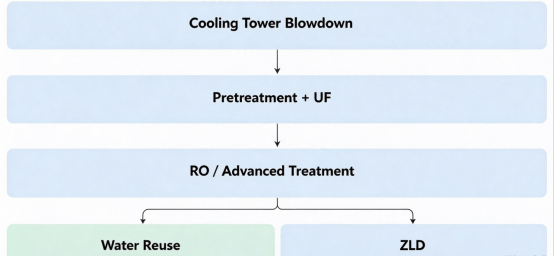
To keep salts from building up, towers must bleed off some water. This blowdown is the hardest stream to handle because it is salty and often rich in silica and scale-forming ions. In water-stressed areas, discharge permits are tightening too.
Common recovery routes:
Reclaimed municipal water can also replace potable water. It needs stronger pretreatment, but it takes pressure off local supplies.
3. Closed-Loop Chilled Water Treatment
Closed loops use little water, but they run for years, and small problems compound. Treatment usually means:
4. Ultrapure Water for Humidification and Liquid Cooling
Humidifiers spray minerals into the air if you feed them tap water. The usual fix is RO, often followed by deionization (DI) or electrodeionization (EDI).
Liquid cooling raises the bar further. Direct-to-chip and immersion systems circulate coolant through narrow channels, so particles and ions matter. Facility-side loops tolerate normal treated water. Technology cooling loops need controlled conductivity and fine filtration, and they follow the OEM’s specification. High-density AI racks are pushing more operators toward this setup, which makes ultrapure supply a growing part of water treatment for data centers.
5. Domestic, Fire Protection and Wastewater Systems
These are the quiet utilities. Domestic water needs disinfection and filtration. Fire tanks need circulation to avoid stagnation. Sanitary and process wastewater must meet local discharge rules before it leaves the site. They are small next to cooling, but auditors look at them.
Monitoring and Redundancy
Treatment only works if someone knows it is working. Online sensors for conductivity, pH, ORP and turbidity feed a control system that adjusts dosing and flags drift before it becomes damage. Remote alarms matter because many sites are lightly staffed.
Data centers also expect high availability. Treatment systems are typically built N+1, with duplex filters and parallel RO trains, so one failed pump never forces a shutdown. Modular, skid-mounted units help too, because capacity can grow with each new hall.
How to Choose the Right Water System for Data Centers
- Test your source water. Get a full analysis covering hardness, silica, chloride, TDS and seasonal swings. Don’t design from a single sample.
- Define the cooling design. Evaporative towers, hybrid, closed-loop and liquid cooling each have different water demands.
- Check local rules. Intake limits, discharge permits and reuse mandates can decide the design on their own.
- Plan for growth. Phased builds suit modular trains better than one oversized plant.
- Compare lifecycle cost. Membranes, chemicals, energy and labor often outweigh the purchase price over a decade.
The most common mistake is underestimating blowdown. It is easy to size the front end and forget where the concentrate will go.
Where Molewater Fits
Molewater has built water treatment systems since 2003 and supplies filtration, UF, RO, EDI and ZLD equipment, customized from 0.25 to 200 m³/h. It delivers turnkey projects from design through installation and training, and its engineers have worked on validated, high-purity systems for pharmaceutical and hospital clients, where water quality is audited. Those are the same building blocks that water treatment for data centers relies on: makeup treatment, blowdown recovery and ultrapure supply. If you are planning a project, talk to the Molewater team about a water analysis and system recommendation.