
As wastewater discharge requirements become stricter, many treatment plants are facing the same practical problem: how to remove more nitrogen and phosphorus without building larger tanks or significantly increasing operating costs. At the same time, conventional activated sludge systems can require substantial aeration, tank volume, and sludge handling.
Biofilters offer another approach. By growing microorganisms on filter media, these systems combine biological treatment with filtration in a relatively compact process. Depending on the configuration, they can remove organic matter, ammonia, nitrogen, and suspended solids, making them useful for both new treatment plants and upgrades to existing facilities.
So, what exactly is a biofilter, and how does it work? The answer starts with the biofilm growing on the media.
What Are Biofilters for Wastewater Treatment?
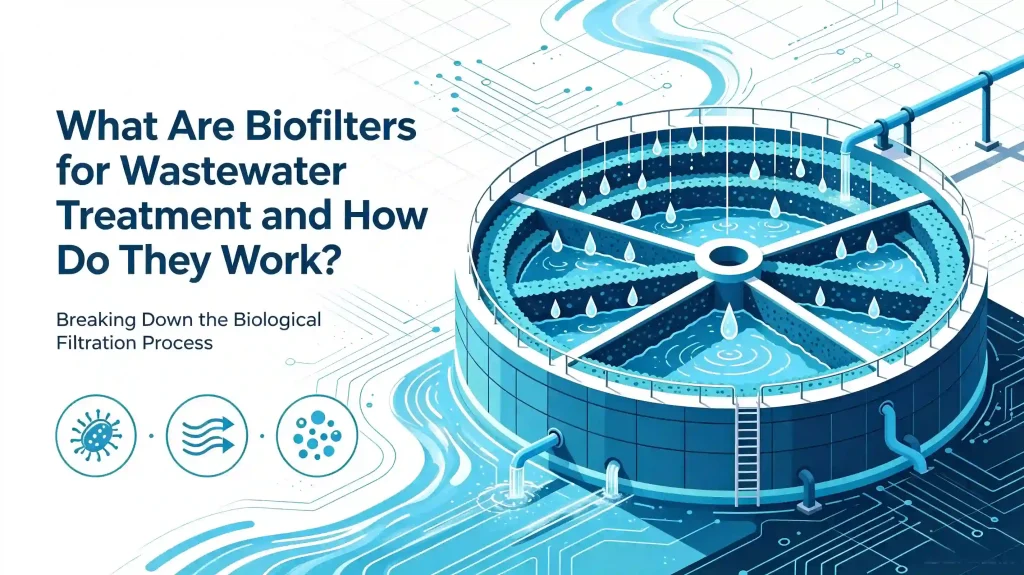
Biofilters, also called biological filters, are wastewater treatment systems that use microorganisms attached to a fixed or moving media to break down pollutants. The media provides a large surface area where a biofilm can develop. As wastewater passes through or around the media, microorganisms in the biofilm consume organic pollutants and convert nitrogen compounds through biological reactions.
Depending on the system design, aerobic zones can support organic oxidation and nitrification, while anoxic conditions can support denitrification. Some systems also provide physical filtration, helping retain suspended solids.
This attached-growth approach is the main difference from conventional activated sludge. In an activated sludge system, much of the biomass remains suspended in the mixed liquor. In a biofilm system, a significant portion of the microorganisms stays attached to the treatment media. EPA materials identify MBBR and other fixed-film processes as established options where higher biomass concentrations and smaller reactor volumes are important.
How Do Biofilters Work?
Although biofilters come in different forms, the basic treatment process is relatively easy to understand.
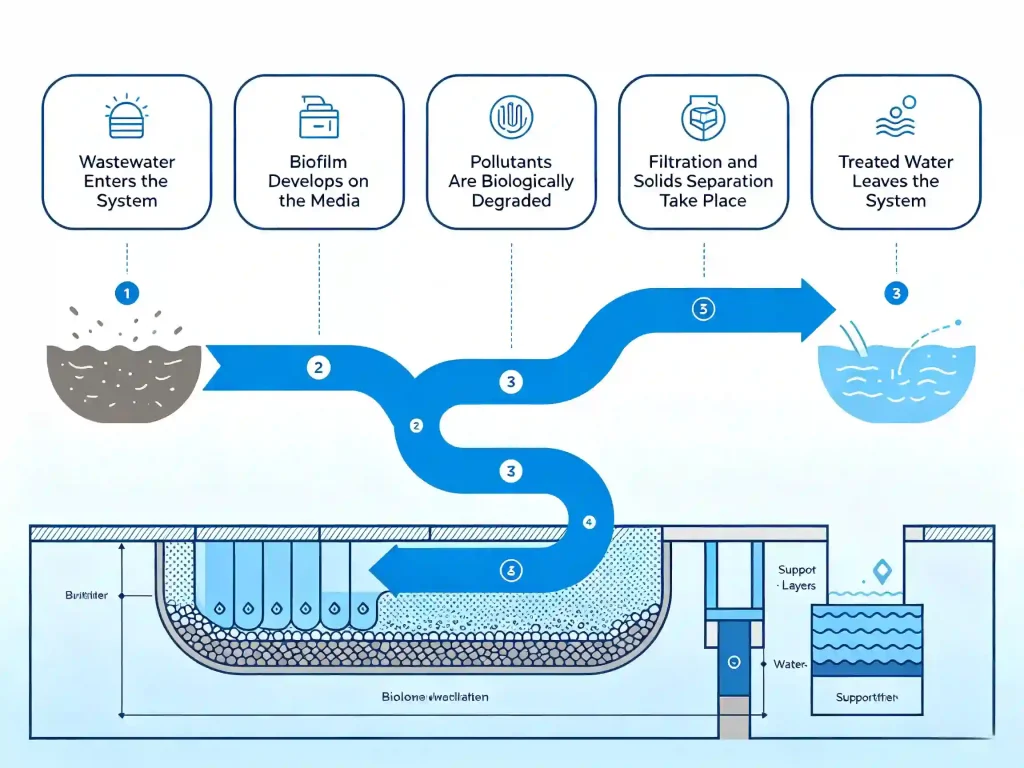
1. Wastewater Enters the System
Before reaching the biofilter, wastewater normally passes through preliminary treatment to remove large solids, grit, and other materials that could interfere with the biological process.
Flow equalization may also be used when wastewater volume or pollutant concentration changes significantly during the day. Good pretreatment is important because the biofilter works best when the incoming water is reasonably controlled.
2. Biofilm Develops on the Media
The treatment media provides a surface for microorganisms to attach and grow. Over time, a biofilm forms on the media and becomes the main biological treatment zone.
Different microorganisms perform different jobs. In an aerobic section, bacteria can break down organic matter and convert ammonia into nitrate through nitrification. In an anoxic section, denitrifying bacteria can convert nitrate into nitrogen gas, which is released from the water.
This is why biofilters can be configured with different aerobic and anoxic zones depending on the treatment target.
3. Pollutants Are Biologically Degraded
As wastewater comes into contact with the biofilm, dissolved organic matter and nitrogen compounds are used by microorganisms.
For example, nitrification needs oxygen, while denitrification takes place under anoxic conditions and generally requires a suitable carbon source. The actual removal performance therefore depends on wastewater characteristics, reactor configuration, temperature, dissolved oxygen, loading, and process control.
Biological nutrient removal is already widely used in wastewater treatment, and EPA guidance covers both biological nitrogen and phosphorus removal as important treatment approaches.
4. Filtration and Solids Separation Take Place
In some biofilter configurations, the media and biofilm also contribute to solids capture. Excess biofilm eventually detaches from the media and leaves the reactor with the treated water or is removed through a separate solids-handling step.
For systems such as biological aerated filters, periodic backwashing is used to remove accumulated solids and excess biomass. This helps maintain hydraulic performance and prevents excessive head loss.
5. Treated Water Leaves the System
After biological treatment and solids separation, the treated water can be discharged when it meets the required standard or move to additional treatment.
Depending on the project, downstream treatment may include disinfection, phosphorus polishing, filtration, or other advanced processes. For plants targeting very low nutrient concentrations, a biofilter may therefore be one part of a larger treatment train rather than the only treatment step.
Main Types of Biofilters Used in Wastewater Treatment
Not every biofilter is designed for the same purpose. The choice depends on flow, pollutant loading, discharge requirements, available space, and whether the system is being built from scratch or added to an existing plant.
Trickling Filters
Trickling filters are one of the older biological filter technologies. Wastewater is distributed over a fixed media bed, allowing it to flow downward while microorganisms grow on the media surface.
They are relatively simple and can provide reliable organic removal and nitrification. Because they normally rely on gravity flow and fixed media, they are often considered where simple operation and long-term durability are priorities.
Biological Aerated Filters (BAF)
BAFs use submerged filter media together with aeration. Wastewater passes through the media while microorganisms attached to the media treat organic matter and ammonia.
Their combination of biological treatment and filtration allows a relatively compact footprint. BAFs can be useful where nitrification, solids removal, and limited available space are important considerations.
Moving Bed Biofilm Reactors (MBBR)
MBBR uses small buoyant carriers that move freely inside the reactor. Microorganisms grow on the carrier surfaces while the media remains in the tank.
Aeration provides oxygen and mixing in aerobic zones, while mixing without aeration can be used in anoxic zones. Because biomass is retained on the carriers, MBBR can achieve a high biomass concentration without simply increasing tank volume.
EPA describes MBBR as a biological treatment process using free-moving biofilm carriers and notes its potential advantages over conventional activated sludge, including higher biomass concentration, smaller reactor volumes, lower sludge production, and better resistance to load fluctuations.
MBBR is particularly useful for upgrading existing plants because carriers can be added to existing biological tanks to increase treatment capacity without constructing an entirely new process line.
Deep-Bed Denitrification Filters
Deep-bed denitrification filters are generally used as a polishing step rather than as the main biological treatment stage.
They can remove residual nitrate after upstream biological treatment and also provide filtration of fine suspended solids. This makes them useful when a plant needs to meet a particularly strict nitrogen limit or improve final effluent quality before discharge or reuse.
EPA references denitrification filters among technologies used for achieving very low total nitrogen concentrations.
Other attached-growth systems, including rotating biological contactors and fixed-bed biofilm reactors, can also be selected depending on the project requirements.
Key Advantages of Biofilters
Compared with conventional activated sludge, biofilters can offer several practical advantages.
| Aspect | Biofilters | Conventional Activated Sludge |
| Footprint | Smaller in many applications | Generally larger |
| Biomass concentration | Higher | Lower |
| Shock load resistance | Generally better | Moderate |
| Sludge production | Often lower | Higher |
| Nutrient removal | Excellent with proper process zones | Good, but may require more reactor volume |
| Energy consumption | Can be lower for equivalent treatment goals | Often higher aeration demand |
| Operation | Moderate; some systems require backwashing | Moderate |
The biggest benefit is often space. A biofilm process can retain a large amount of active biomass in a relatively small reactor. This is especially valuable when a plant has limited land or needs to increase capacity without adding large new basins.
MBBR is a good example. Because microorganisms remain on the carriers, the system can maintain a higher biomass concentration and potentially reduce the required reactor volume.
Actual savings, however, should not be treated as fixed percentages for every project. Claims such as 30–50% improvement in nitrogen removal or up to 60% reduction in chemical phosphorus removal should be supported by project-specific process data. Wastewater composition, temperature, loading, carbon availability, aeration requirements, and the existing treatment process all affect the final result.
Typical Applications of Biofilters
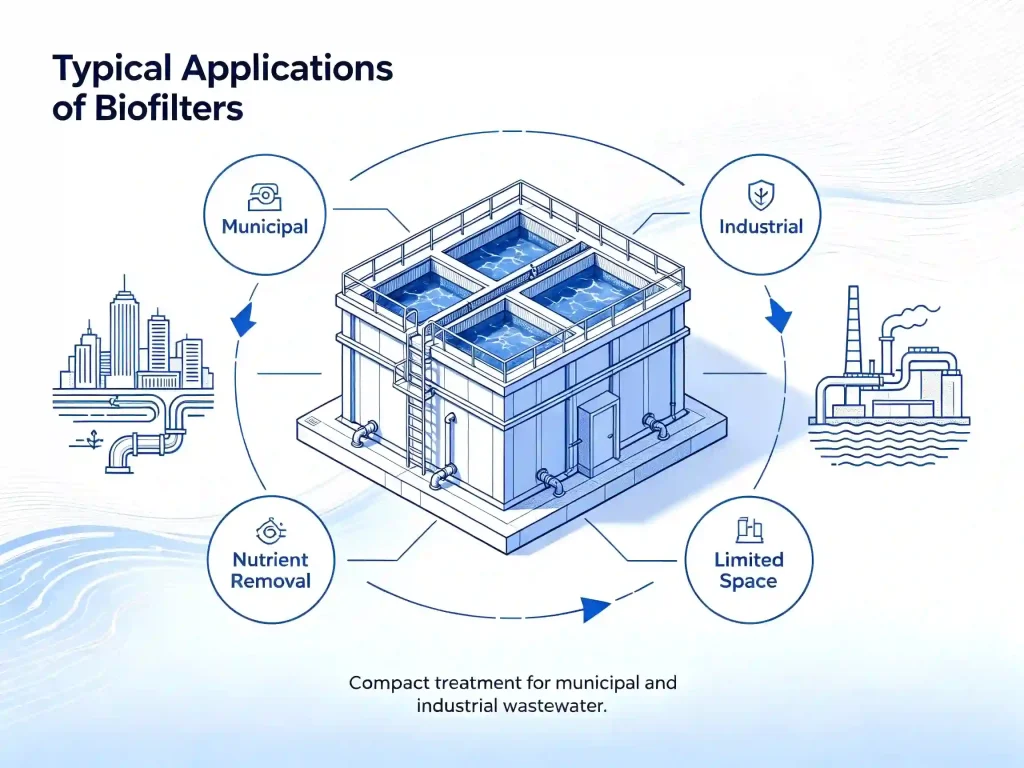
Biofilters can be used in both municipal and industrial wastewater treatment, particularly when nutrient removal or limited space is a major concern.
For municipal plants, they can be incorporated into biological nutrient removal processes to help achieve low TN and TP targets. For smaller communities, modular or containerized biofilter systems can provide a compact treatment option where conventional treatment infrastructure is difficult to expand.
They are also used in industrial applications where wastewater characteristics vary. EPA’s review of MBBR applications includes industries such as petroleum refining, oil and gas extraction, mining, food and beverage processing, and meat and poultry processing.
Another important application is plant upgrading. An existing activated sludge tank may have sufficient hydraulic capacity but not enough biological capacity to meet a new discharge requirement. Adding MBBR media can increase the available surface for attached biomass and improve treatment capacity without rebuilding the entire biological system.
Biofilters can also be used as a final polishing stage, especially when a plant needs additional nitrate or suspended-solids removal before discharge or water reuse.
Conclusion
Biofilters are not a single type of wastewater treatment system. They are a group of attached-growth technologies that use microorganisms growing on media to remove organic pollutants and nutrients, with some configurations also providing filtration.
Their main value is straightforward: more active biomass can be maintained in a relatively compact treatment volume. For plants dealing with stricter nutrient limits, limited space, or the need to upgrade existing infrastructure, technologies such as MBBR, BAF, and denitrification filters can provide practical alternatives to simply building larger activated sludge tanks.
The right process still depends on the wastewater and the required effluent quality. A good solution should consider the existing treatment process, flow and loading conditions, nutrient targets, available space, and long-term operating costs rather than selecting a technology based on a single performance figure.
At Molewater, we design and remotely optimize MBBR and deep-bed denitrification filter systems for wastewater treatment projects. Our approach focuses on meeting stringent TN and TP requirements while making effective use of available space and minimizing unnecessary chemical and operating costs. If you are planning a new wastewater treatment system or upgrading an existing plant, contact Molewater to discuss your project and request a customized solution.