Your purified water leaves the generation skid in perfect shape. Two days later, the sample from the storage tank tells a different story. This frustrating pattern is common in pharmaceutical plants, hospitals and laboratories. Purified water quality drifts in storage for three main reasons: microbes multiply, air dissolves into the water, and materials leach into it. The good news is that each cause is predictable and preventable. Following, we explain what changes, why, and how to keep your water in specification.
Note: “purified water” here means pharmacopoeial-grade water used in pharmaceutical, lab and healthcare settings, not bottled drinking water.
What Actually Changes in Stored Purified Water?
Four readings move most often. Purified water has very little buffering capacity, so even tiny contamination shifts results quickly, as Thermo Fisher notes about its low ionic strength.
| Parameter | Common benchmark | What happens in storage | Main driver |
| Conductivity | 1.3 µS/cm at 25 °C (USP <645>, Stage 1) | Rises | CO₂ absorption, leaching |
| TOC | ≤ 500 ppb (USP <643>) | Rises | Leaching, microbial by-products |
| Microbial count | 100 CFU/mL action level (USP <1231>) | Rises | Stagnation, biofilm |
| pH | Evaluated within USP <645> | Drifts acidic | Dissolved CO₂ |
One caution: the 100 CFU/mL figure is an informational action level, not a pass/fail monograph limit. FDA’s position, as summarised by Laafon, is that these are not pass/fail limits, so you should set in-house levels from your own system history.
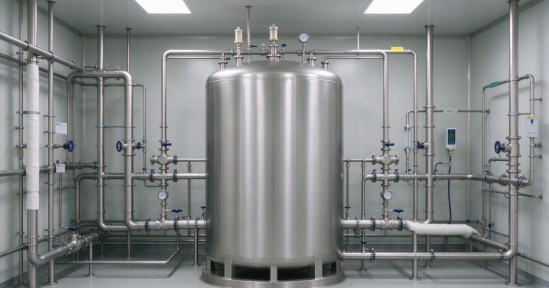
Cause 1: Microbial Growth and Biofilm
Purified water is low in nutrients, yet bacteria adapt and attach to surfaces. Once a biofilm forms, it keeps shedding cells into the water, even after a clean sample.
- Stagnation: when water sits still, growth accelerates.
- Dead legs: unused branches become microbial reservoirs.
- Low flow: consultancy Zamann Pharma lists flow below about 1 m/s among common biofilm-friendly mistakes.
Regulators notice. In one reported FDA Warning Letter, a purified water system with a dead leg that did not circulate continuously was cited for encouraging biofilm. Because Purified Water has no endotoxin requirement, per the USP specification summary, bioburden trending carries even more weight.
Cause 2: Air Exposure and CO₂ Absorption
Carbon dioxide dissolves into water on contact with air, forming weak carbonic acid. Thermo Fisher reports that water exposed to ambient air containing up to 500 ppm CO₂ can reach roughly 1 µS/cm. That single effect can consume most of the 1.3 µS/cm Stage 1 limit before any other contaminant appears.
Typical entry points are unprotected tank vents, loose seals and open sampling. Yokogawa also observes that offline samples or storage-tank water can read higher conductivity than online sensors.
Cause 3: Leaching from Tanks, Pipes and Gaskets
Pure water is “hungry” and extracts what it touches. The WHO guideline states that materials should not contain chemicals that the water can extract.
| Component | Risk | What to look for |
| Tank and pipework | Metal ions, rouging | Electropolished, passivated 316L stainless steel |
| Plastic parts | Organic leachables raising TOC | Grades suitable for high-purity water |
| Gaskets and seals | Elastomer extractables | Suitable grade, planned replacement |
AWhy the Problem Appears Only After Some Time
These causes stack up. Picture water produced on Friday and sampled on Monday. Over the weekend there is low demand, so flow slows. The vent filter has aged, so CO₂ creeps in. Warm ambient temperatures help any biofilm. By Monday, conductivity and bioburden have both moved. Storage time, temperature, flow and usage pattern work together.
How to Keep Purified Water Quality Stable in Storage
| Risk | Control measure |
| Stagnation, biofilm | Continuous loop recirculation at turbulent flow; no dead legs; sloped, fully drainable pipework |
| Microbial growth | Hot storage or periodic sanitisation (hot water above 65 °C, ozone or chemical); UV where appropriate |
| CO₂ ingress | Hydrophobic vent filters; sealed tank; closed sampling |
| Leaching | Suitable materials, qualified gaskets, planned inspection |
| Unknown drift | Online conductivity, TOC and temperature monitoring |
On temperature, the revised WHO guidance reduced the recommended figure for hot-stored systems from 70–80 °C to above 65 °C, according to GMP Compliance. Hot storage suppresses growth but costs energy, so many sites weigh it against ambient storage plus sanitisation. Whatever you choose, confirm the maximum holding time through validation.

A Practical Monitoring and Troubleshooting Checklist
When a result drifts, check in this order:
- Vent filter: integrity, age and wetting.
- Sampling method: was the sample exposed to air before testing?
- Dead legs and low-flow zones: map them, then flush.
- Sanitisation records: missed or late cycles.
- Materials: new gaskets, replaced parts or visible rouging.
Then trend the data. A slow upward line is a stronger warning than one isolated reading.
FAQs
Final Word
Purified water quality changes in storage because of three predictable forces: microbes, air and materials. Design the loop to keep water moving, protect it from air, choose the right materials, and watch the trends. If you are planning a new system or fixing an unstable one, Molewater, which describes itself as having 20+ years of experience and 500+ global projects, offers a Purified Water System (PW) and a PW Storage and Distribution System. Contact the team to review your storage design.