Water may be the most overlooked ingredient in a beverage, even though it often makes up more than 85% of the finished product. Whether a plant produces bottled water, soft drinks, juice, dairy beverages, or beer, the quality of the incoming water can affect far more than basic safety.
A small change in mineral content, hardness, chlorine, or microbial quality may show up as a change in taste, appearance, shelf life, or production performance. This is why water treatment in the beverage industry is not simply about making water look clean. It is about keeping the quality of the water stable enough for a consistent and safe production process.
So why do beverage manufacturers pay so much attention to water quality?
1. Water Is a Major Ingredient, Not Just a Utility
In many beverages, water accounts for most of the finished product. This means its characteristics can directly influence the final taste and appearance.
For example, water with excessive hardness may contribute to scaling and can affect taste. Residual chlorine or organic compounds may introduce unwanted odors or interfere with the intended flavor profile. Changes in total dissolved solids (TDS) can also affect the mineral balance of the finished drink.
This becomes particularly important when a beverage is produced in large batches. If the source water changes from one period to another, the same recipe may not produce exactly the same result.
For manufacturers, controlling water quality is therefore part of controlling product consistency. The WHO Guidelines for Drinking-water Quality also emphasize that water quality needs to be managed according to potential hazards and the intended use.
2. Microbial and Chemical Safety Cannot Be Compromised
Taste is important, but food safety comes first.
Water used in beverage production can carry microorganisms or chemical contaminants if the source and treatment process are not properly controlled. Depending on the source, potential concerns can include bacteria, viruses, heavy metals, pesticides, organic contaminants, and other substances.
For bottled water, the requirements are particularly clear. The U.S. FDA requires bottled water producers to maintain sanitary processing conditions, protect water sources from contamination, and conduct quality control and testing. Internationally, the Codex General Standard for Bottled/Packaged Drinking Waters provides another important reference for packaged drinking water.
The exact requirements vary by country, product type, and application. A beverage manufacturer exporting to different markets may also need to consider local requirements such as FDA, EU, GB, or other applicable standards. A water treatment system therefore needs to do more than remove visible particles. It should be designed around the actual risks identified in the source water and the quality required at the point of use.
3. Poor Water Quality Can Affect Production Equipment
Water quality also has another effect: it can gradually damage the equipment used to manufacture the beverage.
Hard water contains calcium and magnesium that can form scale on boilers, heat exchangers, pasteurizers, pipes, and other equipment. As scale builds up, heat transfer becomes less efficient and cleaning and maintenance may become more frequent.
Other water chemistry issues can contribute to corrosion or affect sensitive membrane systems. In a large beverage plant operating continuously, even relatively small changes in water quality can eventually lead to higher maintenance costs or unexpected downtime.
The same principle applies to cleaning. Water is widely used in CIP (Clean-in-Place) systems and equipment sanitation. If its quality is unsuitable, cleaning performance may be affected, while excessive hardness can also increase the demand for cleaning chemicals.
For this reason, water treatment should be considered together with the production process rather than as a separate utility system.
4. Different Beverages Have Different Water Requirements
Bottled and purified water usually require close control of TDS, microorganisms, taste, and overall purity.
Soft drinks and carbonated beverages can be sensitive to hardness, chlorine, organic matter, and mineral variations because these factors may affect flavor and carbonation.
Beer and other fermented beverages can require more specific control of mineral composition, alkalinity, and dissolved oxygen because water chemistry can influence brewing and fermentation.
Juice and dairy beverages place strong emphasis on microbiological quality and process hygiene, while water used for cleaning and ingredient preparation may have different requirements.
This is why simply choosing a standard filtration system based on flow rate is rarely enough. The source water, finished product, production process, and required water quality all need to be considered together.
5. Water Quality Also Affects Brand Reputation
A beverage manufacturer may have a carefully controlled recipe, attractive packaging, and strict quality inspections. However, if consumers notice an unusual taste, odor, sediment, or another quality issue, they are unlikely to look into whether the problem was caused by the water treatment system. What they notice is the final product.
This matters even more for brands that emphasize purity, freshness, or natural ingredients. A problem with the finished beverage can quickly result in customer complaints and, depending on its severity, may require product withdrawal or even a recall.
Proper water treatment cannot prevent every quality issue, but it can help keep the water used in production consistent and under control. This reduces one potential source of variation and gives manufacturers a more stable starting point for maintaining product quality.
6. How Can Beverage Plants Maintain Consistent Water Quality?
A reliable system normally starts with raw water analysis, rather than choosing equipment first.
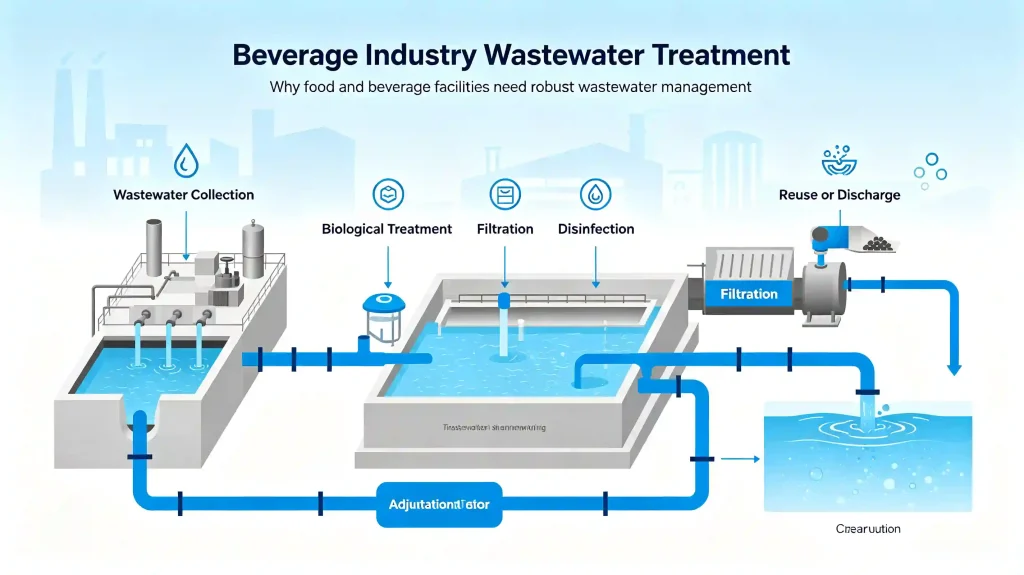
The treatment process may include several stages depending on the source water and application:
- Multi-media or sand filtration for suspended solids and turbidity
- Activated carbon for chlorine, odors, and certain organic compounds
- Water softening to reduce hardness and control scaling
- Reverse osmosis (RO) or nanofiltration (NF) for dissolved salts and other contaminants
- Ultrafiltration (UF) for fine particulate and microbiological control in suitable applications
- UV or ozone disinfection as part of microbial control
- Online monitoring of parameters such as conductivity, pH, turbidity, and other relevant indicators
Not every plant needs all of these technologies. The appropriate combination depends on the raw water quality and the required finished-water specification.
This is also why a good water treatment project should consider the complete process, from pretreatment to final water storage and distribution. A high-quality RO system, for example, cannot compensate for poor pretreatment or inadequate control further downstream.
For beverage manufacturers looking for a tailored system, Molewater’s food and beverage water treatment solutions cover applications including soft drinks, bottled water, breweries, dairy processing, and other food production processes. Its solutions include sanitary RO, water softening, UV and ozone disinfection, and modular treatment systems.