
If your seawater reverse osmosis system is showing rising differential pressure, declining normalized flux, or a slow drop in permeate quality, membrane fouling is almost always the underlying cause. Fouling is rarely triggered by a single factor — it’s usually a combination of feedwater conditions, pretreatment gaps, and operating parameters working together. Understanding the full mechanism is the first step to fixing it, and preventing it from coming back.
The Main Types of RO Membrane Fouling
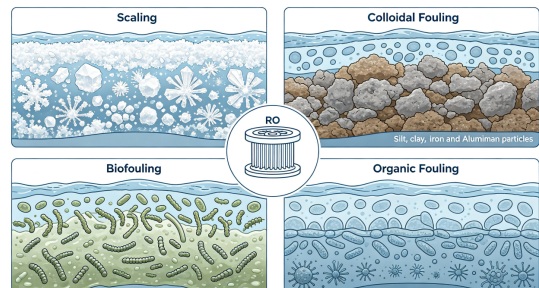
Before diagnosing root causes, it helps to identify which category of fouling you’re actually dealing with — each behaves differently and requires a different response.
Scaling (Inorganic Fouling)
When dissolved salts like calcium carbonate or calcium sulfate exceed their solubility limit on the concentrate side of the membrane, they precipitate directly onto the membrane surface. This is common in systems running high recovery rates without adequate antiscalant dosing.
Colloidal Fouling
Fine suspended particles — iron and aluminum oxides, silt, and clay — accumulate on the membrane surface, forming a physical barrier that restricts flow. The Silt Density Index (SDI) is the standard metric used to assess this risk in the feedwater before it ever reaches the membrane.
Biofouling
Microorganisms present in seawater attach to the membrane surface and multiply, forming a biofilm layer. This is widely considered the most common and most difficult fouling mechanism in seawater RO, since biofilms can regenerate quickly even after cleaning if the underlying microbial source isn’t controlled.
Organic Fouling
Natural organic matter — including algal metabolites and humic substances — adsorbs onto the membrane surface, often working in combination with biofouling to accelerate flux decline.
Root Causes Behind Membrane Fouling
Fouling doesn’t start at the membrane — it starts upstream, and traces through several stages of the system.
Feedwater Quality Fluctuations
Seasonal algal blooms, sudden turbidity spikes, and salinity shifts change the fouling load a system has to handle day to day. A pretreatment design that works fine in stable conditions can be overwhelmed during a bloom event, allowing organic and colloidal material through to the membrane.
Inadequate or Failing Pretreatment
Multimedia filtration, ultrafiltration (UF), and coagulation stages exist specifically to reduce the SDI and turbidity of feedwater before it reaches the RO membrane. When these stages are undersized, poorly maintained, or not matched to actual raw water conditions, fouling load downstream increases significantly.
Mismatched Chemical Dosing
Dosing of biocide and antiscalant chemicals has to be in line with the chemical and biological activities of the water source. Insufficient dosing exposes the system and over-dosing may lead to fouling in a few instances. This is among the most frequent operational flaws in the real world of systems.
Operating Parameters Outside Design Range
Running recovery rates too high, or operating below the design crossflow velocity, concentrates foulants faster than the system was engineered to handle. Flux that exceeds the “critical flux” threshold for a given feedwater accelerates fouling formation on the membrane surface.
Delayed or Mismatched Cleaning Cycles
Chemical cleansing (CIP) that’s scheduled often — or utilizes a cleaning chemical that’s not appropriate to the type of fouling in use — causes fouling layers to form and become more difficult to get rid of, eventually leading to irreparable fouling.
Early Warning Signs to Watch For
Being able to catch fouls early is much less expensive than regaining the foul. Some of the indicators to look for are:
- Rising differential pressure (ΔP) across the membrane train
- Declining normalized permeate flux at a given feed pressure
- Changes in salt rejection rate, indicating membrane surface disruption
- Uneven pressure drop between lead and tail elements in a pressure vessel
- Trending SCADA data showing gradual deviation from baseline performance
Monitoring these parameters continuously — rather than relying on periodic manual checks — allows operators to identify fouling type and severity before it becomes a full production issue.tor of fouling in the market.
Prevention and Response Strategies
The most cost-effective fouling control happens at the design stage, not after fouling has already occurred.
Strengthen pretreatment design. A properly sized combination of UF/MF filtration, coagulation, and disinfection stages remains the single most effective defense against colloidal and biofouling, since it addresses the problem before water ever reaches the membrane.
Use data-driven chemical dosing. Antiscalant and biocide programs should be calibrated to actual feedwater chemistry rather than generic dosing rates, and adjusted seasonally as source water conditions change.
Design with a safety margin. Setting recovery rate and flux targets with appropriate margin below the system’s critical flux threshold reduces long-term fouling accumulation, even during periods of variable feedwater quality.
Establish a proactive cleaning and monitoring schedule. Regular CIP cycles matched to the dominant fouling type — combined with continuous ΔP and flux monitoring — catch fouling while it’s still reversible, extending membrane life and reducing energy costs from pressure compensation.
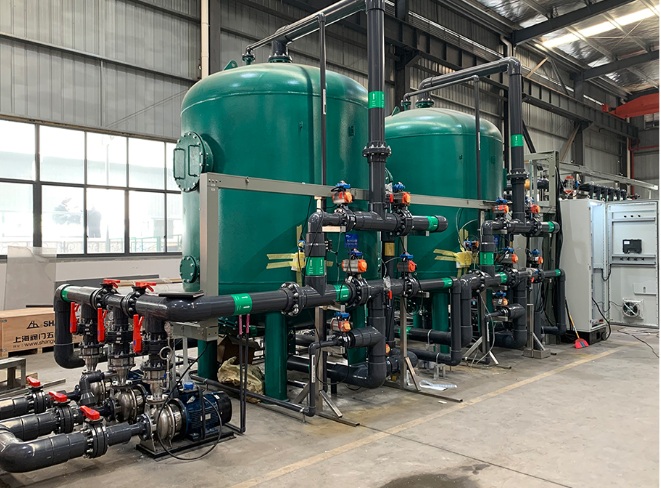
This is where desalination system design matters as much as day-to-day operation: a desalination system engineered with adequate pretreatment capacity and monitoring built in from the start faces a fundamentally lower fouling risk than one retrofitted after problems appear.
Seawater RO membrane fouling is the product of several factors compounding together — feedwater variability, pretreatment gaps, dosing mismatches, and operating parameters that drift from design intent. No single fix eliminates fouling entirely, but a system built with robust pretreatment, calibrated chemical dosing, and continuous performance monitoring can keep fouling manageable and largely reversible.
If your plant is seeing early signs of flux decline or rising pressure differential, it’s worth reviewing where in this chain — feedwater, pretreatment, or operating parameters — the gap actually sits, before the fouling becomes harder and more costly to reverse.