
Two plants can install the same resin and get very different results. One changes media after a few months, the other runs for years. The reason is often the water itself, the types of PFAS present and how the treatment system is designed and operated. These are important to understand when considering ion exchange for removal of PFAS. This article reviews the factors that affect treatment performance, compares ion exchange with carbon and membrane systems and discusses considerations before selecting a solution.
How Does Ion Exchange Remove PFAS?
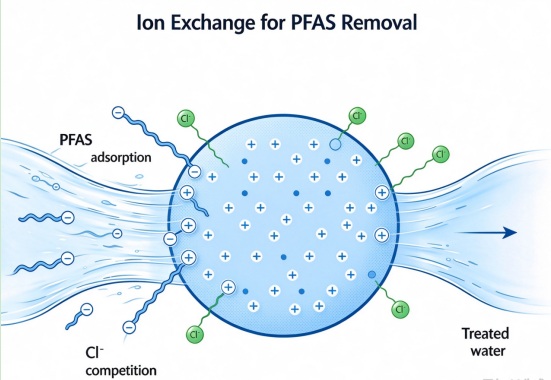
Most regulated PFAS carry a negative charge in water. Anion exchange resin has positively charged sites that grab them as water passes through the bed. The fluorinated tail also sticks to the resin’s polymer matrix, so removal combines electrostatic attraction to the charged head with non-electrostatic interaction with the hydrophobic tail.
That dual mechanism explains most of what follows. Anything that weakens either interaction, from a short carbon chain to a flood of competing ions, shortens the time before PFAS start showing up in the effluent.
What Affects Ion Exchange Efficiency for PFAS?
PFAS chain length and head group
Short-chain compounds break through first. In one column study, short-chain carboxylic acids had the longest mass transfer zone, which called for longer contact times. A 441-day pilot on groundwater dominated by short-chain PFCAs projected full-scale service of no more than 61 days for anion exchange resins before initial breakthrough.
Sulfonates are held more tightly. In another pilot, single-use resins treated more than 180,000 bed volumes before perfluoroalkyl sulfonic acids broke through.
Resin type
Not every anion exchange resin is built for PFAS. The same pilot found polystyrene resins far outperformed polyacrylic ones, because sorbent hydrophobicity matters. Single-use resins also significantly outperformed regenerable resins, especially for long-chain compounds. A resin made for other jobs may do poorly, which is why a generic softening resin is a bad shortcut.
Competing anions
Your water has lots of ions that want the same sites. Chloride, bicarbonate, sulfate and nitrate were tested in a SERDP-funded study. Nitrate had the strongest negative effect on removal and short-chain PFAS were more affected by it compared to long-chain PFAS. If you have a lot of nitrate in your source water, plan for it early.
Organic matter
TOC competes for sites and can foul the resin. The same study found that TOC hurt ion exchange performance, though less than it hurt carbon, and long-chain PFAS were affected more than short-chain.
Contact time and concentration
Ion exchange vessels run on short contact times. Pilot designs for anion resins use 1.5–3 minutes of empty bed contact time, against 8–13 minutes for carbon. More isn’t always better, though. For one resin, doubling EBCT from 1.5 to 3 minutes had a negligible impact, and initial concentration and co-occurring PFAS barely changed the breakthrough curves. Results are resin- and water-specific, which is why pilot testing matters.
Fouling
Suspended solids, iron and biological growth can coat or clog the bed. This is the factor most within your control, and it’s mostly a pretreatment question.
Ion Exchange vs. GAC vs. RO/NF
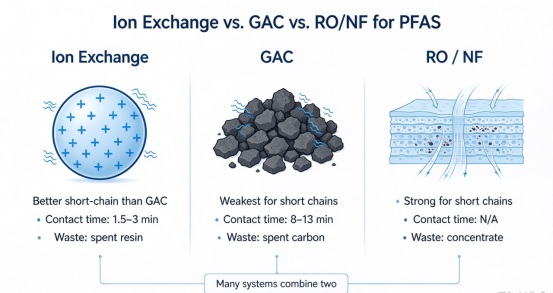
Each option has a different strength, and many systems combine two.
| Ion exchange | GAC | RO / NF | |
| Short-chain PFAS | Better than GAC, still breaks through early | Weakest | Strong |
| Contact time | About 1.5–3 min | About 8–13 min | Not applicable |
| Waste stream | Spent resin | Spent carbon | Concentrate |
In a pilot-scale comparison, resins adsorbed 6–7 times more PFAS per unit of media mass than GAC, yet both treated similar volumes before PFCA breakthrough. A cost analysis concluded that ion exchange was the most cost-effective option for both long and short chains. But that result depends on how many bed volumes you actually get. One engineering review noted that low-pressure RO removes all PFAS well, including short-chain compounds. The tradeoff is concentrate that still needs a disposal plan.
Designing a Reliable Treatment Train
Resin shouldn’t be the first thing the water meets. Filtration, and where needed softening or iron removal, protect the bed from fouling. This is standard pretreatment work: Molewater’s systems already cover particle removal, residual chlorine removal and hardness reduction ahead of RO and EDI.
Beyond that, a few design habits pay off:

What the Regulatory Picture Means
The U.S. federal limits for PFOA and PFOS are 4 ppt each. In May 2026, EPA proposed rules that leave those limits untouched. One of them would let water systems request a two-year extension, moving the deadline from April 2029 to 2031. Another would drop the standards for PFHxS, PFNA, GenX and the hazard index mixture (comments were due July 20, 2026). I couldn’t confirm the final outcome, so check EPA’s site for the current status. State limits and project-specific targets can also be stricter.
Conclusion
Strong results with ion exchange for PFAS come from matching the resin and design to your actual water, not from the resin alone. Test your water, pilot the options and protect the bed with good pretreatment. If you’re sizing a treatment train and want a second opinion on pretreatment, RO or NF, Molewater’s engineering team can review your water data.