
Your controller flashes a high-conductivity alarm, the blowdown valve never appears to close, and the chemical bill continues to grow. In most cases, cooling tower water has just become too concentrated. Evaporation removes pure water but leaves behind dissolved salts and they build up cycle after cycle. Things can be made worse by poor make-up water, a stuck valve or a drifting probe. The good news is that the problem is measurable and solvable. Let’s review the causes, the costs, and how good cooling tower water treatment puts you back in control.
What Conductivity Really Tells You About Cooling Tower Water
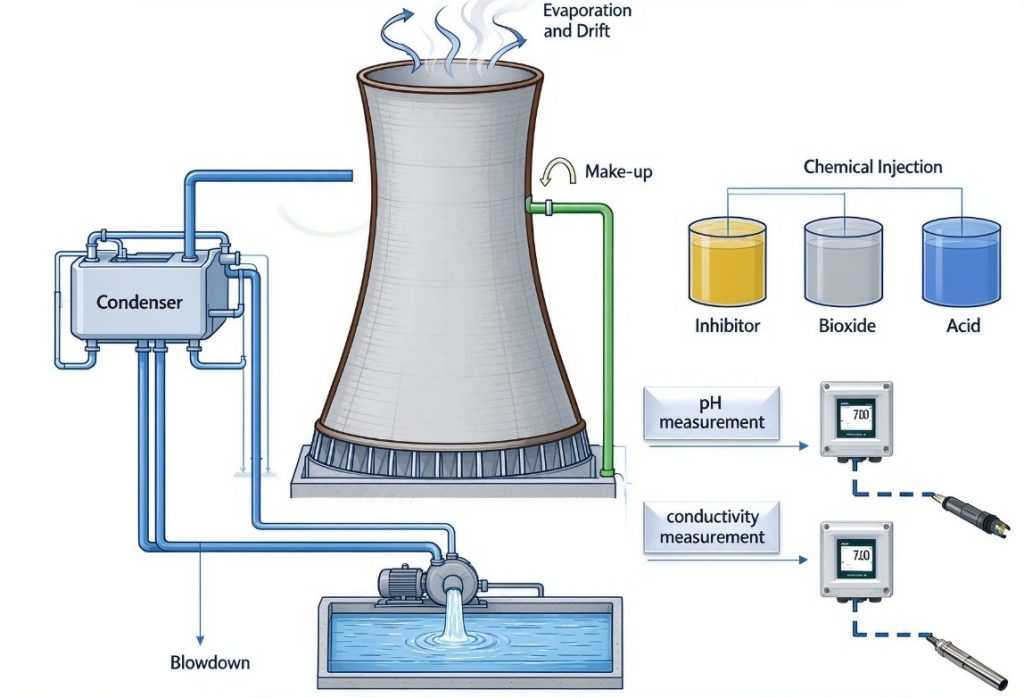
Conductivity measures how easily water carries an electric current. Dissolved ions such as calcium, magnesium, chloride, sulfate, and bicarbonate drive it, and it is reported in microsiemens per centimeter (µS/cm). Because it tracks total dissolved solids so closely, most towers use it to decide when to open the blowdown valve.
The number that matters most is cycles of concentration (COC): the conductivity of the circulating water divided by the conductivity of the make-up water. According to the EPA WaterSense at Work guide, many systems run at two to four cycles, while six or more may be possible with the right make-up water and treatment program.
Here is a quick example. If your make-up water measures 300 µS/cm and your target is four cycles, the circulating water should hover around 1,200 µS/cm. There is no universal “normal” reading. The right limit depends on make-up quality, equipment metallurgy, and the chemical program, so the real question is whether you are running above your own design target.
7 Common Causes of High Conductivity in Cooling Tower Water
1. Cycles of concentration set too high
Operators sometimes raise the set point to save water and never revisit it. Past a certain point, calcium, silica, and chloride exceed what the chemical program can keep in solution.
2. Poor make-up water quality
Hard, brackish, or seasonally variable supply water brings more dissolved solids into cooling tower water before evaporation even starts. Always test the source, not just the basin.
3. Blowdown valve or controller faults
A sticking solenoid, a clogged strainer, or a wrong set point means too little water leaves the system. Conductivity climbs quietly until someone spots scale.
4. Chemical overfeeding
Acids, inhibitors, and biocides all add ions. A feed pump running past its setting can push conductivity up even when blowdown works properly.
5. Heat exchanger or process leaks
If conductivity jumps suddenly while make-up quality stays the same, suspect a leak. Process fluid entering the loop raises dissolved solids and can upset pH and microbial control.
6. Airborne contamination
An open tower works like an air scrubber. Dust, pollen, and industrial emissions wash into the basin, which matters most near roads, construction sites, or chemical plants.
7. A dirty or uncalibrated probe
Sometimes the water is fine and the sensor is wrong. A fouled electrode can read high and trigger needless blowdown, or read low and let the system over-concentrate.
What Happens When Conductivity Stays Too High
Scale. As minerals concentrate, they eventually crystallize on heat-transfer surfaces. Hong Kong’s Electrical and Mechanical Services Department notes that even a thin scale layer of 0.8 mm can raise chiller energy use by nearly 10%.
Corrosion. Chloride and sulfate make water more aggressive toward carbon steel and copper alloys, shortening the life of pipes, fill, and exchangers.
Biofouling. Deposits shelter bacteria from biocides, which hurts efficiency and complicates Legionella control.
Higher operating cost. More blowdown, more chemicals, and more downtime for cleaning all add up.
Pushing conductivity too low has its own penalty, though. The U.S. Department of Energy reports that raising cycles from three to six cuts cooling tower make-up water by 20% and blowdown by 50%. The goal is the highest safe COC, not the lowest possible conductivity.
How to Diagnose the Problem in Six Steps
- Check the probe. Clean the electrode and verify it against a calibration standard or a handheld meter.
- Test the make-up water. Compare today’s reading with your records. Seasonal swings are common.
- Calculate actual COC. Divide circulating conductivity by make-up conductivity and compare the result with your target.
- Compare flow ratios. The DOE’s cooling tower best practice advises checking the make-up-to-blowdown flow ratio against target cycles. If they do not match, look for leaks or unauthorized draw-off.
- Inspect the hardware. Test the conductivity controller, the blowdown valve, and the make-up fill valve.
- Audit chemical feed. Confirm pump rates, and watch for sudden changes in chloride or pH that point to a heat exchanger leak.
Keep a simple log of make-up volume, blowdown volume, conductivity, and COC. The DOE recommends it, and trends reveal trouble weeks before scale does.
How to Fix High Conductivity in Cooling Tower Water
Quick fixes for this week
Clean and recalibrate the probe, repair or replace faulty valves, correct the set point, and bring chemical feed back to specification. For an urgent spike, a manual blowdown followed by fresh make-up will bring readings down while you hunt for the root cause. If you confirm a leak, repair it first.
Long-term fixes with proper cooling tower water treatment
Tune the chemical program. Work with a treatment specialist to match inhibitors and dispersants to your target COC.
Improve the make-up water. This is where lasting gains come from. Softening removes hardness so you can run higher cycles, pretreatment filtration protects downstream equipment, and reverse osmosis cuts dissolved solids at the source. Not every tower needs RO, so compare its cost with your water, sewer, and chemical savings.
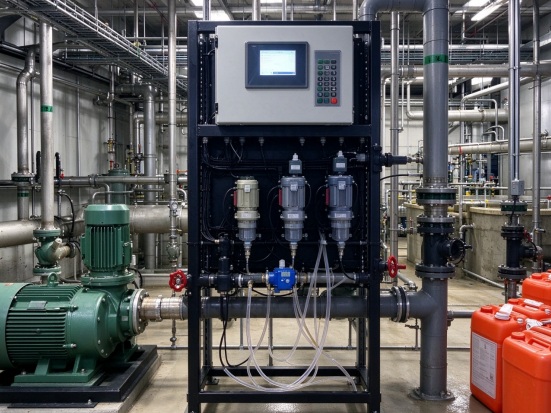
Automate blowdown. A conductivity controller discharges water only when the set point is exceeded, a measure the DOE specifically recommends.
Recover blowdown water. Ultrafiltration combined with RO can turn blowdown into usable make-up, and zero liquid discharge helps where discharge limits are strict.
Final Thoughts
High conductivity is rarely a mystery. It usually traces back to over-concentration, weak make-up water, or a control fault, and each has a clear fix. Start with the probe and the numbers, then invest in better make-up water and automation. With more than 20 years of experience and customers in over 80 countries, Molewater designs pretreatment, RO, UF, and ZLD systems for industrial cooling loops. Contact our team for a free consultation on your cooling tower water treatment needs.