

A purified water or WFI system passes validation, sails through routine monitoring for months, and then — without warning — a single sample exceeds the action limit. QA opens an OOS investigation, production halts, and everyone asks the same question: how did a “compliant” system suddenly become a contamination risk? The reality is that pharmaceutical water microbial control is seldom broken by one obvious defect. It gradually deteriorates through the use of a few weaknesses in design and operation. Let’s look at the reasons why control is difficult to maintain and what are the seven risks that cause the majority of accidents and ways to close the gaps prior to an event that can be dangerous to batch.
Why Microbial Control in Pharmaceutical Water Is Inherently Difficult
Pharmaceutical water systems cannot be examined once and then left to stand. They run all the time, every day, meaning that the risk of contamination is always present to grow and establish itself instead of one point of entry to protect.Water for Injection is typically stored and circulated either above 80°C in a continuous hot loop or below 4°C in a cold loop, with the elevated temperature relied upon to prevent microbial growth in the distribution pipework without chemical sanitization. Any deviation from that thermal or hydraulic discipline — even briefly — creates a window for regrowth.
On top of that is the sheer volume of parameters in the compendial system that have to be managed simultaneously. WFI must meet the requirements for conductivity (≤1.3 uS/cm) and all organic carbon (≤500 ppb) and endotoxins from bacterial sources (≤0.25 EU/mL) and Microbial count (≤10 CFU/100 milliliters) and pH (5.0-7.0) that are uniform throughout USP, EP, and JP Pharmacopoeias. USP General Chapter <1231> sets the action level that are 100 CFU/mL in the case of Purified WFI and 10 CFU/100 mL in the case of WFI. These are levels generally treated as the threshold above which the water is considered unfit for use, triggering a mandatory investigation whenever exceeded. Meeting one parameter rarely guarantees another; a system can pass conductivity and TOC testing while still harboring the biofilm that eventually drives a microbial excursion.
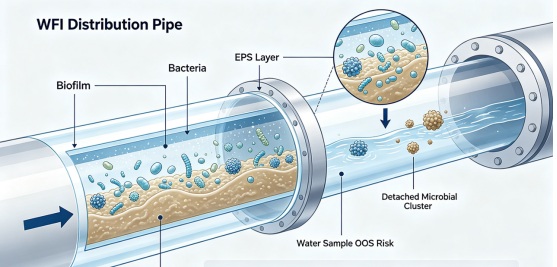
7 Common Risk Points Behind Pharmaceutical Water Microbial Contamination
1. Biofilm Formation in Dead Legs and Low-Flow Zones
Any pipe that has slow or stagnant waterdead legs longer than the recommended length, a sample port that is not used and a large valve body provides bacteria with an opportunity to adhere to, multiply, and build an encapsulated biofilm. After establishing biofilm is able to shed organisms periodically and this is the reason the presence of contamination is more sporadic rather than continuous, making an investigation into the root of the problem difficult.
2. Inadequate Sanitization Frequency or Method
A sanitization cycle designed around convenience rather than validated kill-time, or one that hasn’t been re-verified after a system modification, often looks adequate on paper while failing to reach every wetted surface. Ozone, hot water, and chemical sanitization all have different penetration limits, and none of them can compensate for design flaws elsewhere in the loop.
3. Storage Tank Design Flaws
Vent filters that aren’t hydrophobic or properly integrity-tested, and spray balls that don’t achieve full 360° coverage of the tank’s internal surface, are two of the most common — and most overlooked — sources of tank-level contamination. A dry spot on the tank wall is functionally a dead leg.
4. Poor Material Selection and Surface Finish
The roughness of the interior surface is more important than what most facilities plan for. A pipe that is rough or poorly passivated stainless interior provides microorganisms a larger surface to colonize than an electropolished pipe, which can accelerate biofilm growth even in good flow conditions.
5. Loop Design and Flow Velocity Issues
Distribution loops that are long, oversized or are running below the minimum turbulent flow speed permit water to remain longer than the very edge of the loop changing the entire return route into a dead-leg that is extended.
6. Membrane Fouling in RO/UF/EDI Pretreatment
Upstream failures compound downstream. When pretreatment membranes foul due to inadequate cleaning or oversight, bioburden loading on the purification train increases. Reverse osmosis membranes themselves are known to be susceptible to biofouling, gradually shifting more of the microbial control burden onto later stages of the system that weren’t designed to carry it.
7. Human and Procedural Gaps
Even a flawlessly engineered system can be undermined by inconsistent sampling technique, poorly located sample valves, or SOPs that haven’t kept pace with equipment changes. Sampling error is one of the few risk points that can introduce a false excursion — and one of the hardest to distinguish from a genuine system failure without a disciplined investigation process.
How to Reduce These Risks: A Practical Checklist
- Trend alert and action levels over time rather than relying on pass/fail snapshots — trend-based monitoring is the recommended way to keep a system consistently producing water that is fit for use
- Schedule periodic biofilm risk assessments for dead legs, valves, and low-flow branches, not just routine microbial sampling
- Re-validate sanitization cycles after any hardware change, not only on a fixed calendar
- Include TOC and conductivity trending as early-warning indicators for resin or membrane degradation, since TOC monitoring is a sensitive signal for system contamination before it shows up in microbial counts
- Review sample point design and technician training as part of every deviation investigation, not as an afterthought
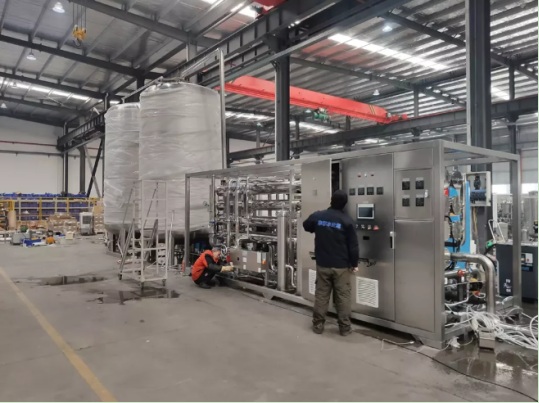
Designing Microbial Control Into the System From Day One
Retrofitting a contaminated system is expensive, disruptive, and often only partially effective — dead legs get shortened but rarely eliminated, and legacy material choices are hard to reverse. The most durable option is to integrate microbial controls within your pure water (PW) and water-for-injection (WFI) and the pure steam generation (PSG) system starting from the beginning: eliminating dead legs, utilizing electropolished surfaces, designing loops that can be sized for confirmed flows, as well as incorporating sanitation access to every branch prior to construction beginning.
Partnering With an Experienced Pharmaceutical Water System Provider
Because so many of these risk points originate at the design stage, the choice of system provider matters as much as day-to-day operations. Molewater designs and manufactures PW systems, PW/WFI storage and distribution loops, multi-effect distillation generators, and pure steam generation systems built to GMP, USP, EP, and JP requirements, with reverse osmosis, ultrafiltration, EDI, and multi-effect distillation technologies engineered specifically to reduce dead-leg risk and support validated sanitization.
If you’re considering evaluating your existing system’s microbial risk or are preparing an entirely new GMP-compliant water system, look into Molewater’s Pharmaceutical Water Solutions to learn the ways in which system design can be designed to address these risk factors right from the beginning.resistivity alone won’t automatically hit the endotoxin or nuclease targets without dedicated design for that purpose.
FAQ
What is the most significant source of microbial contamination within medical water treatment systems?
The development of biofilm in dead legs and low flow areas is one of the frequently identified root causes, as it allows organisms to remain and shed in a sporadic manner, even between sanitation cycles.
How often should a pharmaceutical water system be sanitized?
There is no single universal interval — frequency should be set based on validated data for the specific system design, water demand, and historical trending, then re-verified whenever the system is modified.
What is the acceptable microbial limit for purified water in the USP?
USP <1231> sets an action threshold of 100 CFU/mL for Purified Water, and 10 CFU/100mL for WFI. Both are treated as thresholds that require an examination, not the regular cutoffs of pass/fail.