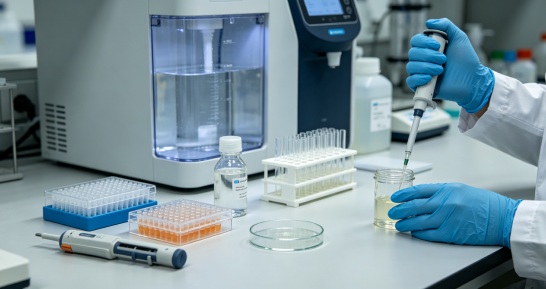
If your cell lines show improbable growth or contamination or results that aren’t reproducible, the issue could be not with your process. It could be your water. Ultrapure water for cell culture requires a higher standard than lab-grade water. It has to be free of any endotoxins, RNase/DNase, and have a low concentration of dissolved ions. Let’s examine what those standards really mean, the numbers that support them and how to pick an option that is reliable in delivering the results you expect.
Why Cell Culture Demands Such Strict Water Quality
Water isn’t just a secondary ingredient in the cell culture process. It’s the basis for the preparation of media along with buffer formulation and nearly every rinsing step within the workflow. Every contaminant in the water is absorbed directly into the culture system without a buffer for dilution to shield the cells from the toxins.
This is the place where a widespread mistake is causing problems in laboratories: high resistivity is often regarded as evidence of purity; however, it’s only measuring the absence of dissolving ions. Water samples can have a clean 18.2 MO*cm and contain biologically active contaminants such as nucleases and endotoxins that aren’t affecting conductivity in any way. Ultrapure water is ideal for cell cultivation; resistance is the initial point of reference and not the end point — the biological cleanliness needs to be checked in isolation.
What Is Endotoxin-Free Water, and Why Does It Matter for Cell Culture?
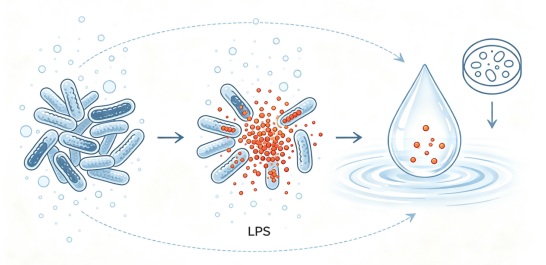
What Endotoxins Actually Are
They are lipopolysaccharide (LPS) fragments that are released by the cells of bacteria that are gram-negative. They’re extremely stable, and can withstand normal autoclaving as well as many filtering steps that kill the bacteria.
The Damage They Cause in Culture
Even trace endotoxin levels can trigger abnormal activation in immune cells like macrophages, skew cytokine expression, and compromise the reliability of downstream assays. In sensitive applications — immunology research, vaccine development, cell-based potency testing — this kind of interference doesn’t just add noise; it can invalidate an entire experiment without an obvious cause.
The Numbers Labs Should Know
Endotoxin contamination is usually measured as Endotoxin Units per milliliter (EU/mL), and for pharmaceutical-grade water it is generally expected to stay under 0.25 EU/mL . Still, for high-precision cell culture or molecular work, people often want even tighter control, so thresholds near 0.025 EU/mL are pretty common benchmarks , especially for setups that are built for exactly this kind of purpose.
What Does RNase/DNase-Free Mean?
Where These Enzymes Come From
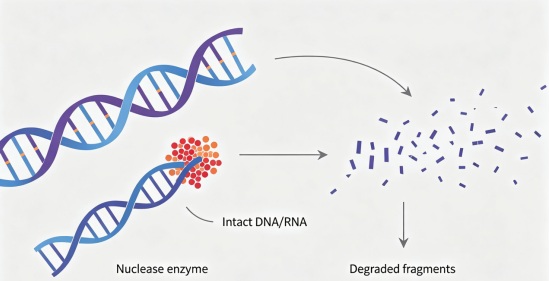
RNase and DNase are everywhere in a typical lab environment — shed from skin, present in dust, and carried by ambient microbial contamination. They’re notoriously resistant to degradation, which makes accidental introduction easy and difficult to reverse once it happens.
Why Enzyme Residue Ruins Downstream Work
For PCR, gene sequencing, cloning, and transfection work, nuclease contamination isn’t a minor inconvenience — it degrades nucleic acid templates before amplification even begins, often forcing researchers to discard entire sample sets and restart from scratch, losing both time and irreplaceable material.
How Labs Verify It
Nuclease-free status is typically confirmed using enzymatic activity assay kits designed to detect residual RNase or DNase activity at trace levels — a verification step that should be part of routine system qualification, not just a one-time claim at purchase.
The Core Parameters Behind True Ultrapure (Type 1) Water
Meeting the definition of ultrapure water for cell culture means satisfying several parameters simultaneously, not just one impressive number:
| Parameter | Typical Type 1 Benchmark | Why It Matters |
| Resistivity @25°C | 18.25 MΩ·cm | Confirms ionic purity |
| TOC (Total Organic Carbon) | ≤5 ppb | Flags organic contamination invisible to resistivity |
| Bacteria | <1 CFU/mL | Prevents microbial byproducts, including endotoxins |
| Particles | <1/mL | Avoids interference in sensitive analytical work |
| Pyrogens/Endotoxins | <0.025 EU/mL | Protects immune-sensitive cultures |
| Reactive Silica | <0.01 ppm | Prevents trace mineral interference |
| Heavy Metals | <0.01 ppm | Eliminates toxic trace contamin |
Each of these is independently regulated by the purification process — a system optimized for resistivity alone won’t automatically hit the endotoxin or nuclease targets without dedicated design for that purpose.
How to Choose a System for Cell Culture-Grade Water
Single-Stage vs. Double-Stage RO Pretreatment
Labs running high-stakes molecular or cell-based work generally benefit from double-stage reverse osmosis pretreatment, which delivers tighter conductivity control before the water even reaches final polishing — a meaningful advantage when endotoxin and nuclease control are non-negotiable.
Matching Output Capacity to Lab Scale
Output volume matters as much as purity specs. A system generating roughly 1–1.5 L/min of ultrapure water suits most standard cell culture and molecular biology workflows without long wait times between draws.
Maintenance Is Part of the Purity Spec
Passing a purity test once doesn’t guarantee consistent results over time. Filter replacement schedules, UV disinfection modules, and routine resistivity monitoring all directly affect whether a system keeps meeting endotoxin and nuclease-free thresholds month after month — not just on installation day.
How Molewater’s Molcell System Meets These Standards
Molewater’s Molcell Ultrapure Water Machine is engineered specifically for high-risk laboratory research, where trace contamination carries outsized consequences. The system is available in single- or double-stage RO configurations and generates Type 1 water at 18.25 MΩ·cm resistivity, with pyrogen levels controlled below 0.025 EU/mL and bacteria held under 1 CFU/mL.
It’s built to support demanding applications including IC/ICP-MS/HPLC/LC-MS analysis, TOC and trace analysis, and molecular biology experiments — the same categories where endotoxin and nuclease contamination most commonly derail results. Rather than requiring labs to stack multiple purification devices to hit every benchmark, Molcell is designed to meet resistivity, endotoxin, and biological cleanliness standards in a single integrated system.
Successful cell culture often comes down to details that are easy to overlook — and water quality is one of the most consequential. Ultrapure water for cell culture isn’t just about hitting a resistivity number; it demands verified control over endotoxins, RNase, and DNase at every stage. Choosing a system engineered to meet all three standards together, rather than assembling a patchwork solution, is the most reliable way to protect your results.
Ready to see if your lab’s water quality meets the standard your research demands? Explore Molewater’s laboratory ultrapure water systems to find the right fit for your workflow.eet your water treatment needs. Contact us to discuss your project requirements.