

For an offshore oil platform, fresh water is not something that can be treated as a routine supply item. Personnel need water every day for drinking, cooking, washing, cleaning, and other basic operations, while the platform may be hundreds of miles from the nearest shore. If a supply vessel is delayed by bad weather, the problem can quickly become an operational issue.
This is why many offshore facilities use seawater reverse osmosis (SWRO) to produce potable water on site. Instead of depending entirely on water transported from land, the platform can take seawater, remove dissolved salts and contaminants, and produce fresh water continuously.

Why Onboard Potable Water Supply Matters
Water demand offshore can be higher than expected. For example, Norwegian offshore guidance commonly uses at least 200 liters of water per person per day for drinking, food preparation, hygiene, and cleaning.
For a platform with 100 to 200 people, this can mean roughly 20–40 m³ of water per day under that baseline alone. Actual demand depends on accommodation standards, industrial use, emergency reserves, and the number of personnel on board.
Transporting this amount of water from shore requires regular logistics support. Distance, weather, vessel availability, and fuel costs can all affect the reliability and cost of delivered water. An onboard SWRO system changes the equation by producing water where it is needed.
What Makes Offshore SWRO Different?
Installing a desalination system offshore is not simply a matter of putting a standard RO machine on a platform.
Space and weight are major constraints. Every piece of equipment must fit within a limited deck area and meet lifting and structural requirements. For this reason, offshore systems are often designed as compact skids or modular packages that can be lifted and installed more easily.
The environment also places greater demands on equipment. Saltwater, humid air, vibration, and temperature changes can accelerate corrosion and affect equipment reliability. Materials and components therefore need to be selected with the actual marine environment in mind.
There is another issue: some offshore areas are classified as hazardous zones. Where equipment is installed in or near a Zone 2 area, electrical and control components must be suitable for the applicable hazardous-area requirements.
Water quality is equally important. Producing low-salinity water is only part of the job. The final water needs suitable treatment and disinfection before it is stored and supplied for human consumption. Depending on the location, the system may be designed against requirements such as the U.S. EPA drinking water regulations or equivalent offshore and national standards.
How Does Seawater Reverse Osmosis Work Offshore?
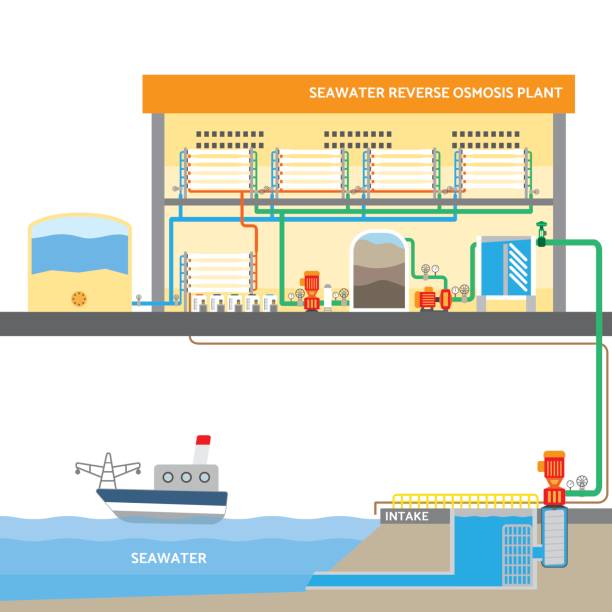
A typical offshore SWRO system follows a relatively straightforward process:
Seawater intake → Pretreatment → High-pressure pumping → RO membranes → Post-treatment → Disinfection → Freshwater storage
Pretreatment removes suspended solids and reduces the risk of fouling. Depending on the seawater conditions, this can include multimedia filtration, cartridge filters, chemical dosing, and antiscalant treatment.
The pretreated water is then pressurized, typically to around 55–70 bar, before entering the RO membranes. The membranes allow water molecules to pass through while rejecting most dissolved salts and other contaminants.
A typical seawater RO system may operate at around 35–45% recovery, although the actual figure depends on seawater temperature, salinity, membrane selection, and operating conditions. With suitable membrane design, salt rejection can exceed 99%.
Energy consumption is another important consideration offshore. Systems equipped with an energy recovery device (ERD) can commonly achieve specific energy consumption in the range of approximately 3–5.5 kWh/m³. Without energy recovery, consumption can be considerably higher.
After RO, the water usually requires post-treatment. Because RO removes most minerals, remineralization may be needed to improve water stability and reduce its tendency to become corrosive. Disinfection, using methods such as UV or controlled chlorination, is also commonly included before the water enters the storage and distribution system.
Key Design Considerations for Offshore SWRO
The first step is selecting the right capacity. A simple starting point is to calculate personnel demand and then add an appropriate operating margin. For example, a platform with 150 people using 200 L per person per day would require about 30 m³/day for basic domestic demand. The final SWRO capacity should also consider peak consumption, maintenance periods, storage capacity, and other onboard water uses.
Reliability is just as important as capacity. Offshore systems may be operated with limited personnel, so PLC-based automatic control, alarms, automatic flushing, pressure monitoring, and remote monitoring can reduce the need for constant manual operation.
Material selection also deserves attention. Components exposed to seawater should have appropriate corrosion resistance, while piping, pumps, valves, electrical equipment, and control systems need to match the operating environment and project specifications. Stainless steel grades such as 316L or duplex stainless steel may be considered for different sections of the system, depending on the water chemistry and design requirements.
Maintenance should also be planned from the beginning. Cartridge filters need regular replacement, membranes require monitoring for fouling and scaling, and chemical cleaning may be necessary when performance begins to decline. A well-designed pretreatment system can make a significant difference to membrane life and overall operating stability.
Finally, modular construction can simplify offshore installation. A skid-mounted system can be assembled and tested before shipment, reducing the amount of installation work required on the platform.
What Can Offshore Operators Expect?
Existing offshore applications show that SWRO systems can be built across a fairly wide capacity range. Systems producing around 40 m³/day, 60 m³/day, and approximately 100 m³/day have been used for offshore accommodation and potable water applications.
The main benefit is not simply the volume of water produced. Onboard desalination reduces dependence on external water deliveries and gives operators greater control over their freshwater supply. This becomes increasingly valuable when platforms are located far from shore or when weather can interrupt marine logistics.
For platform operators, the most useful performance indicators are therefore not just production capacity. Energy consumption, freshwater quality, equipment footprint, maintenance requirements, redundancy, and system availability all need to be considered together.
Choosing the Right Desalination System for Offshore Projects
Once the platform’s water demand, seawater quality, space limitations, and operating conditions are clear, the next step is selecting a desalination system that can meet those requirements. Molewater provides customized seawater desalination systems for different freshwater production needs, with system configurations covering pretreatment, RO desalination, post-treatment, and automatic control. For offshore applications, the equipment can be planned around available space, power conditions, installation requirements, and the expected water production capacity. This project-based approach is important because an offshore SWRO system cannot be selected by capacity alone. The system also needs to fit the platform’s physical and operating constraints. You can learn more about Molewater’s desalination systems and evaluate the appropriate configuration based on your project requirements.
Conclusion
For offshore oil platforms, seawater reverse osmosis provides a practical way to produce potable water close to the point of use. Its effectiveness depends on more than the RO membranes themselves. Correct capacity sizing, reliable pretreatment, corrosion-resistant materials, suitable automation, energy recovery, and proper post-treatment all contribute to stable operation.For a new offshore project or a system replacement, the best design should be based on the platform’s actual conditions, including personnel numbers, seawater quality, available space, power supply, hazardous-area requirements, and expected operating schedule. A properly engineered modular SWRO system can then provide a reliable freshwater source while reducing dependence on long-distance water transportation.