There’s no definitive answer for the frequency at which the ion exchange resin must be renewed, as it varies based on the hardness of the water, the flow rate, type of resin and system size. Softeners for household use typically regenerate every 2-7 days, whereas industrial systems might require periodic or even constant regeneration. We will break down the main elements, the typical intervals, and warning indicators so that you can determine the best timetable for your system and not waste the capacity of resin or salt.
What Is Ion Exchange Resin Regeneration?
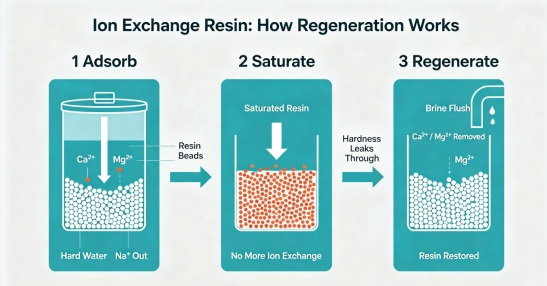
Ion exchange resin functions by trading undesirable ions such as calcium, magnesium or other pollutants — to more benign ions, such as hydrogen or sodium. As time passes, the resin beads become over-saturated and lose their capacity to exchange. Regeneration reverses this loss of capacity through flushing of the resin using an acid or concentrated salt solution, and restoring its ability for exchange of ions.
The timing of your operation is more important than the majority of operators are aware. When you do not replenish enough, you’ll waste salt water, aeration, and operating time. When you are waiting too long, the hardness or the contaminants begin to slip into the treated water; the result shows through in the buildup of scale or reduced service life or failure to pass tests for water quality.
Key Factors That Determine Regeneration Frequency
Water Hardness or Contaminant Load
Higher hardness of the water coming in (measured in grams per gallon or mg/L in CaCO₃) reduces resin’s capacity faster. A system that is treating 20 gpg of water will require renewal more frequently than one that is treating 5 gpg of water at the same flow rate.
Flow Rate and Daily Water Usage
The number of gallons processed each day directly determines how fast the resin capacity is exhausted. A family of four can use around 300-400 gallons a day. Industrial and commercial enterprises can process thousands of gallons every hour, reducing the cycle of regeneration from days to hours.
Resin Type and Capacity
A standard gel-like softening resin usually gives around 20,000–30,000 grains of capacity per cubic foot,but high capacity resins can go even beyond that, sort of more. The resin type also changes how well it regenerates, and it even influences how many service cycles you can do before the performance starts to drop.
System Size and Bed Volume
Larger resin beds hold more exchange capacity, extending the interval between regenerations for the same water demand — one reason undersized systems regenerate far more frequently than properly sized ones.
Application Type
Household softening, commercial water treatment, and industrial demineralization all run on very different cycles, since each one is driven by its own water quality target , and the tolerance level for hardness or contaminant slip kinda varies.
Signs That Your Resin Needs Regeneration
- Rising hardness or TDS readings in treated water
- Noticeable drop in flow rate or increased pressure differential
- Timer or conductivity sensor triggering an alert
- Changes in water taste, feel, or scale formation on fixtures
Catching these signs early prevents both under-treatment and unnecessary strain on downstream equipment.
Typical Regeneration Intervals by Application
| Application | Typical Frequency | Common Trigger |
| Household water softener | Every 2–7 days | Timer or meter-based |
| Commercial softening system | Daily to weekly | Volume or hardness sensor |
| Industrial boiler feedwater | Hours to a few days | Conductivity/TDS monitoring |
| Laboratory/high-purity water | Continuous to daily | Real-time resistivity monitoring |
These ranges are the industry’s typical starting points. The actual frequency should be confirmed by comparing your water analysis and usage information.
Time-Based vs. Volume-Based vs. Quality-Based Regeneration
Time-based regeneration is run on a set schedule, regardless of usage. Simple but frequently inefficient. Volume-based systems keep track of the number of gallons processed and then regenerate when the threshold is met and match capacity with demand. Quality-based regeneration makes use of real-time monitoring (conductivity sensors for hardness and conductivity) to activate regeneration only if the quality of output is declining – the most accurate and resource-efficient method, even though it requires higher-end equipment.
How to Regenerate Ion Exchange Resin: Step by Step
- Backwash -Reverse the flow of water to expand and loosen the bed of resin, and remove obstructions.
- Regenerative Injection — Inject brine (for softening) or acid/caustic solution (for demineralization) to remove ions that are exhausted.
- Slow Rinse — Flush the regenerant through the bed slowly to complete the ion exchange reaction.
- Fast Rinse — Rinse at service flow rate to remove residual regenerant before returning the system to service.
How to Extend Time Between Regenerations
- Install pre-filtration to reduce the load reaching the resin bed
- Optimize regenerant concentration and contact time rather than defaulting to excess salt or acid
- Monitor resin condition regularly and replace aging or fouled resin before capacity drops significantly
- Match system sizing to actual water demand rather than relying on oversized safety margins alone
Common Mistakes That Affect Regeneration Efficiency
Utilizing the wrong regenerant concentration or ignoring seasonal shifts in incoming water quality, as well as adhering to a rigid, fixed schedule without monitoring the real performance, are among the main reasons for premature exhaustion of resin or inefficient regeneration cycles.
There isn’t a universal schedule for regeneration and the ideal frequency is determined by the quality of your water flow rate, resin type and design. Monitoring the actual performance instead of making assumptions is the best method to ensure water quality and control operating costs.
If you’re unsure of what regeneration frequency is best for your system, the water treatment experts of Molewater will help you evaluate your system and suggest the appropriate resin size, sizing, as well as regeneration plan for your particular application.