
When comparing reverse osmosis (RO) systems, you will often come across capacity ratings such as 500 GPD, 1,000 GPD, or even 10,000 GPD. These numbers refer to the amount of water an RO membrane or system is rated to produce under specific operating conditions.
GPD means Gallons Per Day, and it is one of the most common ways to describe RO production capacity. However, a system rated at 1,000 GPD will not necessarily produce 1,000 gallons of water every day in actual use. Factors such as feed water pressure, temperature, and water quality can affect its output.
So, what does an RO system’s GPD rating really mean, and how should you use it when choosing a system? Understanding the rating can help you compare different systems more accurately and select a capacity that fits your actual water demand.
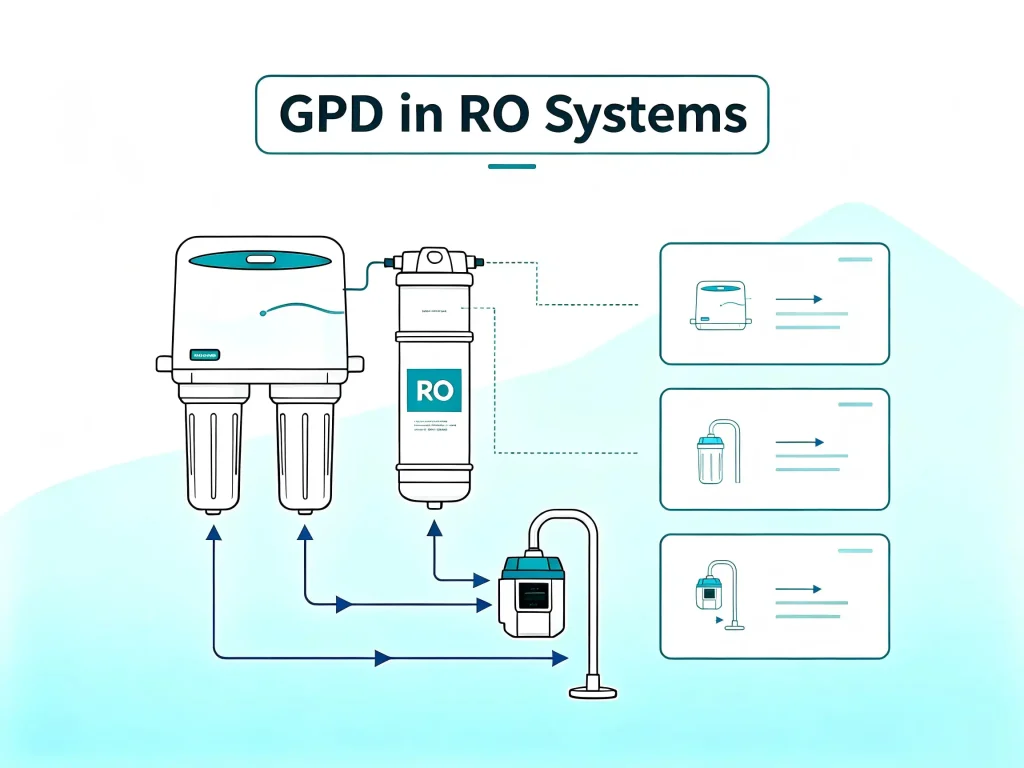
What Does GPD Mean in Water Treatment?
GPD means Gallons Per Day, a unit used to describe how much water an RO system or membrane can produce over a 24-hour period under specified operating conditions.
For example, a 1,000 GPD RO system has a rated production capacity of 1,000 gallons of permeate water per day under its specified test conditions.
It is important to understand that GPD describes capacity, not water quality. A higher GPD rating does not automatically mean better contaminant removal or higher water purity.
RO system specifications may also include other important figures, such as salt rejection, recovery rate, feed pressure, and membrane type. These specifications describe different aspects of system performance.
For example, an EPA evaluation of an RO drinking water system reported its production rate together with specific test conditions, including inlet pressure, water temperature, and TDS. This shows why a rated production figure should always be considered alongside its operating conditions.
How Is GPD Calculated?
Converting GPD into more familiar units is fairly simple.
1 US gallon ≈ 3.785 liters
So:
- 100 GPD ≈ 379 L/day
- 500 GPD ≈ 1,893 L/day
- 1,000 GPD ≈ 3,785 L/day
- 10,000 GPD ≈ 37.85 m³/day
If a 1,000 GPD system were to operate continuously for 24 hours, its rated average production would be about 157.7 L/h.
In commercial and industrial applications, RO system capacity is often listed in L/h or m³/h instead of GPD. Since these systems may run for a set number of hours each day, hourly flow rates can make it easier to estimate how much water the system can actually produce.
GPD vs. LPH vs. m³/h: What’s the Difference?
GPD, LPH, and m³/h all describe RO water production capacity, but they measure it over different time periods and use different volume units.
GPD (Gallons Per Day) refers to the number of gallons an RO system is rated to produce in 24 hours. It is commonly used for RO membranes and smaller systems.
LPH (Liters Per Hour) shows how many liters the system can produce in one hour. This unit is useful when looking at the system’s output during operation.
m³/h (Cubic Meters Per Hour) measures hourly production in cubic meters and is more common for larger commercial and industrial RO systems.
For example, a system rated at 10,000 GPD can produce about 37.85 m³ of water per day. If it runs continuously for 24 hours, its equivalent flow rate is around 1.58 m³/h.
Converting between these units is relatively simple. The more important question is whether the rated capacity matches the way the system will be used. Operating hours, peak water demand, storage capacity, and recovery rate can all affect the actual system capacity you need.
What Factors Affect Actual RO Production?
A membrane’s rated GPD is normally based on defined test conditions. Actual production can be different once the system is installed and exposed to real feed water.
Feed Water Pressure
RO membranes need sufficient pressure to push water through the membrane. When effective operating pressure changes, permeate production can change as well. EPA technical material also identifies feedwater pressure as an important factor affecting RO production.
Feed Water Temperature
Temperature also affects membrane flow. Colder water generally passes through an RO membrane more slowly than warmer water under otherwise similar conditions. This is one reason actual production can differ from the rated GPD.
TDS and Feed Water Quality
The characteristics of the feed water matter, too. Higher dissolved solids increase osmotic pressure, which can reduce the effective driving force across the membrane. Feed water quality should therefore be considered when selecting an RO membrane and system.
Membrane Fouling and Scaling
Over time, suspended solids, scale-forming minerals, and other contaminants can build up on the membrane surface. Fouling and scaling increase resistance to water flow and can reduce production.
Membrane Condition and System Design
Membrane age, pretreatment, pumps, piping, recovery settings, and other components can also affect the final output. For this reason, looking only at the GPD number is not enough when evaluating a complete RO system.
Is a Higher GPD RO System Always Better?
Not necessarily.
A higher GPD rating simply means the system has a higher rated production capacity. It can be useful for facilities with high water demand or limited operating hours, where a large amount of water needs to be produced in a shorter period.
However, choosing a system with more capacity than you need does not necessarily provide an advantage. If water demand is relatively low, the extra capacity may go unused while adding to the equipment and operating costs.
Larger RO systems may also need higher feed water flow, stronger pumping capacity, and suitable pretreatment. For this reason, system capacity should be based on actual water demand, operating hours, and site conditions rather than simply choosing the highest GPD rating available.
How Much GPD Does an RO System Need?
The first thing to look at is how much treated water the facility actually needs.
For example, suppose a facility uses 10,000 gallons of treated water per day, but the RO system will only run for 10 hours. To meet that demand, the system would need to produce an average of:
10,000 ÷ 10 = 1,000 gallons per hour
This gives you a starting point for determining the required system capacity. The final selection will depend on other factors as well, including recovery rate, peak water demand, operating conditions, and whether treated water is stored in a tank.In commercial and industrial applications, it is therefore better to size an RO system around actual water demand and operating schedules rather than choosing a GPD rating on its own. Molewater’s guide to RO system sizing takes similar factors into account, including daily demand, peak demand, and operating hours.