
Purified water systems are the lifeblood of pharmaceutical production, clinical diagnostics and other high-tech laboratory applications around the world. These specialized networks are extremely vulnerable to the invasiveness of bacterial colonies, making an active monitoring system essential. The presence of bacteria in these high-purity environments can compromise the safety of products and can alter sensitive data from experiments and can trigger devastating regulatory compliance violations in the global auditing bodies. To ensure operational integrity facilities must be able to see past superficial methods and establish a multi-layered, comprehensive control system.
How Microorganisms Survive in High-Purity Water
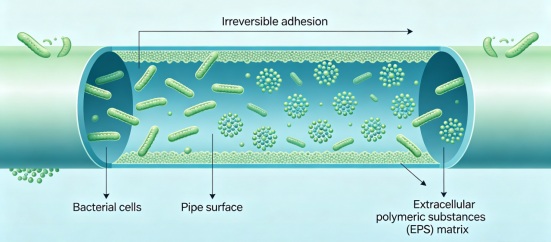
To eliminate bacteria effectively engineers must first know how microorganisms thrive in environments that are free of the traditional nutrients. In the normal environment the free-floating (planktonic) bacteria can be easily destroyed or swept away by the simplest sanitizing agents. But, inside the pipework of a purified system, bacteria swiftly adjust by changing into the state of sessile, creating an intricate structural community called biofilm.
[Biofilm Lifecycle in Water Piping]
Stage 1: Planktonic Bacteria Attachment (Reversible)
↓
Stage 2: Irreversible Adhesion & Microcolony Formation
↓
Stage 3: Secretion of Extracellular Polymeric Substances (EPS Matrix)
↓
Stage 4: The maturation process into a Fully Shielded Complex Community
↓
Stage 5: Periodic Sloughing / Release of New Planktonic Bacteria
Biofilms develop when bacteria that are in the beginning stick to pipe surfaces by secreting an extracellular polymeric (EPS) composed made up of proteins and polysaccharides in just a few hours. The protective, slimy shield is a kind of physical bunker shielding the underlying colonies from chemical cleaning.
High-purity water systems typically contain the oligotrophic bacteria Pseudomonas aeruginosa as well as Ralstonia pickettii that live on organic trace elements even at TOC levels that are less than 50 ppb. As per USP Guidelines <1231>, Bulk Purified Water has an microbial limit of less than 100 CFU/mL. The biofilms of mature age periodically shed huge bacterial colonies into the water flow that trigger uncontrollable, sudden spikes that quickly exceed the compliance thresholds.
The Limitations of Intermittent Maintenance
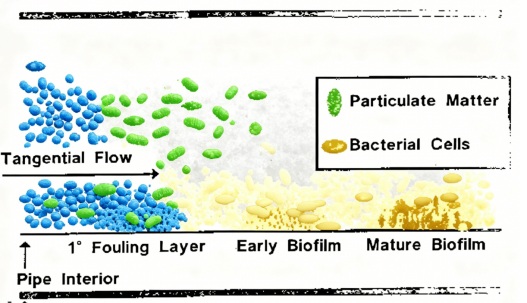
Many facility managers try to manage microbial burdens through relying on old reactive maintenance strategies. The most frequently encountered issue is the overreliance on chemical shock treatments that employ chlorination, hydrogen peroxide as well as peracetic acids. While these treatments are effective in removing floating planktonic bacteria that are free-floating throughout the water column they’re largely ineffective against an older, biofilm that has been established. The chemical sanitizing agents removes the outermost layer of the EPS matrix, leaving deep-seated bacteria to regenerate the colony after the chemical flush has ended.
Beyond physical and chemical limitations, engineering flaws often cause water distribution systems to be to be unsanitary. One of the most obvious structural hazards is the insertion with “dead legs”–sections of pipe where the water does not flow or is flowing at a low quantity.
When purified water is left to sit in a stagnant state for more than 4 hours, the local temperature begins to adjust to the space, forming an ideal incubation space for the growth of bacterial. Traditional pipe layouts that violate the internationally recognized “3D Rule” (where the length of a pipe that is stagnant is greater than three times the diameter) result in permanent breeding grounds that are able to systematically re-contaminate the entire distribution loop, no matter how frequently chemical flushes are carried out.
The Indispensable Capabilities of a Compliant Water System
To achieve long-term, lasting microbiological control means moving away from manual periodic maintenance and moving to a water purification system built from scratch for biological protection. Modern, dependable systems has to have unique operational capabilities to interrupt the bacterial lifecycle indefinitely:
- Continuous Turbulent Flow: Maintain >=0.9 milliseconds of velocity within distribution loops in order to produce shear stress that is kinetic, which prevents planktonic cells from collapsing and making biofilms.
- Multi-Stage filtering: While RO eliminates more than 99% endotoxins and bacteria Add terminal barriers such as submicron-sized UF, or 0.22 millimeter pharmaceutical-grade filters prior to distribution points to prevent downstream contamination.
- Automated Environmental Control: Eliminate manual intervention by using continuous, automated background disinfection techniques to ensure the integrity of the system.
Targeted Implementation: Key Technologies Working in Harmony
In order to successfully implement an absolute Microbial Control Strategy facilities should combine physical chemical, structural, and physical technology into a integrated water treatment system.
Dual-Wavelength UV Disinfection
Continuously recirculating UV lamps provide 254 nm light to destroy DNA in bacterial cells and block replication. They also provide the 185 nm wavelength of light that creates radicals called hydroxyls that break down organic carbon trace, thus the primary source of nutrient for bacteria.
Continuous Electrodeionization (EDI)
Installation is done following RO removal, EDI uses constant internal current to produce extreme pH shifts within resin beds, creating an electrochemically hostile environment which neutralizes any bacteria that bypass RO membranes.
Automated Thermal Pasteurization
Periodic cycles of heating the system to temperatures of 80-85 degrees Celsius for minimum 60 minutes. The uniform heat is absorbed into biofilm EPS matrices, denatures proteins, and achieves full system sterility, without chemical residues.
Sanitary Materials & Orbital Welding
Utilize stainless steel with low carbon 316L or PVDF for wet surfaces. They should be polished to Ra less than 0.4 millimeters to avoid tiny scratches. Automated orbital welding with argon results in crevice-free joints and prevents bacteria from anchoring.
The ROI of Flawless Microbiological Control: Strategic Business Values
In investing in an engineered, automated microbial control system yields significant long-term financial and operational benefits in commercial establishments. First, it stops the financial calamity of abrupt production shut-downs. When a drug batch or a clinical test line is impacted due to sudden bacterial outbreaks and subsequent decontamination of the facility protocols, loss of products and reporting to regulatory authorities can cost thousands of dollars.Second keeping an sterile environment significantly prolongs the life of costly treatment consumables. By preventing bio-fouling from the surface of reverse osmosis membranes as well as ion exchange resins, companies can increase the lifespan of membranes by between 30 and 50 percentage, significantly reducing the total cost of Owning (TCO). In addition, it assures constant and stress-free compliance even during unexpected inspections by regulators. A validated, automated system that produces transparent, continuous temperature and conductivity logs enables quality control managers to effortlessly be able to pass GMP, FDA, and ISO 17025 audits with absolute certainty.