

When a facility plans a new water treatment system, most people jump straight to talking about membranes or filtration technology. But the decision that actually shapes the whole project comes earlier: how the system gets built in the first place. A site-built plant and a modular, skid-mounted unit solve the same problem in very different ways, and the choice affects your construction schedule, your budget, and how easily you can expand years down the road.
This article compares both approaches across the factors that matter most to engineers and procurement teams, so you can figure out which one actually fits your project.
What Is a Traditional (Stick-Built) Water Treatment System?
A traditional water treatment system is designed and built entirely on-site, from the ground up. Engineers lay out the system based on the specific building or plot, then contractors pour foundations, run piping, mount tanks, and wire the controls in place, one step at a time. There’s no pre-built unit shipped in. The whole system takes shape in the field.
This approach still holds up well for large municipal plants, sites with unusual layout constraints, or projects where the required capacity is too large for any standard skid to handle. If your production line needs several hundred cubic meters per hour with a heavily customized layout, site-built construction is often still the better fit.
What Is a Modular (Skid-Mounted) Water Treatment System?
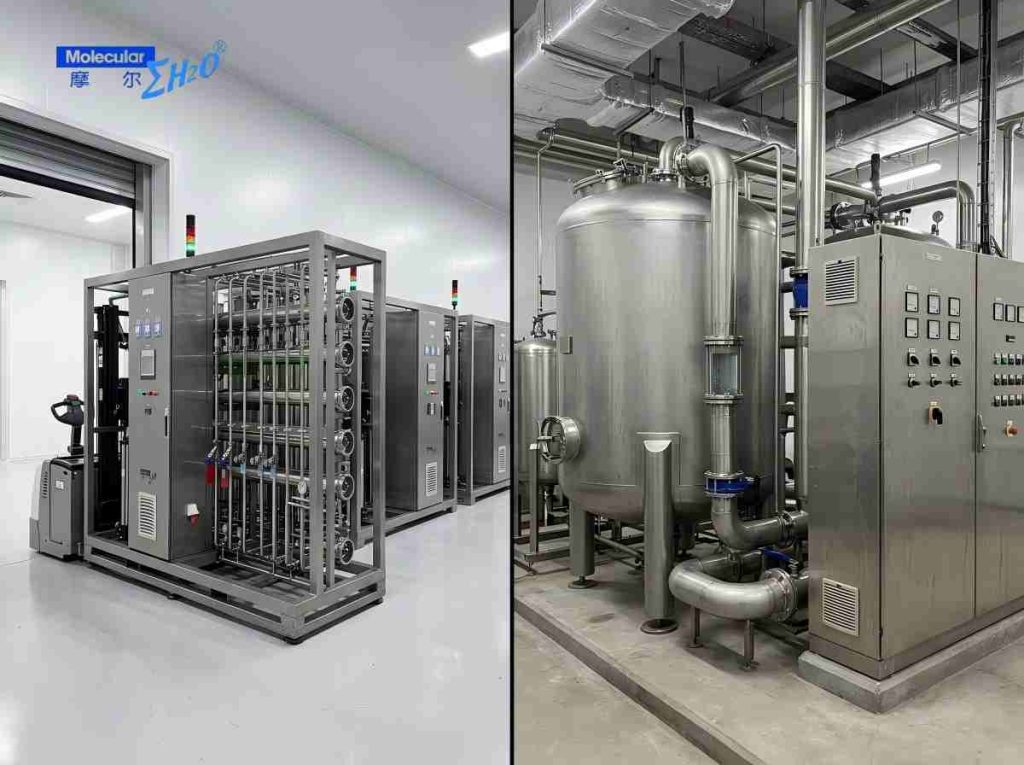
A modular system, often called a skid-mounted system, is built in a factory and shipped to the site as a nearly complete unit. Pumps, valves, piping, instrumentation, and the control panel all get assembled onto a single frame, usually stainless steel or carbon steel, and tested before it ever leaves the factory. By the time it reaches your site, most of the work is done. Installation just means hooking up utilities and running through startup checks.
This is how Molewater builds pharmaceutical, industrial, and laboratory water systems. Modules can be built at different flow rates and combined on-site later, so clients aren’t locked into one fixed capacity from day one.
Modular vs. Traditional Water Treatment Systems: 7 Key Decision Factors
1. Installation timeline
For time-sensitive projects, this is usually what decides everything else. A traditional system can take anywhere from two to six months for on-site construction and commissioning, depending on scope. A modular system cuts that down significantly, since most of the fabrication happens off-site while civil work is still being prepared at the plant. Once the unit arrives, it can often be installed and running within two to four weeks. A pharmaceutical company trying to hit a production deadline usually can’t afford the longer timeline, which is often what pushes the decision toward modular in the first place.
2. Upfront and lifecycle cost
Modular systems usually come with a lower upfront cost, since factory fabrication is more efficient than field labor and there’s less risk of the construction delays or cost overruns that tend to hit site-built projects. Traditional systems can occasionally end up cheaper over a very long lifecycle, though, especially for extremely large-scale operations where the economies of scale in civil construction start to catch up with the labor savings. So the cost comparison really comes down to how big the project is and how long it’s meant to run.
3. Space and site constraints
Modular units are compact by design, which makes them a good fit for facilities dealing with limited floor space, low ceilings, or tight access points. Traditional systems need more room to assemble on-site, and they usually call for structural support built specifically around the layout, something that’s not always easy to add in a retrofit or an older building.
4. Customization flexibility
This is one area where a traditional build can actually have the edge. If a project needs an unusual configuration, non-standard flow paths, or has to tie into existing infrastructure that doesn’t match any standard skid footprint, building on-site gives engineers more room to design around those constraints. Modular systems are flexible, but only within a certain range. They’re not built to handle a completely custom layout from scratch the same way.
5. Scalability for future expansion
If a facility expects to grow production in phases, modular systems make that path much simpler. Additional skids can be added alongside existing ones without shutting down the whole plant. Expanding a traditional system, on the other hand, usually means new construction work and a longer disruption to operations.
6. Quality control and factory acceptance testing (FAT)
Because modular systems are built and tested in a controlled factory environment before shipment, issues get caught and corrected before the unit ever reaches the site. This is particularly valuable for pharmaceutical and medical water systems, where FAT and SAT documentation plays a direct role in the qualification process. Traditional systems are tested after full on-site assembly, which means problems are sometimes discovered later, when they’re more expensive to fix.
7. Regulatory and validation considerations
For GMP-regulated facilities, modular systems often simplify part of the validation pathway. Since the core unit is built and factory-tested to a consistent design, much of the commissioning work gets verified before it even reaches the site, which shortens the on-site IQ/OQ phase considerably. This kind of factory-first, risk-based approach to qualification has become fairly standard across the industry, as outlined in the ISPE Baseline Guide on water and steam systems. Traditional builds still meet the same regulatory standards in the end, but since the validation work happens entirely on-site, the schedule tends to stretch out longer.
Which Industries Benefit Most from Modular Systems
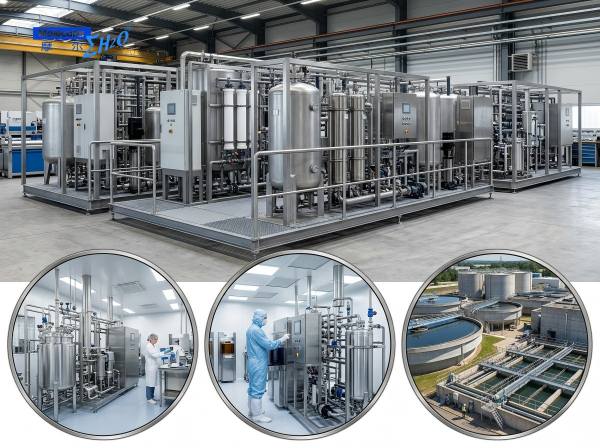
Pharmaceutical and medical facilities tend to gain the most from modular systems, since speed to compliance matters so much in this sector. A hospital expanding its dialysis unit, or a pharmaceutical plant bringing a new line online, usually can’t afford to lose months to on-site construction.
Semiconductor facilities are another strong fit. Cleanroom build schedules run tight, and any delay in the utility systems ends up holding up the whole project. Food and beverage producers dealing with seasonal demand lean toward modular units too, mainly because they need to bring capacity online fast without committing to a long construction timeline.
Large-scale municipal plants and facilities with unusually high, non-standard capacity needs are where traditional construction still holds up better, particularly when the timeline isn’t the main pressure point.
Common Misconceptions About Modular Water Treatment
A common assumption is that modular systems are lower quality because they’re mass-produced. Usually it’s the other way around. Modules get built in a controlled factory setting with consistent processes and testing before they ever ship, so quality control tends to be tighter than what happens during on-site field assembly, where conditions shift from one project to the next.
Another misconception is that modular means settling for a fixed, one-size-fits-all design. Most manufacturers, Molewater included, build modular systems around a client’s specific flow rate, water quality target, and industry requirements. What’s standardized is how the system gets built and delivered, not what it’s capable of doing.
A Practical Checklist: How to Decide Between Modular and Traditional
Before choosing a direction, it helps to walk through a few questions:
- How tight is your installation timeline, and can your project absorb a multi-month construction delay?
- Do you expect to expand capacity in phases within the next few years?
- Is your facility space limited, or do you have a dedicated area for traditional construction?
- Does your project require a highly unusual configuration that standard skids can’t accommodate?
- What level of regulatory documentation does your industry require, and would factory testing simplify your qualification process?
If most of your answers lean toward speed, limited space, and growing in phases, a modular system is usually the more practical choice. But if your project involves an unusually large scale, or a layout that doesn’t fit any standard configuration, it’s worth talking to an engineering team about building on-site instead.
How Molewater Approaches Modular System Design
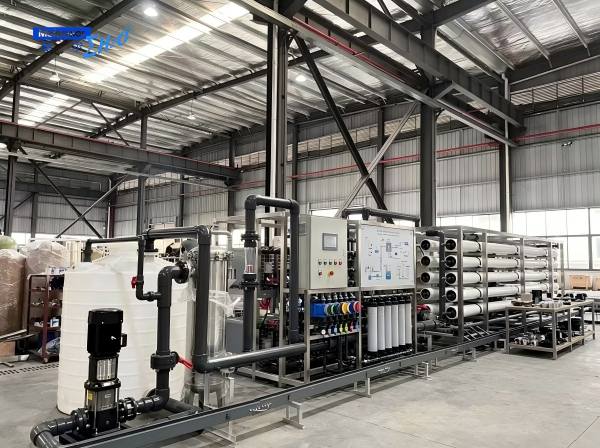
Molewater builds modular water treatment systems for pharmaceutical, industrial, and laboratory clients, with each skid fabricated from 316L stainless steel and tested through factory acceptance procedures before it ships. Systems are sized around the client’s required flow rate, from smaller lab-scale units up to large industrial installations, and additional modules can be added later as production needs grow.
If you’re still weighing modular against traditional for an upcoming project, our engineering team can look at your site conditions, timeline, and compliance requirements and help narrow down which approach makes sense. Get in touch with our team if you want to talk through the details.