Anyone specifying raw water pretreatment equipment ends up comparing multi-media filters and activated carbon filters at some point, and often assumes they’re interchangeable options for the same job.
They’re not. A multi-media filter removes suspended solids and turbidity through physical filtration — water passes through layered media and particles get trapped. An activated carbon filter works on a different mechanism entirely: dissolved chlorine and organic compounds bind to the carbon’s surface through adsorption, which physical filtration doesn’t touch. That difference in mechanism is why the two aren’t substitutes for each other, and why most pretreatment lines for RO systems or boiler feed water end up using both rather than choosing one.
What Each Filter Removes From Raw Water
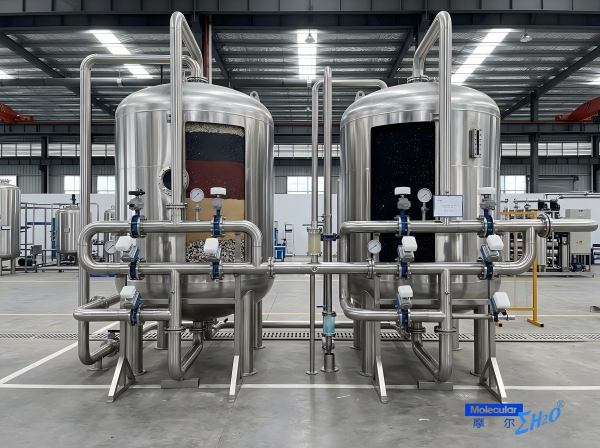
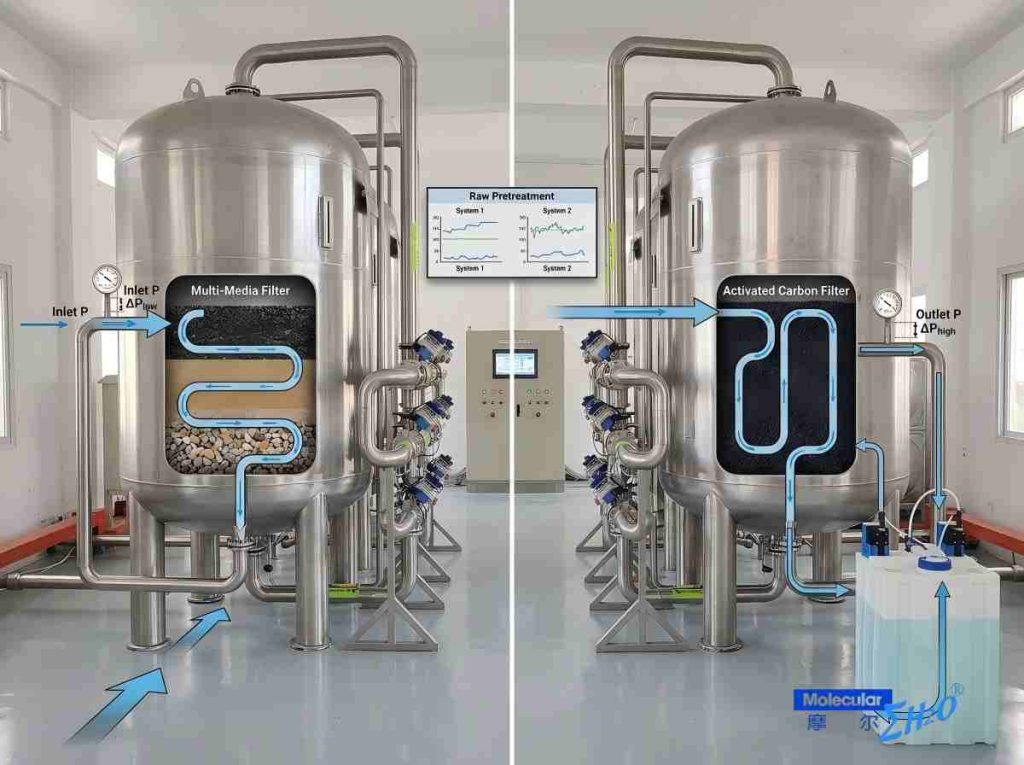
Multi-media filter works by passing water down through layered filter media stacked by density and grain size. Coarser particles get caught near the top, finer ones deeper in the bed. That layering lets multi-media filters handle higher turbidity loads and run longer between cleanings than a single-media sand filter would. Depending on the source water, a properly sized unit brings turbidity removal into the 85–95% range and strips out suspended solids, silt, and colloidal matter down to a few microns. It won’t touch dissolved material, though — chlorine, residual organics, taste, and odor pass straight through a multi-media bed, since physical filtration has no mechanism for capturing molecules at that scale.
Activated carbon filters handle that part instead. Rather than straining particles out mechanically, activated carbon works through adsorption: water moves through a porous carbon bed (usually bituminous coal, anthracite, or coconut shell), and dissolved organic compounds, chlorine, and odor-causing substances bind to the carbon’s surface. A single gram of activated carbon can carry several hundred square meters of internal surface area, and that’s what makes it effective at pulling chlorine and trace organics out of water a multi-media filter would let pass. It performs poorly on turbidity and suspended solids, though — high-sediment water clogs the carbon bed quickly and shortens its service life. The U.S. EPA’s guidance on drinking water treatment technologies classifies activated carbon separately from conventional filtration, since it targets a different category of contaminant altogether.
Filter Media and Design
A multi-media filter bed is usually 1.2 to 1.5 meters deep, layered with anthracite on top for coarse capture, sand in the middle, and sometimes a garnet layer at the bottom for polishing. That layering keeps the filter working efficiently even as solids build up in the bed, instead of clogging at the surface the way a single-media sand filter tends to.
An activated carbon filter needs a deeper bed by comparison which is often 1.0 to 1.8 meters because organics need longer contact time with the carbon surface to adsorb properly. There’s no stratification by particle size here; the carbon itself does the work, and bed depth mainly determines how much residence time the water gets. Some pretreatment setups fold activated carbon into a broader multi-stage filter as one layer rather than running it as a standalone unit, though facilities dealing with meaningful chlorine or organic loads generally get better results from a dedicated carbon vessel.
Backwash Cycles, Media Life, and Operating Costs
Multi-media filters generally need backwashing every 24 to 48 hours, using a combined air-and-water scour to lift and resettle the media bed and flush out accumulated solids. The media itself typically lasts three to five years before replacement, and since backwashing is frequent but the media stays durable over that stretch, operating costs stay moderate.
Activated carbon filters run on a longer backwash interval — often 72 to 168 hours — since carbon beds don’t clog with sediment the way media filters do. The carbon itself has a shorter working life, though, usually one to two years before its adsorption capacity runs out and it needs replacing. Over the same period, that replacement cycle tends to push a carbon filter’s overall operating costs above a multi-media unit’s, which matters most for facilities running high volumes or heavily contaminated raw water where carbon turns over faster than the one-to-two-year average.
Can Activated Carbon Replace a Multi-Media Filter
If activated carbon removes organics and chlorine on its own, it’s reasonable to wonder whether the multi-media stage is even necessary. Carbon can’t substitute for physical filtration, and running high-turbidity water directly into a carbon bed is one of the more common ways pretreatment systems underperform — suspended solids clog the media, cut contact time short, and force much more frequent (and expensive) carbon replacement than the system was designed for.
For most industrial and large-scale facilities, the standard setup runs multi-media filtration first to knock down turbidity and suspended solids, then activated carbon to handle chlorine and dissolved organics.
Reversing that order undercuts both stages. Engineering discussions on forums like Eng-Tips regularly surface this exact scenario: a facility switches to a new raw water source, canal or surface water with higher suspended solids than what the system was built for, and finds its carbon-only or carbon-first setup can’t keep up — usually ending in a multi-media stage retrofitted ahead of it.
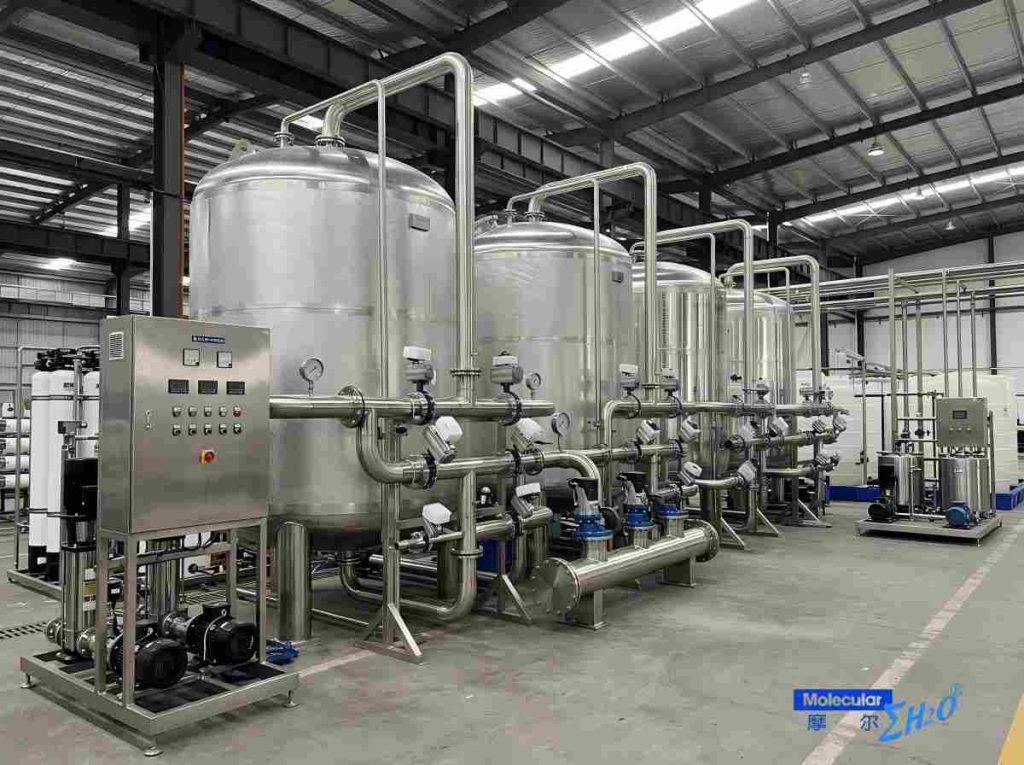
How to Choose the Right Raw Water Filtration System for Your Facility
Raw water quality data should drive this decision, not a product catalog. If turbidity or suspended solids dominate, common with surface water or sources affected by seasonal runoff, a multi-media filter needs to go in first, regardless of what follows it. If chlorine, organics, or odor are the concern instead, typically the case with chlorinated municipal supply feeding an RO or boiler system, activated carbon becomes necessary, though it still performs best downstream of a media filter rather than running on its own.
Facilities feeding RO membranes or ultrapure systems generally need both stages no matter what the raw water source is, since even moderate suspended solids will foul membranes over time and residual chlorine can damage certain membrane types outright. Molewater sizes its multi-media filter and activated carbon filter units to a facility’s flow rate and raw water profile, and most projects end up specifying both together rather than one or the other. Facilities also dealing with hardness alongside turbidity and chlorine typically add a water softener as a parallel or downstream stage, since neither media filtration nor carbon adsorption touches dissolved calcium and magnesium. Molewater’s pretreatment water filters lineup covers the full range of configurations for higher-turbidity or higher-chlorine raw water.