
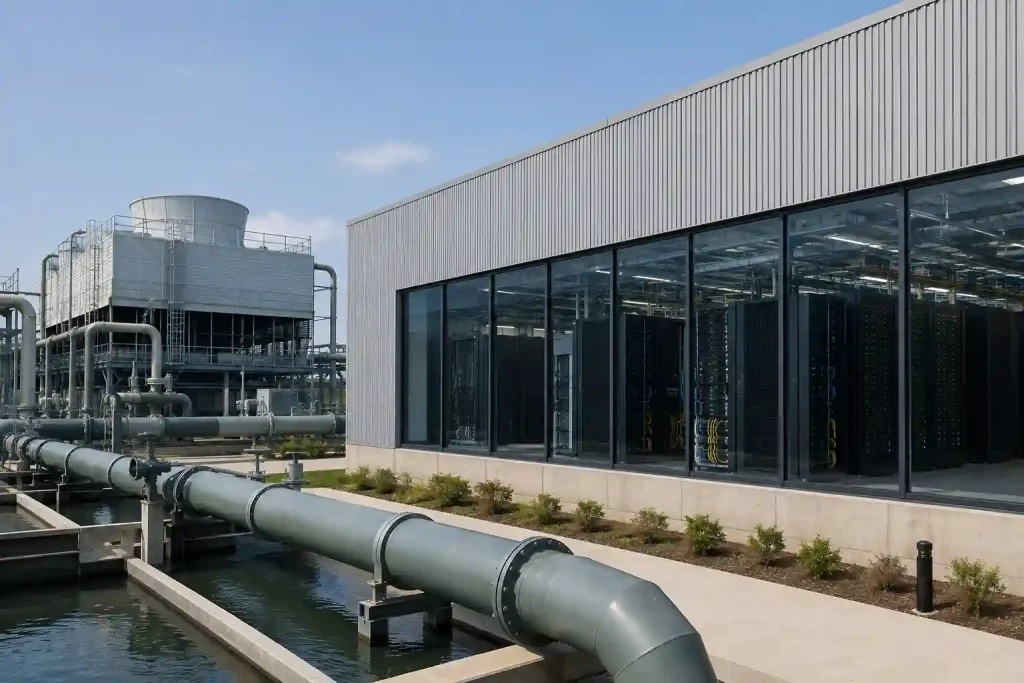
AI runs on software, but the systems behind it rely on large amounts of physical infrastructure. AI models are processed on servers equipped with GPUs and other high-performance hardware, which generate significant heat during operation. That heat needs to be removed to prevent equipment from overheating and to keep data centers running reliably.
Water can be part of this cooling process. However, AI itself does not have a fixed daily water consumption figure. The amount of water associated with AI computing varies depending on factors such as data center size, computing workload, cooling technology, local climate, and the source of the electricity used to power the facility.
This makes AI’s water footprint difficult to measure with a single number. Some water may be used directly for cooling, while additional water can be associated with electricity generation. Understanding where this water is used—and whether it can be treated and reused—is an important part of improving the water efficiency of AI data centers.
How Much Water Does AI Use Per Day?
There is no fixed daily water-use figure for AI. Published research can provide useful reference points, but the numbers vary with the model, workload, data center location, cooling system, and other operating conditions.
A study from the University of California, Riverside estimated that training GPT-3 in Microsoft’s U.S. data centers could directly consume about 700,000 liters (185,000 gallons) of freshwater through evaporation. The researchers also estimated that GPT-3 could consume roughly 500 milliliters of water for every 10 to 50 responses, depending on where and how the model was run.
These figures describe a specific model and computing setup. They should not be taken as a standard water-use rate for all AI systems.
Water Use per AI Query
A single AI request may have a relatively small water footprint. At a large scale, however, the total can add up as data centers process millions of requests. The amount associated with each request depends on factors such as the model being used, the hardware, the data center location, and the cooling system.
Water Use per 100 Words
Water-use estimates based on 100 words are also subject to the same variables. Generating more text generally involves more computation, but the amount of water associated with that computation depends on how efficiently the data center is powered and cooled.
For this reason, a figure expressed as water use per 100 words is better understood as an estimate under specific conditions, rather than a fixed rate that applies to every AI model or service.
Water Use at the Data Center Level
The numbers become much larger when water use is considered at the data center level. Large facilities may run thousands of servers continuously, creating a substantial cooling load. Data centers that rely on evaporative cooling use water through evaporation and blowdown, while air-based and closed-loop cooling systems can reduce ongoing water consumption.
AI’s overall water footprint can also include water used to generate the electricity that powers these facilities. Whether this indirect water use is included in an estimate can have a significant effect on the final figure, which is one reason published estimates can differ considerably.
Why Do AI Data Centers Use Water and How Is It Used for Cooling?
The main reason AI data centers use water is the amount of heat generated by computing equipment.
AI workloads can place heavy demands on GPUs and other accelerators. The electricity used by this hardware is ultimately released as heat, which needs to be removed to keep servers operating within a safe temperature range. Cooling systems transfer this heat away from the IT equipment, and water can be part of that process.
The amount of water required depends on the cooling technology. Some data centers rely mainly on outside-air cooling or air-cooled chillers and use relatively little water. Others use evaporative cooling or liquid cooling, which have different water requirements. Local climate, rack density, energy efficiency and the type of computing equipment also affect cooling needs.
In evaporative cooling systems, water helps remove heat as some of it changes into vapor. For example, a cooling tower uses warm water to transfer heat, with part of the water evaporating during the process. This evaporated water has to be replaced with fresh make-up water.
Another source of water loss is blowdown. As cooling water circulates, dissolved minerals and other substances can become more concentrated. A portion of the circulating water is therefore discharged and replaced to maintain suitable water quality.
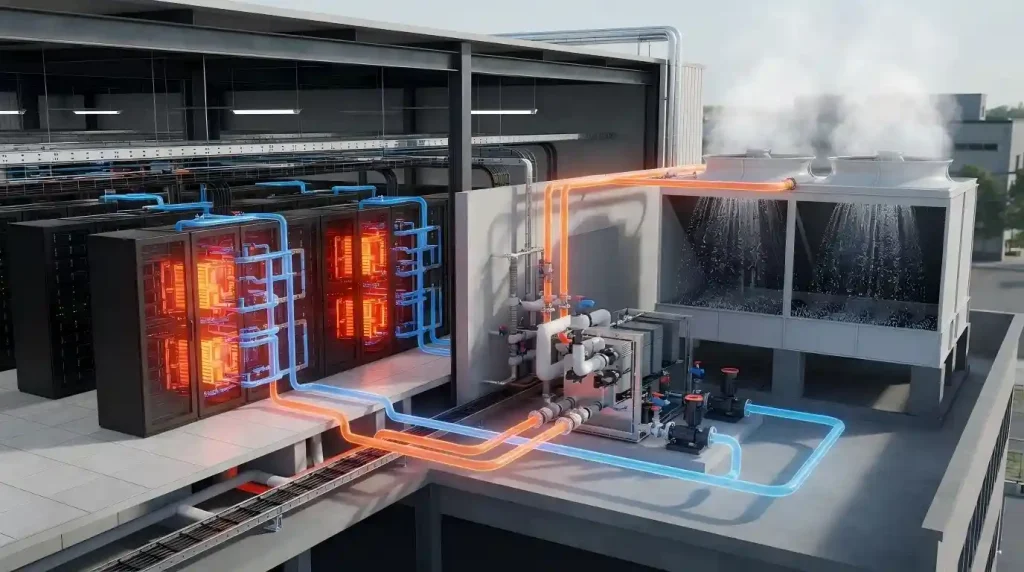
The basic process can be summarized as:
AI servers → heat generation → cooling system → heat removal → water circulation and heat rejection
It is important to note that water entering a cooling system is not necessarily consumed immediately. Much of it can remain in circulation, while some is lost through evaporation and some leaves the system as blowdown. The actual water footprint therefore depends on how the cooling system is designed and operated.
For example, Microsoft uses different cooling approaches across its data centers, including outside-air cooling, evaporative cooling, air-cooled chillers and chip-level cooling, depending on location and operating requirements. This illustrates why water use can vary significantly between data centers running similar computing workloads.
Where Does the Water Go and Is It Recycled?
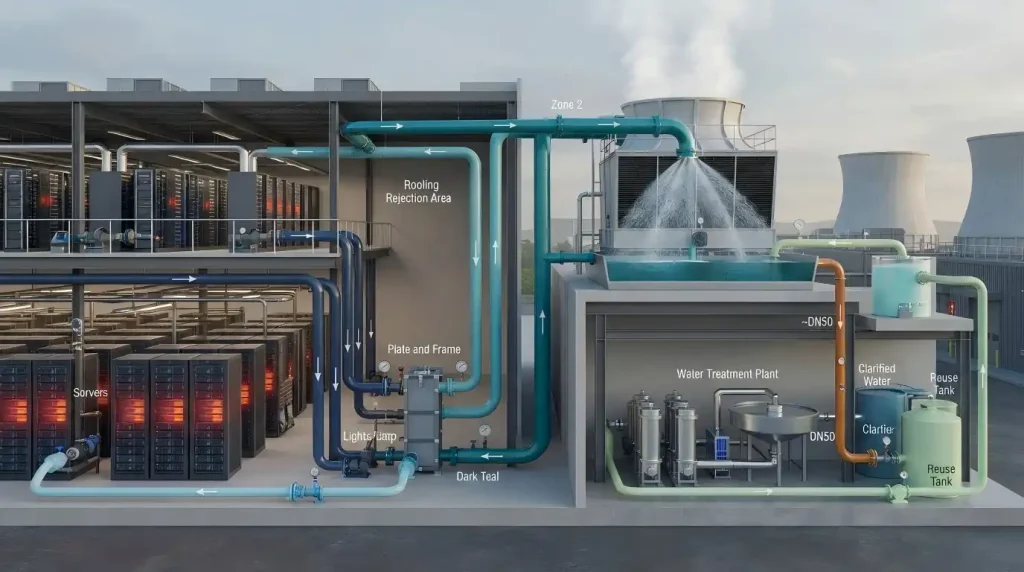
Not all water used by an AI data center is consumed in the same way. Some water evaporates during cooling, some remains in circulation, and some leaves the system as blowdown. Depending on the cooling system and water quality, part of this water can also be treated and reused.
Understanding these different water pathways is important because water withdrawal and water consumption are not the same thing. Water withdrawn from a source may remain in a cooling system or be returned after treatment, while water that evaporates is no longer immediately available for reuse.
Water That Evaporates
In evaporative cooling systems, some water is intentionally lost as vapor while removing heat from the cooling system. Cooling towers are a common example.
This water needs to be replaced with fresh make-up water to maintain the required cooling capacity. In areas with hot or dry climates, evaporation can account for a significant part of a data center’s direct water consumption.
Water That Remains in the Cooling Loop
Not all cooling water is lost. In recirculating systems, water can move repeatedly between the cooling equipment and heat rejection system.
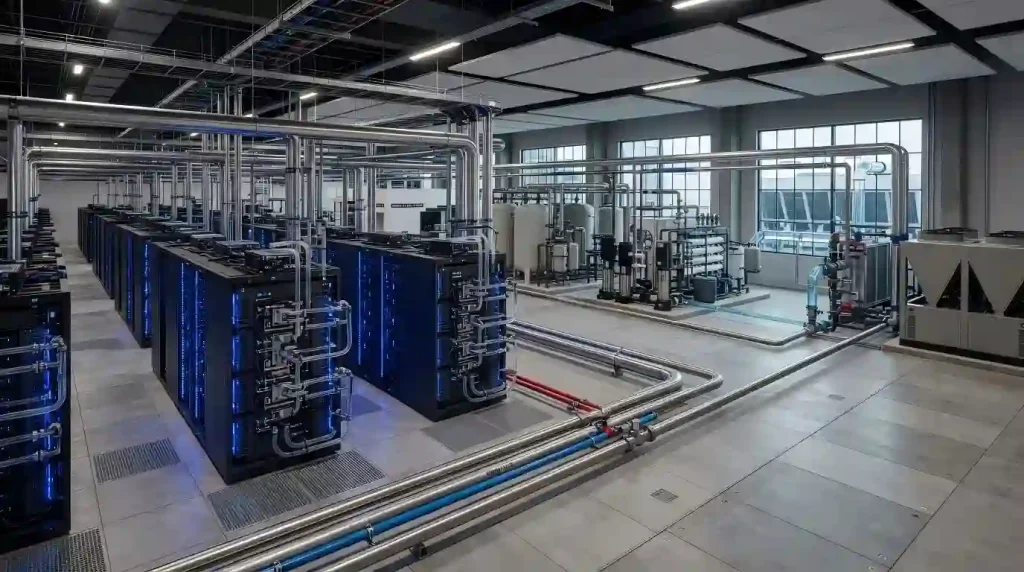
Closed-loop liquid cooling takes this approach further. In newer direct-to-chip systems, a cooling liquid circulates between the servers and heat rejection equipment without being continuously discharged or replaced. Microsoft has developed AI data center designs using closed-loop chip-level cooling that are designed to eliminate ongoing freshwater consumption for cooling during normal operation.
Because the same cooling liquid can be used repeatedly, these systems can significantly reduce the water consumption associated with evaporative cooling.
Cooling Water That Can Be Treated and Reused
Water that leaves a cooling system does not necessarily have to become waste. For example, cooling tower blowdown contains concentrated dissolved minerals and other substances, but it may be suitable for treatment and reuse depending on its characteristics.
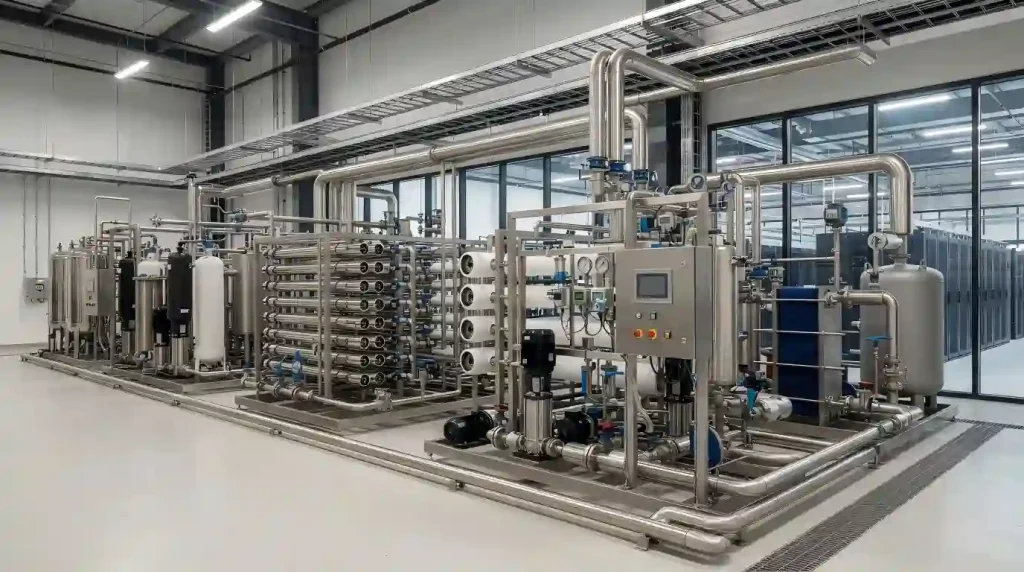
Treatment can include filtration, ultrafiltration, reverse osmosis or other processes selected according to the source water and the cooling system’s requirements. Treated water can potentially be returned to the cooling system or used for other non-potable applications.
The treatment approach needs to match the actual water quality. Parameters such as TDS, hardness, silica, suspended solids and biological contaminants can affect the treatment process and the quality required for reuse.
As a result, water recycling in AI data centers is not simply about collecting used water. It requires a treatment system that can reliably bring the water back to a quality suitable for its next use.
How Can AI Data Centers Reduce Water Consumption?
Reducing water consumption does not always require a complete change in cooling infrastructure. In many cases, improvements to cooling efficiency, water management, and water sourcing can work together to lower overall demand.
Improve cooling efficiency. Better controls, operating temperatures, and heat rejection systems can reduce the amount of cooling required for a given computing workload.
Increase cycles of concentration. In evaporative cooling systems, maintaining appropriate water chemistry can allow cooling water to circulate for longer before blowdown is needed. This can reduce the amount of water discharged from the system.
Reuse cooling water. Treated blowdown and other reclaimed water may be suitable for reuse when they meet the quality requirements of the cooling system. Appropriate treatment can help remove contaminants that would otherwise limit reuse.
Use alternative water sources. Reclaimed municipal wastewater and other non-potable sources can replace some of the freshwater used for cooling, particularly where local infrastructure makes these sources available.
Adopt water-efficient cooling designs. Direct-to-chip liquid cooling and other closed-loop systems can reduce the reliance on evaporative cooling and, in some applications, avoid ongoing evaporative water consumption.
Microsoft reported an average Water Usage Effectiveness (WUE) of 0.27 liters per kilowatt-hour across its owned data center fleet in 2025. The company also reported that about 90% of its 2025 owned fleet operated with low- to zero-water cooling systems, illustrating how cooling design can have a significant impact on data center water use.
Can Treated Wastewater Be Used for AI Data Center Cooling?
Yes, treated wastewater can be used for cooling in suitable data center applications. It can help reduce reliance on freshwater, especially in areas where water availability is limited or freshwater demand is under pressure.
However, wastewater cannot be fed directly into most cooling systems. The treated water needs to meet the quality requirements of the cooling equipment and operating conditions. Parameters such as hardness, total dissolved solids (TDS), silica, suspended solids, and biological activity may need to be controlled to prevent scaling, corrosion, fouling, and microbiological problems.
Depending on the source water and the cooling application, treatment may involve several stages, for example:
Alternative water source → pretreatment → UF → RO → polishing or conditioning → cooling system
Not every facility needs the full treatment train. Some sources may require only pretreatment and filtration, while more demanding applications may require UF, RO, or additional polishing to achieve the required water quality.
The treatment design should therefore be based on the characteristics of the incoming water and the requirements of the cooling system. This allows the facility to achieve the necessary water quality without adding treatment steps that are not needed.
How Much Water Could AI Data Centers Save Through Water Reuse?
The amount of water a data center can save through reuse depends on its cooling system, current water demand, source water quality, and the amount of water that can be recovered and treated. There is no single percentage that applies to every facility.
For example, a data center that uses 1 million liters of make-up water per day could reduce its freshwater demand by about 500,000 liters per day if reclaimed water could safely provide 50% of that requirement.
Water reuse can provide greater savings when combined with other measures, including higher cycles of concentration, more efficient cooling, and closed-loop systems. Microsoft has also developed newer data center designs with closed-loop cooling that are designed to use zero water for cooling during normal operation. This shows how much the cooling system itself can affect a facility’s water demand.
For existing data centers, however, water reuse may be more practical than replacing the entire cooling system. For example, cooling tower blowdown can be treated and returned to the cooling process if the recovered water meets the system’s quality requirements.
The basic water cycle looks like this:
Freshwater intake → cooling → evaporation/blowdown → treatment → reclaimed water → cooling reuse
The greater the proportion of cooling demand that can be met with recovered water, the less freshwater the facility needs to withdraw.
The Future of AI Water Consumption
AI-related water demand is likely to remain an important consideration as data centers continue to expand. The International Energy Agency (IEA) estimated in 2025 that global data center electricity consumption could reach around 945 TWh by 2030. In its base case, electricity use from accelerated servers, driven largely by AI, is expected to grow by about 30% per year. More computing capacity will increase the amount of heat that data centers need to remove, but water use does not have to rise at the same rate.
Cooling technology is already changing in response to this growth. Microsoft reported an average WUE of 0.27 L/kWh in 2025, compared with 2.3 L/kWh in its earlier data center generations. The company has also been expanding the use of recycled and alternative water sources and deploying direct-to-chip, closed-loop cooling in newer AI data center designs.
These changes point toward a data center model that relies less on conventional evaporative cooling and freshwater. Liquid cooling, closed-loop systems, reclaimed water, and more efficient treatment processes can be combined to reduce water demand while supporting higher computing densities. In areas where freshwater supplies are limited, recovering and reusing cooling water can be particularly valuable.
AI growth will continue to increase demand for data center infrastructure, but the amount of water required for that computing is also influenced by how facilities are designed and operated. Cooling efficiency, water availability, treatment, and reuse will increasingly need to be considered together when planning new AI data centers.
Conclusion
AI’s water footprint is more complicated than a single number. Water use varies with the AI workload, data center location, cooling technology and the way water consumption is measured. As AI infrastructure continues to expand, the focus is shifting from simply asking how much water is used to finding better ways to manage it.
More efficient cooling, closed-loop systems, reclaimed water and water treatment can all help reduce reliance on freshwater. For existing data centers, treating and reusing suitable cooling water can also provide a practical way to lower freshwater demand without completely replacing the cooling infrastructure.
As AI computing grows, water management will become an increasingly important part of data center planning. Molewater provides water treatment and reuse solutions designed around specific water sources, cooling systems and water quality requirements, helping data centers make better use of available water while supporting long-term operational and sustainability goals.
References
- UC Riverside / arXiv — AI Water Footprint
Making AI Less “Thirsty”: Uncovering and Addressing the Secret Water Footprint of AI Models - International Energy Agency (IEA) — Energy and AI
Energy and AI - Microsoft — Data Center Water Efficiency
Inside Microsoft’s two-decade push to cut water intensity while scaling for growth - Microsoft — Closed-Loop Cooling
Sustainable by Design: Next-Generation Datacenters Consume Zero Water for Cooling - U.S. Geological Survey (USGS) — Water-Use Terminology
Water-Use Terminology - U.S. Department of Energy (DOE) — Data Center Cooling
Cooling Water Efficiency Opportunities for Federal Data Centers