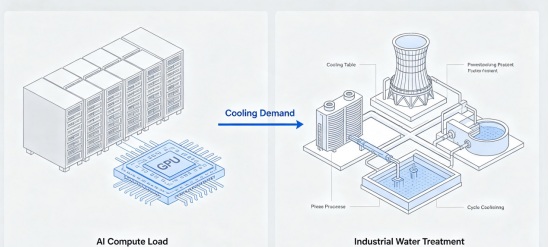
One of Everyone’s talking about how much electricity AI data centers consume. Far fewer people are talking about the water. Behind every rack of GPUs churning through AI workloads sits a cooling system that depends on a steady, treated supply of water — and as data center construction accelerates, that quiet dependency is reshaping demand across the industrial water treatment sector.
The Numbers Behind the Data Center Water Boom
The global data center wastewater and water processing equipment market expected to increase to USD 3.30 billion as of 2026 and reach USD 5.90 billion in 2031. an annual compound growth rate of 12.3 percent driven by the increasing speed of construction of data centers, increasing demands for cooling water, pressure from regulators as well as regional water scarcity and corporate sustainability pledges. Water treatment for cooling is predicted to be the biggest segment in terms of treatment stages since data centers need large quantities of water for cooling towers, chilled-water systems and sophisticated fluid cooling facilities. This isn’t just a speculation; it’s a financed rapid buildout that is already changing the priorities of procurement across the water treatment industry.
Why Data Centers Need So Much Water in the First Place
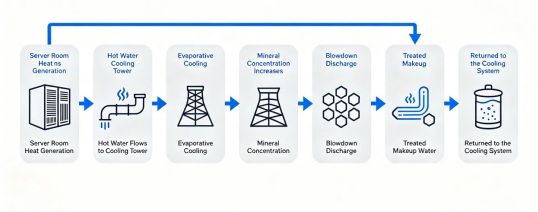
AI workloads have increased cooling requirements by three to six times since 2022. The majority of the heat is eliminated through evaporative cooling towers. About 80 to 90% of data centers’ direct water usage is derived from cooling towers that evaporate that are evaporating blowdown and drift -which is equivalent to an effective water usage of 1.8 Liters per Kilowatt-hour. In contrast to a single-time industrial water usage the following is a constant cycle where water evaporates in order to take heat, dissolved minerals build up in the remaining the remaining water, and it has to be regularly cleaned (blowdown) to be replaced by clean makeup water, which is treated, to ensure that the system continues to function.
What Happens If Data Center Cooling Water Isn’t Properly Treated?
This cycle continues for a long time, and is the point where things can go wrong if they are not given proper maintenance. As water evaporates from the cooling tower, minerals such as silica and calcium get concentrated, causing scaling on the heat exchange surfaces, which gradually reduces the effectiveness of cooling. If left unchecked, this concentrated water can accelerate the deterioration of metal components, and creates perfect conditions for the growth of biological organisms -and that includes bacteria that can cause equipment fouling as well as sometimes real health risks. In a place where minor cooling issues can put servers to shut down they’re not just abstract threats. They’re operational failure scenarios which cause water treatment to be a real major concern, not simply an obligation to checkbox.
The Water Treatment Technologies Data Centers Actually Rely On
The most effective way to meet this need is through an approach that is layered. Pretreatment filters eliminate suspended organic matter and solids out of the makeup water that is incoming before it gets to in the cooling process, thus protecting downstream equipment from contamination. Softening water addresses hardness minerals directly, and reduces the potential for scaling that could otherwise be accumulating in heat exchangers and cooling towers. For those facilities that require higher purity makeup water or wishing to decrease blowdown volume the industrial reverse osmosis system take away the majority of solids dissolved before water is introduced into the cooling loop – increasing the duration of concentration cycles and reducing the frequency with which water needs to be replaced. Increasingly, this is paired with water reuse and zero liquid discharge approaches, which recover and recycle water from the cooling process itself rather than continuously drawing fresh supply.
Regulation and Water Stress Are Accelerating the Trend
Two forces are pushing this from “good practice” to genuine urgency. First, location: two-thirds of new U.S. hyperscale data center campuses built since 2022 are located in high or extreme water-stress counties, putting new facilities directly at odds with already-strained local water supplies and drawing sharper regulatory scrutiny over water withdrawal permits. Second, chemistry: EPA guidance now notes that cooling-system blowdown water can contain chemicals and may require permits or wastewater treatment before discharge, with PFAS — the “forever chemicals” used in some cooling fluids and equipment — drawing particular regulatory attention as reporting deadlines approach. Together, these pressures are pushing data center operators toward closed-loop systems and genuine water treatment investment, rather than simply drawing more water when supply allows it.
What This Means for Industrial Water Treatment Providers
For the industrial water treatment sector, this shift represents a genuinely new category of demand — not just larger cooling systems, but smarter ones. Facilities increasingly need automated, high-uptime pretreatment and softening systems capable of running continuously with minimal downtime, since a treatment failure can cascade directly into a cooling failure. Reverse osmosis and water reuse capability are becoming standard requirements rather than optional upgrades, particularly for facilities operating in water-stressed regions where local authorities are tightening withdrawal and discharge permits. As a manufacturer with two decades of experience across pharmaceutical, semiconductor, and power industry water treatment — sectors that share data centers’ need for continuous, high-reliability operation — Molewater’s modular RO and pretreatment systems are built around exactly this kind of demanding, always-on requirement.
The AI data center boom isn’t just an energy story — it’s a water treatment story unfolding in parallel, with real market growth behind it. As cooling demand rises and regulatory scrutiny tightens, reliable, high-capacity water treatment infrastructure is becoming a core part of data center planning rather than an afterthought. Molewater’s industrial reverse osmosis and pretreatment systems are engineered for exactly this kind of continuous, high-reliability operation — get in touch to discuss your facility’s water treatment requirements.
FAQ
What amount of water does the typical data center consume?
It differs significantly based on dimensions and the cooling system, however large facilities may consume millions of gallons every day, with the largest use being the operation of evaporative cooling towers.
Do data centers need reverse osmosis systems?
Many do, particularly for treating makeup water and reducing blowdown volume, though requirements vary based on cooling technology and local water quality.
Can data centers reuse or recycle their cooling water?
Yes — closed-loop cooling and water reuse systems are increasingly common, especially in water-stressed regions facing stricter withdrawal permits.
Why are data centers being constructed in water-stressed areas?
A lot of times due to power infrastructure, land or other factors not directly related to water supply, which has forced operators to invest more in the treatment of water and reuse in order to ensure that they operate in a sustainable manner.