A high-efficiency water softener conserves water and salt through two engineering options: counter-current regeneration and automated, sensor-based control rather than a set timetable. If you have a plant that runs cooling towers, boiler feed, or pretreatment for process, the difference isn’t just a bill for utilities and is quantified in tonnes of salt as well as thousands of milliliters of rinse water per the course of a year. Below, we’ll go over the exact mechanism and how much it usually is able to save, as well as what to be aware of before deciding on equipment for power, chemical or textile uses.
What Is a High Efficiency Water Softener?
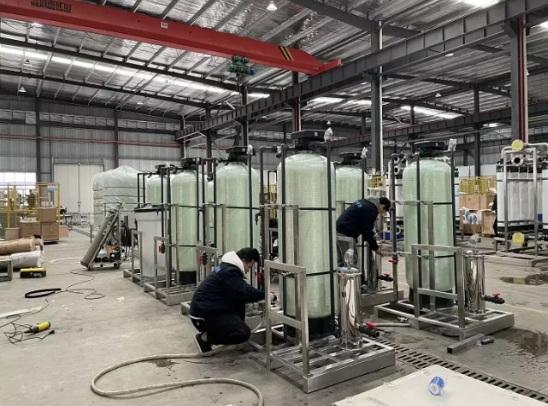
In an industrial environment, water softeners are a sodium ion exchanger a pressure vessel for ion exchange that is filled with cation resin coupled with an automated control valve as well as a brine tank to regenerate. As the water that is hard passes through the resin, it exchanges magnesium and calcium ions for sodium ions, resulting in softened water that can be used for the boiler’s feed or RO’s pretreatment or for use in process. A “high efficiency” unit adds two additional elements to this fundamental design: regeneration flow direction as well as demand-based automation; this combination determines the amount of the rinse and salt water that each regeneration cycle consumes.
How It Actually Saves Salt and Water
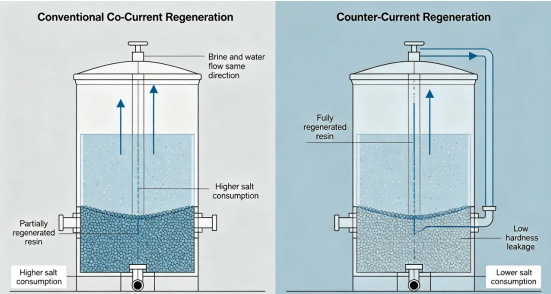
This is the biggest efficiency lever. In the conventional co-current system, it is the case that brine flows in the exact direction as service water, leaving the resin at the outlet that is only partially renewed which means that operators must compensate by introducing a higher salt intake. Counter-current regeneration, however, ensures that the resin with the lowest exhaust is at the outlet, which gives the lowest leakage of hardness and the highest efficiency in chemical efficacy. Since the resin is rebuilt more fully using the same volume of brine, the plant can operate less salt but still achieve the same hardness output goal.
Automatic, Demand-Based Control
Rather than regenerating on a fixed timer regardless of how much water has actually been treated, a fully automatic control valve triggers regeneration based on flow volume or resin exhaustion. Metered and demand-initiated control is particularly effective at reducing the number of regeneration cycles and the associated rinse water use in commercial and industrial systems. Fewer, better-timed cycles mean less brine and less rinse water wasted on resin that wasn’t actually depleted yet.
Conductivity and Flow Monitoring
Advanced systems add conductivity sensors during the rinse phase to detect exactly when residual brine has been flushed out — no more, no less. This prevents the common failure mode of over-rinsing “just to be safe,” which is one of the largest sources of unnecessary water use in softener regeneration.
How Much Can You Actually Save?
The gap between co-current and counter-current designs is well documented in industrial ion exchange literature. Counter-current regeneration typically consumes about 75% less salt and 65% less water than co-current regeneration for the same softening duty. Commercial packed-bed systems that combine counter-current regeneration with conductivity-based rinse control report even larger gains — one such design uses 60% less salt and generates 80% less effluent than a conventional softener.
Salt dosing itself is also far less efficient than most operators assume without the right design. Typical brine doses of 80–150 g of NaCl per liter of resin only achieve 40–65% of the theoretical regeneration efficiency, which is exactly the gap that counter-current flow and precise dosing control are built to close. For plants running softeners daily as boiler feed pretreatment, that gap compounds into a significant, measurable difference in annual salt spend and wastewater discharge.
High Efficiency vs. Standard Industrial Softeners
| Feature | Standard (Co-current) Softener | High Efficiency (Counter-current) Softener |
| Regeneration flow direction | Same as service flow | Opposite of service flow |
| Salt consumption | Higher dose needed for target hardness | Up to ~75% less salt for equivalent output |
| Rinse water use | Higher, often over-rinsed by default | Up to ~65% less, sensor-monitored |
| Regeneration trigger | Often fixed schedule | Automatic, flow- or exhaustion-based |
| Effluent/discharge volume | Higher | Can be reduced by up to ~80% |
Beyond Salt and Water: Added Value for Plants
Boiler protection — without adequate softening pretreatment, boiler systems risk hard, insulating scale that reduces heat transfer efficiency, raises energy use, and in severe cases damages boiler tubes.
Lower chloride discharge — municipalities increasingly track chlorides from softener brine as a wastewater concern, so lower salt doses directly reduce compliance risk.
Longer resin and valve life — fewer, more complete regeneration cycles reduce mechanical wear on control valves and extend resin service intervals.
How to Choose a Genuinely High Efficiency Industrial Softener
When comparing suppliers, look past general “high efficiency” claims and confirm these specifics:
- Counter-current regeneration — confirm the brine flow direction, not just the presence of automation.
- Fully automatic control valve — regeneration should trigger on flow volume or hardness breakthrough, not a fixed calendar schedule.
- Guaranteed output hardness — for boiler feed or RO pretreatment, ask for a specific residual hardness spec (for example, ≤0.03 mmol/L) rather than a general “soft water” claim.
- Vessel material fit for your process — FRP, carbon steel, or stainless steel vessels each suit different chemical, power, or textile environments; match the material to your feedwater chemistry and site conditions.
- Regeneration chemistry — a well-designed unit regenerates with salt alone, avoiding the added handling and disposal complexity of acid or alkali regenerants.
If you’re specifying equipment for chemical, power, textile, or pure-water pretreatment, Mole Water’s industrial water softener is built on this exact combination — automatic control, salt-only regeneration, and an output hardness target of ≤0.03 mmol/L.
FAQ
The salt and water savings in a high efficiency water softener come from two compounding factors: counter-current regeneration that uses brine more completely, and automatic control that regenerates only when the resin actually needs it. Together, these can cut salt use by roughly 60–75% and water use by 65% or more compared to a standard co-current, timer-based system — with the added benefit of lower chloride discharge and better boiler protection over the life of the equipment.