
Every water treatment system that removes dissolved salts produces a byproduct: brine. It is concentrated, often corrosive, and in most places, you cannot simply drain it away. For industrial facilities running reverse osmosis systems, ion exchangers, or desalination units, brine waste management is an ongoing operational challenge and the cost of getting it wrong goes beyond fines.
This guide covers where industrial brine comes from, what treatment options actually exist, and how to decide what makes sense for your facility.
What Is Brine Water?
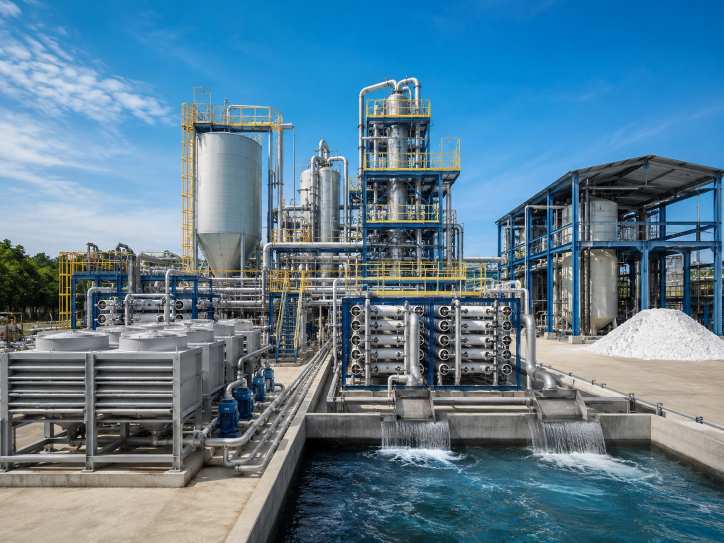
Brine is water with a high concentration of dissolved salts primarily sodium chloride, but industrial brine often contains sulfates, heavy metals, calcium, magnesium, and traces of organic compounds depending on the source.
The general threshold is around 10,000 mg/L total dissolved solids (TDS), though industrial brine streams can run much higher. Seawater sits around 35,000 mg/L TDS by comparison. The brine coming off a reverse osmosis system in a manufacturing plant might range from 5,000 to 70,000 mg/L depending on the feed water quality and system recovery rate.
What matters practically is not just the salt content, but what else is in it because that determines which treatment routes are available and which are not.
Where Does Industrial Brine Come From?
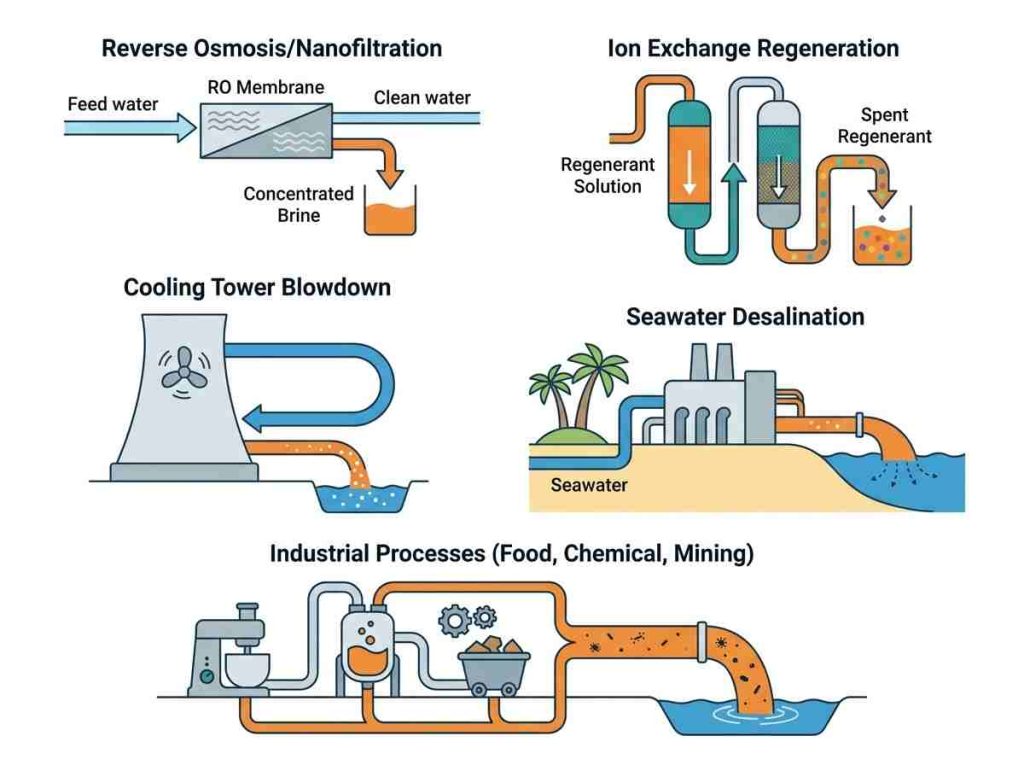
Most industrial facilities do not think of themselves as “producing brine,” but several common processes generate it as a concentrate stream:
Reverse osmosis and nanofiltration systems reject a portion of the incoming feed water as concentrate. Depending on system recovery, that concentrate can represent 20–30% of the total feed volume at significantly elevated TDS levels.
Ion exchange resin regeneration produces a high-salinity spent regenerant after the resin is flushed with brine or caustic solution to restore its capacity. This is one of the more chemically complex brine streams.
Cooling tower blowdown, particularly in systems running at high cycles of concentration, accumulates dissolved solids over time and must be partially discharged to prevent scaling and corrosion.
Seawater desalination produces large volumes of concentrate that must be managed carefully, especially in coastal discharge scenarios.
Food processing, chemical manufacturing, and mining operations also generate brine as part of their core processes often with additional organic or heavy metal contamination that complicates disposal.
Why Brine Waste Cannot Be Ignored
The short answer is environmental regulation, but that is only part of it.
Discharging untreated high-salinity wastewater into surface water bodies causes measurable damage to aquatic ecosystems. The US EPA’s effluent guidelines place limits on TDS and specific ion concentrations for most industrial categories. In the EU, the Industrial Emissions Directive similarly restricts what facilities can discharge. Many regions are tightening these standards, not loosening them.
Beyond compliance, there is a water cost argument. Facilities in water-stressed regions are increasingly treating brine not as waste to dispose of, but as a resource to recover clean water from. The economics depend on local water prices and discharge fees, but in many cases, investing in brine treatment pays back over time.
Main Brine Water Treatment Processes
There is no single brine treatment method that works for every situation. Most systems use a combination of technologies staged in sequence.
Pretreatment and Softening
Before any concentration or membrane process, brine typically needs pretreatment to remove hardness ions, suspended solids, and silica. Scaling is the main risk in downstream equipment — calcium carbonate and calcium sulfate can foul membranes and heat transfer surfaces quickly if not addressed upfront. Lime softening, antiscalant dosing, and multimedia filtration are common at this stage.
Membrane Concentration (High-Pressure RO / NF)
Standard reverse osmosis operates up to around 1,000 psi. For brine concentration beyond what conventional RO can handle, high-pressure RO systems or specialized membranes can push recovery further, recovering additional clean water from what would otherwise be waste concentrate. This step is often the first line of brine volume reduction before more energy-intensive processes.
Evaporation and Crystallization
When brine concentration reaches levels where membranes are no longer effective, thermal evaporation takes over. Mechanical vapor recompression (MVR) evaporators and multi-effect evaporators concentrate the brine to near-saturation, and crystallizers then drive it to solid salt. This is the core technology behind zero liquid discharge (ZLD) systems where the end goal is no liquid discharge at all, only recoverable water and solid waste.
ZLD is expensive to build and run, but for facilities under strict discharge regulations or in water-scarce locations, it is often the only viable path.
Ion Exchange for Brine Polishing
In cases where brine is being reclaimed for reuse either back into the process or as utility water, ion exchange can be used as a polishing step to remove specific ions that membranes cannot fully address. This is particularly relevant for brine streams that need to meet tight purity specs before reuse.
Biological Treatment for Organic-Laden Brine
Some industrial brine streams, particularly from food processing or pharmaceutical manufacturing, carry significant organic loads alongside high salt concentrations. Standard biological treatment struggles at high salinity, but halophilic bacteria and membrane bioreactor (MBR) configurations adapted for saline conditions can handle this combination. The biology needs to be matched to the salt concentration, which requires proper system design from the outset.
Brine Disposal Options When Treatment Is Not the Goal
Not every facility needs to recover water from brine. Where volume is manageable and regulations allow, disposal options include:
Discharge to municipal sewer systems, subject to local pretreatment requirements. Most utilities set TDS limits and may charge surcharges above certain thresholds.
Deep well injection involves pumping brine into underground geological formations. It is regulated under the US EPA Underground Injection Control program and is only viable where suitable geology exists.
Evaporation ponds are used in arid regions with available land. The brine is held in lined ponds and allowed to evaporate, leaving behind salt residue. Long-term management of the accumulated solids is a factor.
Recovered salt for industrial use is possible when brine quality is consistent and the salt purity meets end-user specifications. Industrial-grade sodium chloride from crystallization has commercial markets in chemical production and water softening.
Each option has regulatory, geographic, and cost constraints. What works in Nevada may not be permitted in Germany.
Can Brine Water Be Reused?
Yes but only under the right conditions.
The feasibility of reuse depends on what is in the brine, not just how salty it is. Ion exchange regenerant brine containing heavy metals, for example, has a much narrower set of reuse options than clean RO concentrate from a drinking water plant.
Where reuse is viable, common applications include:
- Process water in chemical manufacturing, where salt concentration is actually a feedstock requirement
- Road de-icing, where municipalities or contractors can use brine solutions directly as liquid anti-icing agents
- Cooling tower makeup water, after appropriate treatment to bring TDS within acceptable operating range
In a ZLD framework, brine is not reused directly — instead, clean water is recovered from it and returned to the process, while solids are disposed of separately. This is a different concept from brine reuse, but achieves the same operational goal of minimizing fresh water consumption. Molewater’s wastewater treatment systems are designed with this kind of closed-loop operation in mind.
What Brine Treatment Actually Costs
Cost depends on four variables: brine volume, TDS concentration, target outcome, and technology choice.
As a rough frame of reference:
- Membrane-based brine concentration systems (high-pressure RO) typically range from low six figures to mid six figures USD for industrial scale, depending on capacity and feed conditions.
- Evaporation and crystallization systems start in the high six figures and can reach several million USD for ZLD-grade installations. Operating costs are also significantly higher due to energy consumption.
- Biological treatment additions for organic-laden brine add cost depending on whether an existing biological system can be adapted or a new one is required.
The lowest-cost option is often not the best long-term choice. A facility that pays low disposal fees now may face much higher costs if discharge regulations change.
Molewater Help You to Choose the Right Brine Treatment Approach
Where facilities often go wrong is skipping the characterization step and selecting equipment based on a partial picture of the problem. Brine composition varies significantly between industries and even between processes within the same facility, and a system designed for one type of brine may underperform or fail on another.
Molewater designs brine treatment and wastewater systems based on site-specific water analysis, not standard configurations. If you are evaluating options for your facility, the starting point is a water quality assessment: Contact the Molewater team to discuss your brine stream and what treatment approach fits your operational and regulatory situation.