
As global water shortage keeps getting worse, the chance to change ocean reserves into safe for drinking water has moved from a far-out idea into something that’s now a necessary industrial and municipal practice. Seawater desalination, especially using modern Reverse Osmosis (RO) systems, provides a climate-ready option for coastal areas, offshore platforms, and water strained businesses. It works by using high pressure membrane separation, which means the setup can deliver steady, good quality water even when seasonal rainfall goes down or doesn’t really show up.
What Is Seawater Desalination?
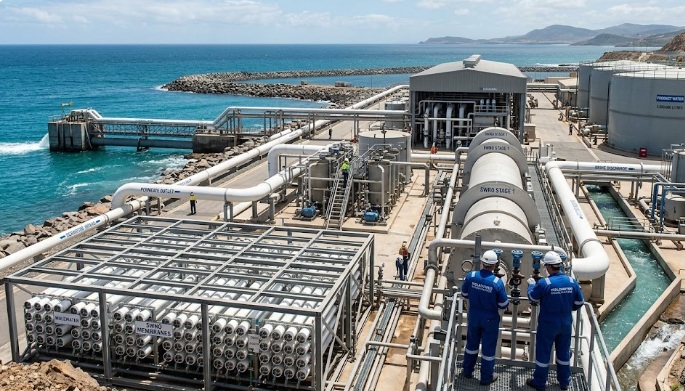
Seawater desalination, is basically a physical process that strips away dissolved salts and minerals from salty ocean water. In nature, water gets desalted kind of indirectly, via the hydrological cycle—mostly evaporation and then later precipitation— but industrial desalination systems sort of speed that up, so you can get a steady, localized water supply, when and where it’s needed.
Seawater Reverse Osmosis (SWRO) is currently the most efficient and cost-effective method currently utilized. This technology employs high-pressure pumps to force seawater through a semipermeable membrane at high pressure; as water molecules pass through this barrier, salt ions, bacteria, and contaminants are blocked off and diverted off, leaving behind high purity permeate behind.
Understanding Desalination Technologies
Different desalination methods cater to specific operational needs. This table compares the most popular methods to help users determine the most efficient method:
| Technology | Best For | Energy Efficiency | Maintenance Level | Key Advantage |
| Reverse Osmosis (RO) | Municipal, Industrial, Marine | Very High | Low | Modular, Fast, Scalable |
| Multi-Stage Flash (MSF) | Large Thermal Power Plants | Moderate | High | Controls surges of high salinity |
| Multi-Effect Distillation (MED) | Low-cost Energy Regions | Moderate | Medium | Low operation cost, stable output with mild salinity water |
How Does a Seawater Desalination System Work?
Professional-grade desalination systems are an engineered combination of many crucial stages, each of which is designed to last and ensure high-quality output:
- Treatment prior to treatment (The Foundation): Seawater is a mixture of sand, algae, along with organic matter. Ultrafiltration and multi-media filters are used to avoid “membrane fouling”–the most common reason for performance decline.
- High Pressure Pumping: In order to counter the pressure of seawater’s osmotic (approx. 355,000ppm TDS) High-pressure pumps push the water through RO membranes.
- Reverse Osmosis (The Core): This is the process that causes separation. Quality of membranes and Pressure calibration are the main factors that determine purity of water.
- Post-treatment (Quality assurance): This is when the water is remineralized, pH-adjusted and re-mine to ensure that it complies with international standards for drinking water.
Why Choose Advanced Desalination Solutions?
For municipal and industrial planners, an approach to water desalination has substantial advantages over traditional sources of water:
| Feature | Traditional Water Sources | Molewater Desalination Systems |
| Reliability | Susceptible to drought and weather | Climate-independent, 24/7 supply |
| Resource Access | Geographical restrictions | Infinite supply for coastal regions |
| Water Quality | Environmental pollution | RO-controlled, High-purity output |
| Strategy | Dependent on grids from outside | Operational autonomy and security |
Key Applications Across Industries
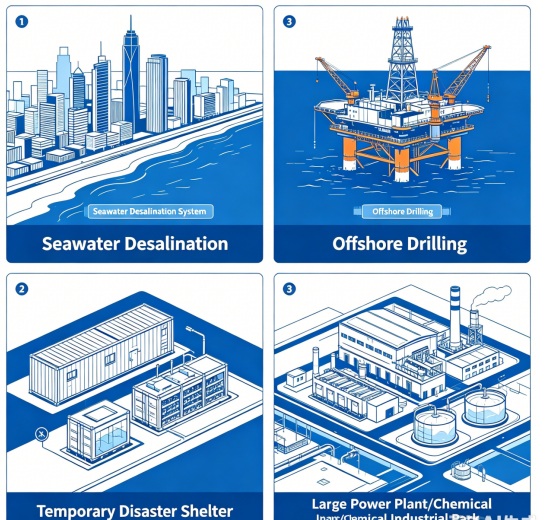
The capacity and flexibility of the modern seawater desalination system have turned them from specialist equipment to a vital infrastructure for different sectors. Through providing a reliable quality, high-quality water supply these systems serve as an important protection against water shortages or environmental instability.
Municipal Water Supply and Coastal Development
Coastal cities that are growing fast and losing freshwater sources, kind of have a problem that does not wait. In that situation, desalination is not really a luxury anymore, it is more like a strategic must. By drawing on what the ocean can provide almost endlessly, municipalities can steer away from the troubles that come with drought-hit surface reservoirs, and also from depleted aquifers. In practice, this supports steady population growth, and lets economic development keep moving in dry regions, so that households and businesses still get safe, potable water, and it keeps in line with international health standards that are strictly followed.
Offshore and Marine Industry
Self sufficiency, well that is basically the safety foundation in the offshore world. For oil rigs, deep sea drilling setups, and long haul commercial vessels, depending on water shipments is not only hard to manage logistically, but it is also risky during operations. That’s why integrated desalination systems show up, because they can furnish these remote locations with a steady water supply for crew use, and for critical machinery work too. This reduces chain dependencies , and it also improves emergency readiness when conditions turn bad.
Emergency Response & Disaster Relief
When natural disasters strike the coastal zone municipal water infrastructures are usually the first thing to fail. Containerized, modular desalination units are a lifeline in these situations. They are able to be deployed quickly in a matter of minutes and “plug-and-play,” they can supply life-sustaining fresh water to the displaced population within hours of arriving to bridge any gap that may exist until a permanent system is rebuilt.
High-Performance Industrial Processes
Many industrial manufacturing sectors–particularly power plants and chemical processing facilities–require water of extreme purity for cooling towers, high-pressure boilers, and specialized production lines. Water sources that are conventional usually contain contaminants or minerals which cause scale build-up and corrosion of the hardware. High-precision systems for desalination provide pure feed water needed to improve the efficiency of equipment decrease maintenance frequency and safeguard the enormous capital investments that are associated with heavy industrial machines.
Addressing Challenges: Maintenance and Sustainability
Desalination is an essential solution, it is under scrutiny in relation to energy consumption as well as environmental impacts. Modern engineering has successfully addressed these issues. The incorporation with Energy Recovery Devices (ERDs) has revolutionized the process of capturing the hydraulic energy from the high pressure concentrate stream to pre-pressurize seawater that is incoming and thereby reducing energy consumption by 50% over the past decade.
Additionally, environmental protection is emphasized through the use of advanced techniques for managing the brinestrategies. Through the use of intelligent, high-velocity diffusers, systems guarantee the rapid dispersion of concentrates into the ocean, reducing the localized spikes in salinity and protecting fragile marine ecosystems and ensuring the long-term efficiency of operations.
A Future of Water Security
Seawater desalination has become more than just a flimsy option but is now an essential component of the worldwide water strategies. As technology improves towards greater energy efficiency and more efficient membranes, the barriers to entry into high-quality water production is decreasing. If you’re trying to address water shortages in a municipal area or ensuring the continuity of operations on a offshore location A robust desalination system ensures the stability that modern-day operations require.
Are you seeking an environmentally sustainable water solution that is that is specifically tailored to your particular environment? Get in touch with Molewater now for a thorough consultation and design proposals. We can help you turn the ocean into a reliable asset.