Industrial facilities are being put under increasing pressure to make more from less water. Industries’ freshwater withdrawals comprise about five percent of all consumption. This percentage is growing because power generation, manufacturing and semiconductor production grow up around the world. In the meantime, discharge regulations are becoming more strict and the costs for water continue to rise. In this climate, clarified water has been gaining popularity as one of the efficient plants that can pull, not as a product in the end but rather as the basis that makes each downstream water process more affordable, cleaner and more environmentally sustainable.
What Is Clarified Water?
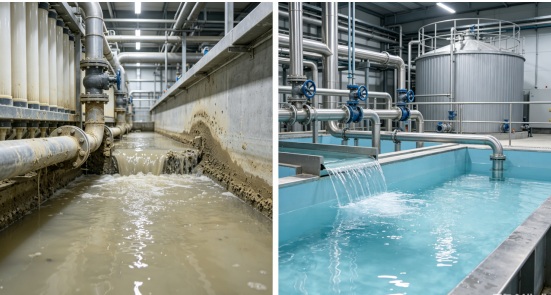
Clear water means that it has been put through a process of clarification to get rid of suspended solids, sediments and particles, usually with the aid of flocculants and coagulants that make fine particles form a clump and then settle out. This results in a cleaner and less turbulent drinking water source that’s now ready to be treated further or, in some instances directly discharge.
Clarified water should be distinguished from other terms that are commonly used. Water that has been purified has gone across a physical obstacle, such as membrane media or sand. The purified water has been through more complex processes like reverse osmosis or deionization in order to get rid of dissolved ions as well as pollutants. Clarified water is placed prior to the treatment train as an initial step in the process and not a final step. In the majority of industrial processes the water is first clarified followed by purification or filtering.
Clarified water is typically made in 3 different settings: municipal water treatment plants, making the raw surface water needed to produce drinking water; industrial facilities that pretreat cooling or process water and wastewater treatment plants that are preparing effluent to be discharged or reused.
How a Clarifier Works in Water Treatment
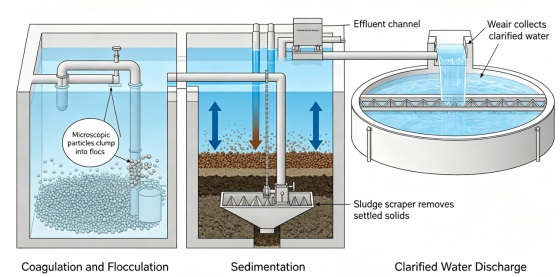
A clarifier is the equipment that performs this separation, usually a circular or rectangular tank designed to let gravity do the work. The process generally follows three stages.
Raw water often has particles so tiny they just don’t want to settle by themselves, like they’re stuck in suspension or something. Coagulant chemicals neutralize the electrical charges that normally keep those particles afloat, and then the particles can bind together, sort of clump up. After that, flocculants help the little clumps grow, and they become larger, more weighty “flocs” which settle a lot easier.
Sedimentation and Solids Separation
Once the flocs are made, the water is sent into the clarifier’s settling area. There, the heavier stuff drops toward the bottom and ends up as a sludge layer. Mechanical scrapers or collection arms keep clearing the sludge out , meanwhile any lighter floating material is skimmed off from the top.
Clarified Water Discharge or Reuse
The clarified water rises to the top of the tank and flows over a weir into an effluent channel, ready for the next treatment stage — whether that’s disinfection, filtration, reverse osmosis, or direct discharge under permit.
Design variations exist to fit different site constraints. Lamella (inclined plate) clarifiers use stacked plates to increase settling surface area within a smaller footprint, which is increasingly attractive for facilities with limited space. Dissolved air flotation (DAF) systems , on the other hand , work with micro-bubbles to lift lighter nasties like oils and greases up to the surface, instead of letting them settle down. In one sort of industry comparison, DAF systems got about 95% removal of oils and greases in food processing wastewater, while a conventional clarifier was more like 70% on the same kind of flow. Which method is “right” really depends a lot on the actual characteristics of the water you’re treating.
Why Clarified Water Is Central to Sustainable Water Management
Clarification might look like a routine pretreatment step, but its downstream impact on sustainability is significant.
Reducing Freshwater Intake Through Water Reuse
Clarified water is much easier to recycle into process loops, such as washing down operations, cooling towers and boiler feed system decreasing the dependency of a facility on the withdrawal of freshwater. As the water shortage increases in industrial areas the reuse potential shifts from a cost-saving option to an essential operational requirement.
Lowering Energy and Chemical Consumption Downstream
Every membrane or ion exchange device that is exposed to water that is not clear is more prone to fouling and wears out more quickly. Reverse osmosis membranes in particular, are particularly vulnerable to suspended solids as well as fouling by colloidal. A clear upstream process decreases frequency for membrane cleansing, prolongs the lifespan of equipment and decreases the chemical and energy dosing needed in later stages an immediate efficiency boost that can be attributed to the entire treatment process.
Minimizing Sludge and Waste Footprint
The optimal coagulant dosage and settling designs reduce the amount of sludge produced per liter of treated water This in turn decreases costs for disposal and the environmental burden that comes with handling sludge, an area that is increasingly scrutinized as part of a facility’s environmental footprint.
Supporting Regulatory Compliance and ESG Reporting
Clarified water that is consistent helps businesses to remain within the limits of discharge permits for turbidity as well as all suspended solids. This helps in which reduces the chance of committing violations. Additionally, it provides measurable performance data that bolsters ESG disclosures that are now the norm for industrial enterprises, specifically those that are in regulated industries like food production and pharmaceuticals.
Clarified Water in Different Industries
Clarification requirements vary considerably by sector:
- Pharmaceutical and healthcare — clarified water as the essential first stage before purified water and water-for-injection systems, where downstream water quality is tightly regulated.
- Semiconductors and microelectronics — pretreatment ahead of ultrapure water systems, where even trace particulate contamination can affect yield.
- Food and beverage — removal of organic solids and oils before discharge or reuse, often favoring DAF-based approaches.
- Power generation — pretreatment of cooling and boiler feed water to reduce scaling and fouling.
- Municipal and industrial wastewater — a core step before water can be safely discharged or reclaimed.
Choosing the Right Clarification Technology
There is no single “best” clarifier — the right technology depends on influent water quality, available footprint, and the treatment goals downstream.
| Technology | Best suited for | Footprint | Relative operating cost |
| Conventional gravity clarifier | High solids loading, stable flow | Large | Low |
| Lamella (inclined plate) clarifier | Space-constrained sites | Compact | Moderate |
| Dissolved air flotation (DAF) | High oil/grease content | Compact | Higher (energy, moving parts) |
A facility that deals with heavy sediment loads from raw surface water will usually lean toward a conventional or lamella clarifier, while a place that’s sorting oily wastewater from food work or metal processing is often better matched to DAF. A lot of the time, the most sustainable end result comes from syncing— or even blending— the techniques to what’s actually in the water, and not just defaulting to some “one size” standard design.
Clarified water doesn’t get the same buzz that reverse osmosis or zero-liquid-discharge systems get, but it’s that clarifier step that basically decides how well everything downstream will behave. If the clarification is done right, the site can reduce freshwater intake, cut back on energy and chemical usage, create less sludge, and still stay comfortably within regulatory bounds. For industrial teams aiming at real, trackable sustainability targets, the practical route forward often begins by getting this first stage.