Drop a block of carbon into polluted water, and miraculously the chlorine smell, color change and taste improve instantly. Although this transformation seems too good to be true, activated carbon water treatment is one of the world’s most widely researched and utilized purification methods – with precise physical processes called adsorption being behind its effectiveness. Let’s look at the process of activated carbon as well as what it can and cannot take away and how it can be integrated into real industrial wastewater treatment processes.
What Is Activated Carbon?
Activated carbon is a very porous form of carbon made from carbon-rich starting materials—often coal, coconut shells, or wood— then processed by a controlled heating procedure. What truly separates it from ordinary charcoal is that extra “activation” step, where the carbon is treated with steam or chemical agents at high temperatures. This basically removes a lot of those impurities, and at the same time it helps open up a huge inner maze of pores.
It’s a substance that has an incredible amount of internal surface. One gram of activated carbon could contain an internal surface of between 500 and 1500 square meters, similar to tennis courts that are folded into a substance that you can hold in your hands. This huge size is base of how activated Carbon is used to treat water.
The Core Mechanism: How Activated Carbon Works
Adsorption, Not Absorption
A common mixup is thinking activated carbon works like a sponge, soaking up contaminants the way a towel absorbs water. But really, activated carbon depends on adsorption — a surface kind of thing where the contaminant molecules kind of cling to the carbon’s internal pore walls, instead of being pulled into the material itself. That difference matters too: absorption tends to fill up a substance’s volume, while adsorption gets capped by the available surface area, and that’s exactly why all that huge internal surface area is such a big deal.
The Role of Pore Structure
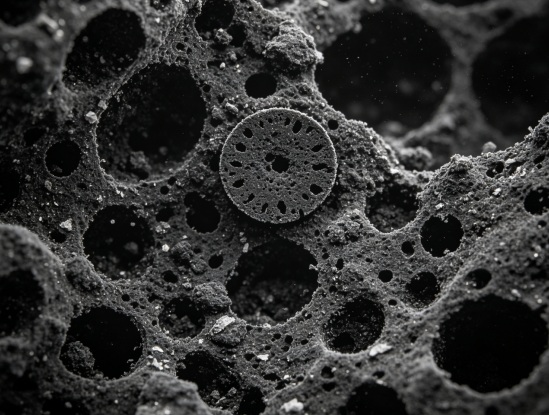
Not all pores in activated carbon are exactly the same size, and that part matters a lot for what it can sort of capture. In general, pores get grouped into micropores (anything under 2 nanometers), mesopores (2–50 nanometers), and macropores (above 50 nanometers). The tiny micropores usually dominate the internal surface area, and they’re really good for grabbing the smaller organic molecules that cause taste, odor,and color. Meanwhile the larger mesopores and macropores tend to work more like highways or transport channels, so water plus contaminant molecules can move through faster, and then reach the micropore network efficiently.
Van der Waals Forces and Chemical Bonding
On a molecular level the capture of contaminants occurs through an array of van der Waals forces – which are weak, but powerful attractive forces that are cumulative between molecules in certain instances chemical interaction between the contaminants and functional groups that are on the carbon’s surface. Since these forces of attraction act across the entire carbon pores at once and simultaneously, the result is reflected across billions of pores and allows even trace amounts of contaminants to be effectively absorbed when water moves through the carbon.
What Contaminants Can Activated Carbon Remove?
Understanding the range of activation for activated carbon is as important as knowing what the process is.
It is effectively removed:
- Chloramines and residual chlorine employed for disinfection
- Organic compounds that cause odor and taste compounds
- Organic compounds that are volatile (VOCs)
- A variety of synthetic organic chemicals as well as certain residues of pesticides
Ineffective or limited against:
- Dissolved organic salts and minerals (hardness, sodium, nitrates)
- Ions of heavy metals are common in conventional configurations
- Bacteria, viruses, as well as other microorganisms
This is an important issue: activated Carbon is not a stand-alone disinfection product. This is the reason activated carbon is typically utilized in conjunction with other treatment processes (such as reverse Osmosis (RO) and ultrafiltration instead of as the sole treatment option in complete water systems.
How Activated Carbon Is Used in Industrial Water Treatment Systems
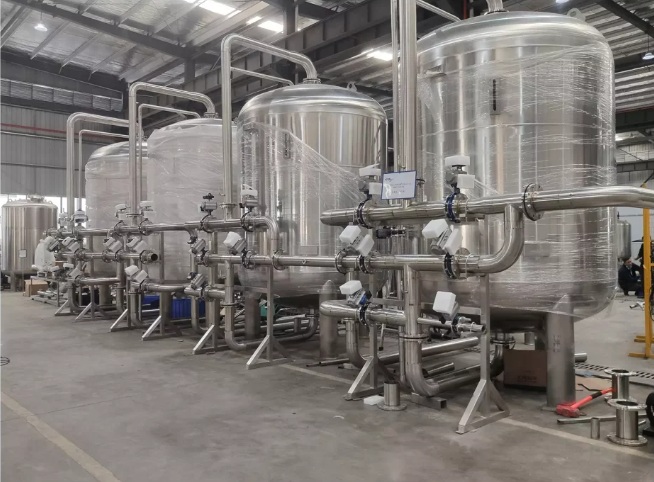
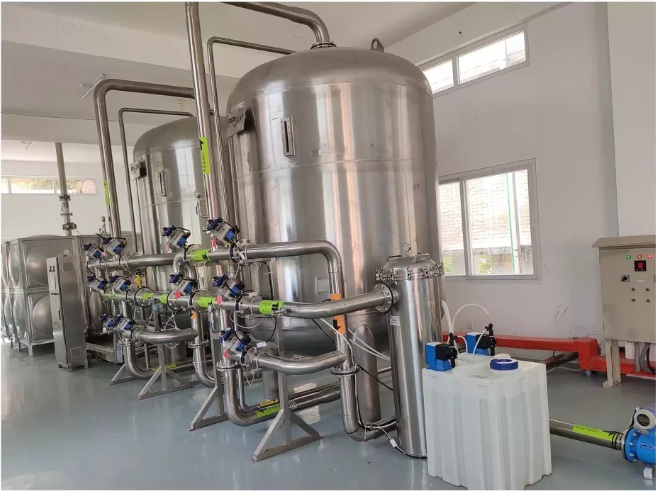
In the industrial-scale water treatment process, activated carbon usually acts as a pretreatment step rather than as a barrier to the end. A typical configuration combines an MMF (MMF) which eliminates suspended solids by layering anthracite and quartz sand, and the activated carbon filter (ACF) placed immediately following it.
This sequence is based on reasons of engineering that are specific reverse membranes that osmosis downstream are susceptible to damage caused by oxidation from chlorine residual. By removing organic compounds and chlorine from the water prior to it getting to the RO membrane, activated carbon filtration ensures membrane integrity and increases its lifespan. Systems that are based on this idea typically manage flows of between 1 and 200 tons/hour with automatic backwash cycles that keep the filtration process consistent without any manual intervention — an aspect that is vitally important for facilities operating in continuous production.
Granular Activated Carbon (GAC) vs. Powdered Activated Carbon (PAC)
Activated carbon comes in two different physical forms, both suited to various applications. Granular activated Carbon (GAC) comprises larger particles that are packed into filter vessels with fixed beds that are well-suited to continuous-flow municipal and industrial water treatment systems, where water flows through a solid carbon bed over a long period of time. Pulsed activated carbon (PAC) is, in contrast, is composed of smaller particles, which are usually injected directly into water to treat batches that is ideal for emergency water contamination or other situations that require immediate temporary treatment instead of an indefinite filtering system.
Maintenance: How Long Does Activated Carbon Last?
Activated carbon isn’t a permanent solution. When pores are occupied with adsorbents for contaminants as time passes The material’s capacity gradually diminishes until it reaches saturation, at which point it will not effectively absorb new contaminants. In the majority of industrial filtering systems activated carbon is replaced approximately each 2 to 3 years. However, the their actual lifespan is dependent on the quality of water, the contaminants, and the flow rate. The most common indicators that a replacement is required include return of chlorine’s odor and taste or noticeable drop in downstream water quality — both of which indicate that the carbon bed is at its adsorption limits.
Activated carbon’s efficiency is due to a single principle that is used on a large scale: an incomparable surface area that allows contaminant molecules to go rather than stick. The concept of the importance of adsorption over filtration, and of pore structure over brute force, clarifies why activated carbon remains a fundamental pretreatment process in industrial water treatment systems, specifically prior to reverse osmosis. If you’re considering the possibility of a multi-media activated carbon filtering system for your industrial use, knowing this mechanism is the initial step towards determining the best system for your water quality and flow needs.