Cooling towers lose water constantly through evaporation that’s the whole point. But as water evaporates, everything dissolved in it stays behind. Minerals concentrate. pH shifts. And given the right temperature and nutrient conditions, microorganisms find an ideal place to grow.
Left unmanaged, these three problems — scaling, corrosion, and biological fouling — quietly erode system performance until you’re dealing with blocked heat exchangers, corroded pipework, or an unplanned shutdown. Chemical treatment is what keeps that from happening. But not all chemicals work the same way, and using the wrong program for your water conditions can be just as costly as using none at all.
This guide covers the main chemical categories used in cooling tower water treatment, how each one works, and what actually determines which program is right for a given facility.
Why Chemical Treatment Is Central to Cooling Tower Performance
When water evaporates from a cooling tower, the dissolved minerals don’t go with it. They stay in the recirculating water and build up with every cycle. This is what’s referred to as the concentration effect and it’s the root cause of most water chemistry problems in cooling systems.
The higher your cycles of concentration (COC), the more concentrated the water becomes relative to the original makeup water supply. At some point, minerals like calcium carbonate exceed their solubility limits and start precipitating onto surfaces. At the same time, fluctuating pH levels create conditions favorable for corrosion and microbial growth. A well-designed chemical treatment program manages all three risks simultaneously.
The Three Problems Chemical Treatment Must Solve
Before choosing specific chemicals, it helps to understand the problems they’re addressing. Most cooling tower water issues trace back to one of these:
Scaling happens when dissolved minerals, primarily calcium carbonate, calcium sulfate, and silica, precipitate out of solution and deposit on heat exchanger surfaces and tower fill. Even a thin scale layer significantly reduces heat transfer efficiency, driving up energy costs. The Langelier Saturation Index (LSI) is a standard tool for predicting calcium carbonate scaling tendency based on pH, temperature, alkalinity, and hardness.
Corrosion is an electrochemical process that degrades metal surfaces over time. In cooling systems, it’s accelerated by low pH, dissolved oxygen, chloride ions, and the presence of dissimilar metals. The type of metals in the system matters considerably, because different metals corrode through different mechanisms and require different inhibitors.
Microbiological fouling is often underestimated. Warm, aerated water with a steady supply of nutrients is exactly what bacteria, algae, and fungi need to thrive. Biofilm, the layer that microorganisms form on wetted surfaces, doesn’t just cause fouling on its own. It also accelerates corrosion underneath it and insulates scale deposits, making both problems harder to treat. Controlling biological activity is not optional in an open recirculating system.
Scale Inhibitors
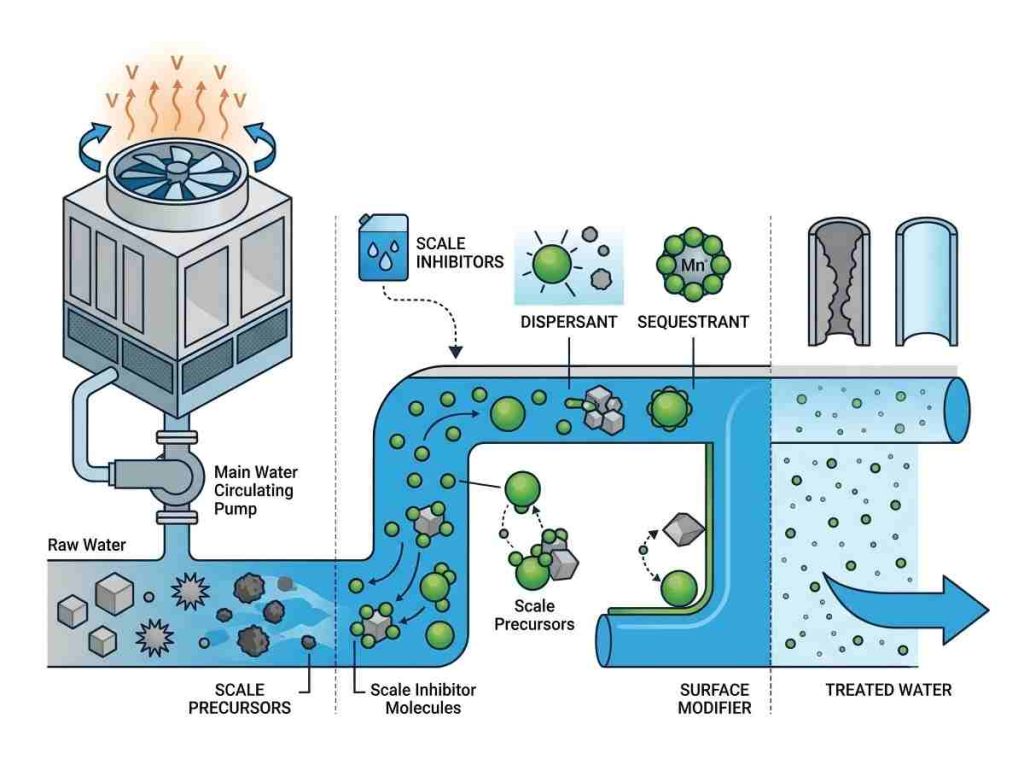
Scale inhibitors work by either preventing minerals from precipitating or keeping them dispersed in solution so they don’t adhere to surfaces. The main categories are:
- Phosphonates (such as HEDP and ATMP) are the most widely used scale inhibitors in industrial cooling water. They’re effective at low doses, work well across a broad pH range, and provide some corrosion inhibition as a secondary benefit. One limitation: at higher temperatures, phosphonates can hydrolyze and lose effectiveness, which matters in high-temperature process cooling applications.
- Polymeric dispersants (polyacrylates and maleic acid copolymers) don’t prevent precipitation directly but keep mineral particles suspended in the water rather than depositing on surfaces. They’re particularly effective for silica control and for systems with high hardness levels where phosphonates alone aren’t enough.
Selecting the right scale inhibitor comes down to the source water analysis: hardness, alkalinity, silica levels, operating temperature, and the target COC. A program that works well on low-hardness municipal water may perform poorly on well water with high calcium and silica content.
Corrosion Inhibitors
Corrosion inhibitors form a thin protective film on metal surfaces, interrupting the electrochemical reactions that cause deterioration. The right choice depends heavily on what metals are present in the system.
- Zinc salts are cost-effective and widely used for carbon steel protection. They work by forming a zinc hydroxide film at cathodic sites. However, zinc is regulated as an aquatic pollutant in many jurisdictions, so discharge limits need to be checked before specifying a zinc-based program.
- Molybdates are a lower-toxicity alternative to zinc, often used in environmentally sensitive applications. They provide anodic protection and are effective across a wide pH range, though they tend to be more expensive.
- Azoles (benzotriazole (BZT) and tolyltriazole (TT) )are specifically formulated for copper and copper alloy protection. Most cooling systems that include copper components (heat exchangers, condensers) will require an azole as part of the treatment program.
It’s worth noting that chromate-based corrosion inhibitors, once the industry standard, have been phased out of open recirculating systems due to hexavalent chromium toxicity. Today’s programs are typically built around phosphate-phosphonate blends or molybdate formulations, which provide comparable protection without the environmental and regulatory risks.
Biocides
Biocide selection is where many treatment programs fall short. The tendency is to rely on a single oxidizing biocide usually chlorine and assume it handles microbial control. In practice, that’s rarely sufficient.
- Oxidizing biocides like chlorine, bromine, and chlorine dioxide act quickly and are effective against planktonic (free-floating) bacteria. But their performance is pH-dependent. Chlorine, for instance, exists predominantly as hypochlorous acid (HOCl) at pH below 7.5 — the form that actually kills microbes. Above that pH, it shifts toward hypochlorite ion (OCl⁻), which is significantly less effective. Most modern cooling water programs run at pH 8.0–8.5 to control scaling, which means chlorine efficacy is already compromised by design. Bromine maintains better biocidal activity at higher pH, which is one reason it’s increasingly preferred over chlorine in industrial cooling applications.
- Non-oxidizing biocides — glutaraldehyde, isothiazolinone (DBNPA), and quaternary ammonium compounds — work through a different mechanism and are better at penetrating and disrupting established biofilm. This is important because once a biofilm forms, oxidizing biocides have difficulty reaching the organisms protected underneath it.
The standard practice is to use both: a continuous or intermittent oxidizing biocide for general microbial control, supplemented with periodic non-oxidizing biocide slugs to address biofilm and prevent resistance from developing.
Legionella Control
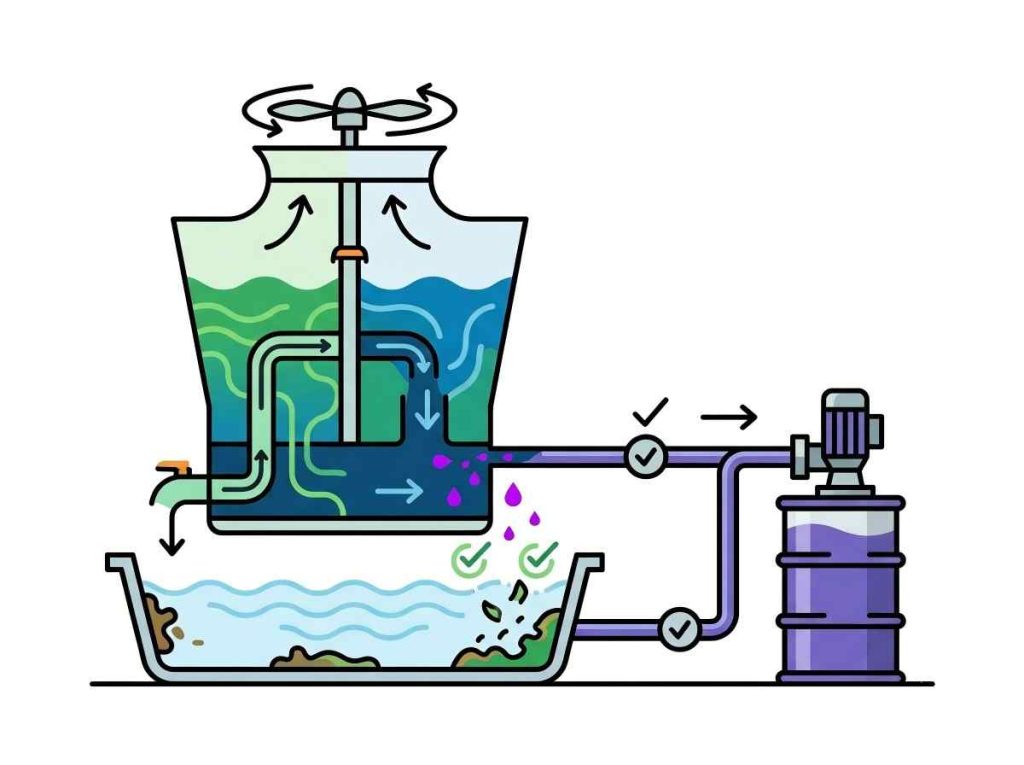
Cooling towers are among the highest-risk environments for Legionella pneumophila, the bacterium responsible for Legionnaires’ disease. Warm water temperatures, aerosol generation, and the potential for biofilm accumulation create conditions where the organism can multiply rapidly.
ASHRAE Standard 188 requires facilities to implement a water management program (WMP) that includes risk assessment, control measures, and ongoing monitoring. In the EU, VDI 2047 Part 2 sets equivalent requirements for cooling tower operators. Chemical treatment specifically biocide selection and dosing is a central component of any compliant WMP, but it doesn’t stand alone. It needs to be paired with system design measures (eliminating dead legs, maintaining appropriate blowdown) and regular microbiological monitoring.
Facilities that are subject to these regulations, and in most jurisdictions, commercial and industrial cooling tower operators are, should ensure their treatment program is documented and defensible, not just functional.
pH Adjusters and Supporting Chemicals
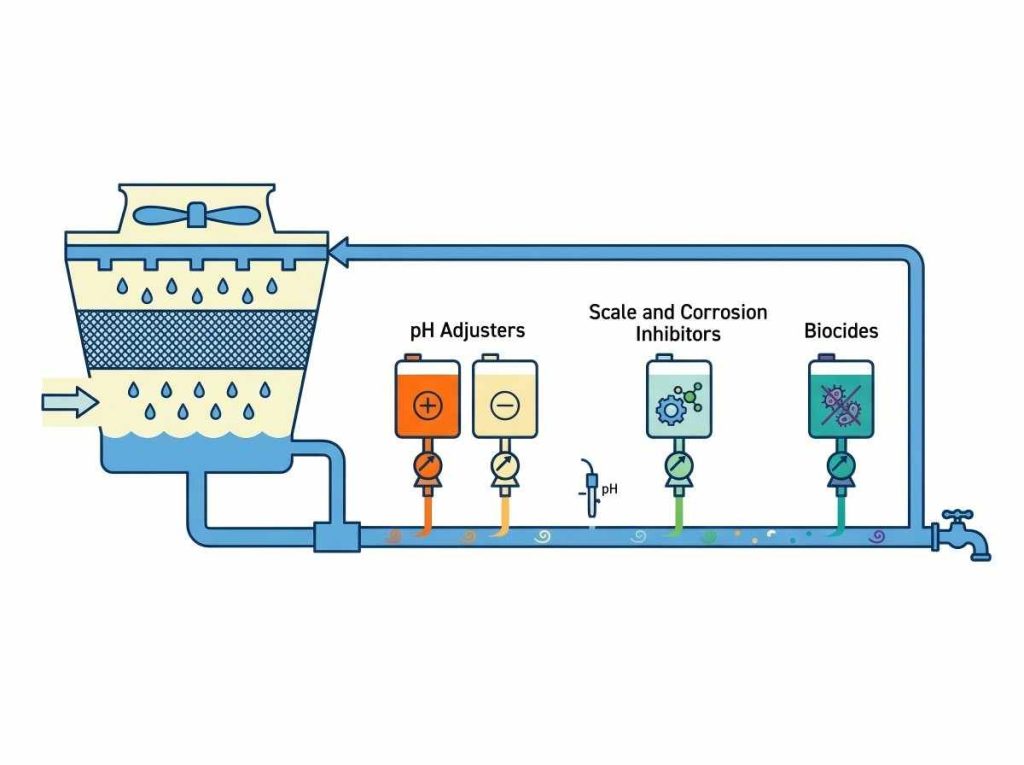
pH control underpins everything else in the treatment program. Most scale and corrosion inhibitors have a defined operating window typically pH 7.5 to 9.0, and biocide efficacy is directly tied to pH as discussed above.
Sulfuric acid is the most common pH adjustment chemical in cooling water, used to neutralize carbonate alkalinity and bring pH into the target range. It’s cost-effective and widely available. Hydrochloric acid works faster but is more corrosive to handle and to system components.
On the other side, sodium hydroxide is used when makeup water is acidic and pH needs to be raised. In practice, most open recirculating systems trend toward rising pH due to carbonate concentration, so acid addition is more commonly needed.
Antifoam agents are a supporting chemical that often gets overlooked until foaming becomes a visible problem. Surfactants from process contamination or certain biocide formulations can generate foam, which reduces heat transfer efficiency and increases drift losses. Antifoams are typically added reactively, but in systems prone to foaming, low-level continuous dosing is common.
How Chemical Treatment Integrates with Your Water Treatment System
Chemical dosing is most effective when it’s integrated with the broader water treatment system, not treated as a standalone fix. Upstream pretreatment (filtration, softening, RO for makeup water) reduces the chemical load the dosing program has to manage. Automated monitoring and control systems, measuring pH, conductivity, ORP, and blowdown rates in real time, can ensure chemicals are dosed accurately rather than on a fixed schedule that doesn’t account for changing conditions.
The relationship works in both directions: better physical pretreatment means lower chemical consumption, and a well-calibrated chemical program extends the service life of filtration media and membranes downstream.
If you’re reviewing or designing a cooling tower water treatment program, contact our engineering team for a system assessment.