
If you’ve tested your water recently and found that the TDS reading has increased in a sudden manner, then you’re not the only one— and honestly, you’re right to look for answers. A sudden increase in the total dissolved solids could indicate anything from runoff during the summer to a faulty filtering system.Let’s look at the most frequent causes of abrupt TDS rises, and how to determine if the issue is and what you can do to correct the issue for good.
Why TDS Levels Matter
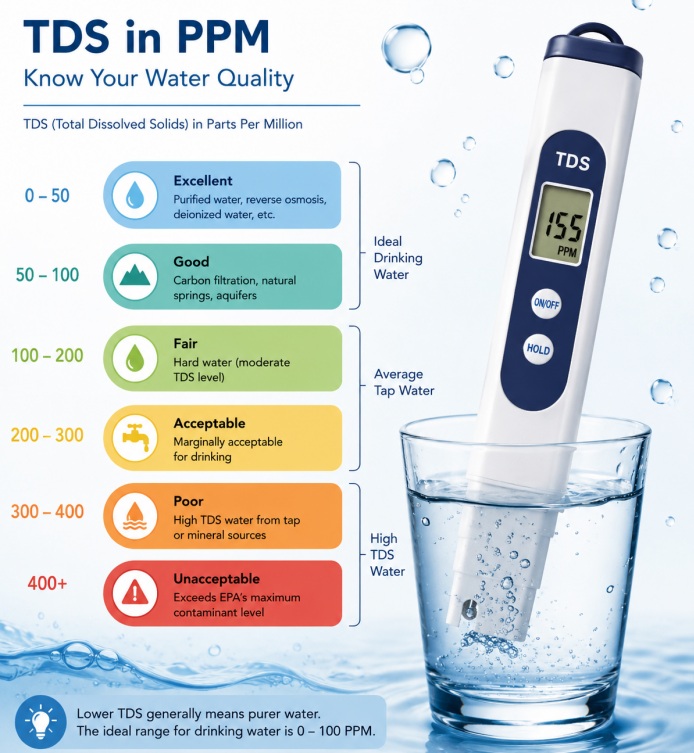
TDS, or total dissolving solids, is the term used to describe the total levels of inorganic salts organic matter and minerals that are dissolved in water, usually determined in milligrams of Liter (mg/L), also known as parts per million (ppm). Based on the U.S. Environmental Protection Agency, 500 mg/L is the preferred secondary standard for drinking water. The World Health Organization considers TDS levels of less than 300 mg/L to constitute “excellent” for palatability and general water quality.
It’s important to note that the presence of low TDS doesn’t mean that it’s better. Certain minerals in dissolved form are advantageous and can even be beneficial when it comes to drinking water. What’s more important is the stability. A sudden, unfathomable spike instead of the number that is baseline is typically an alarm, as it usually indicates an alteration in your water supply or the plumbing system, or equipment that requires investigation.
Common Causes of Sudden TDS Spikes
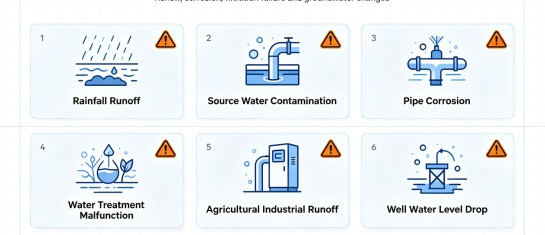
1. Seasonal Changes and Rainfall Runoff
When heavy rain or snowmelt hits, it drags minerals, fertilizers, and fine soil crumbs from adjacent land into the local water body. This is one of the most usual causes of seasonal TDS changes, so it kind of explains why many facilities and homeowners get clearly higher numbers during wet seasons, or during that spring thaw stretch, compared to the drier months.
2. Source Water Contamination
Changes in the underlying water source — whether from nearby industrial discharge, agricultural runoff, or shifting groundwater conditions — can introduce new dissolved solids relatively quickly. Private wells are especially vulnerable, since they lack the large-scale filtration and blending that municipal systems typically provide.
3. Pipe and Plumbing Corrosion
Over the years, metal pipes do corrode, and in that process they can let go of iron , copper , zinc and other metallic ions right into the water supply. This is a pretty usual culprit in older buildings or industrial pipe networks , where internal corrosion sort of quietly ramps up with time. And then you might see a noticeable jump in TDS readings even if the source water hasnt changed at all.
4. Water Softener or Treatment System Malfunction
A water softener that is not functioning properly or a reverse Osmosis (RO) device is among the most often overlooked causes of a TDS rise. Leaks in the softener’s brine, exhaustion of resin or a damaged and fouled RO membrane could allow dissolved solids to flow through, which are normally eliminated. When it comes to industrial RO systems, specifically membrane scale or damaged seals are often detected first by a sudden increase in the permeate TDS, which is a clear indication that maintenance is due.
5. Industrial or Agricultural Runoff Nearby
Facilities located near industrial discharge points or farmland are particularly exposed to fertilizer and pesticide runoff seeping into groundwater. For industrial operations, this matters beyond water quality alone — unstable TDS levels can directly affect downstream production processes, equipment lifespan, and product consistency.
6. Well Water Fluctuations
Falling groundwater levels concentrate existing minerals, effectively raising TDS even without any new contamination source. Nearby construction, new well drilling, or aquifer disturbance can also disrupt the surrounding geology and trigger a sudden, measurable change in a well’s water chemistry.
How to Determine the Severity of a TDS Spike
Not every spike requires immediate action, but knowing where your number falls matters:
| TDS Level (ppm) | Water Quality Rating |
| Below 300 | Excellent |
| 300–600 | Good/Fair |
| 600–900 | Poor |
| Above 900 | Unacceptable for drinking |
These thresholds align with WHO water quality guidelines. A brief, short-lived increase after a storm event is usually less concerning than a level that stays elevated for days or weeks — the latter typically points to an ongoing systemic issue, such as equipment failure or persistent source contamination, rather than a one-time environmental event.
How to Test and Monitor TDS Levels Accurately
A precise monitoring system is what differentiates the false alarm from a real issue:
You should calibrate your TDS device regularly and make several readings at various times of the day. Then, you can average the results, rather than taking a single reading.
For industrial establishments Inline TDS monitoring is more reliable than spot-checks on a regular basis as it detects in-real-time changes and detects malfunctions in equipment before they get out of hand.
Keep a record of your observations over time. Data on trends makes it easier to link the spike to a particular occasion – such as a large rainstorm, a maintenance gap or seasonal shift instead of guessing after fact.
How to Fix and Prevent Sudden TDS Increases
The right fix depends on the root cause:
Source contamination – Upgrade or add the pre-filtration or sedimentation stage prior to the water is introduced into your main system.
Corrosion in pipes – Replace the aging pipework if possible or add corrosion inhibitors to stop metal leaching.
The RO softener is not working properly or the softener is malfunctioning. Make sure to schedule regular maintenance, repair worn resins and examine membranes for damage or scaling.
For industrial processes particularly, a well operating reverse osmosis system is the most complete and durable option, capable of eliminating more than 99% of the dissolved solids and maintaining the same quality of water regardless of sources of fluctuation. If your company is experiencing issues with frequent TDS instability, it might be worthwhile to consider if the filtration system you have in place is keeping up with the source of your water.
Sudden TDS spikes are pretty rarely caused by one single thing, more often it’s that a few overlapping influences sort of pile up together, like how the water source condition actually looks, how the infrastructure is aging, and how the treatment equipment performance is holding up. Regular testing, trend tracking, and a reliable filtration system are the most effective ways to keep TDS levels stable over the long term.
If your facility is experiencing ongoing TDS fluctuations, take a look at our Industrial Reverse Osmosis System to see how a properly designed RO solution can deliver consistent, reliable water quality.