Treating high-TDS water sounds uncomplicated until you really have to do it. When the quantity of dissolved solids exceeds a given threshold, the performance of conventional equipment starts to decline; membranes foul more quickly, energy consumption rises and the quality of the treated water may fall short of the required standard. Getting this wrong is expensive, especially for water sensitive enterprises such as pharmaceutical production, electricity generating, food processing and saltwater desalination.
In this article we discuss the challenges of high-TDS water treatment, why reverse osmosis is often the technology of choice, how different RO configurations match different TDS ranges, what to consider in system design and when a single RO stage is not enough.
What Challenges Does High-TDS Water Create?
High-TDS does not equal “more stuff in the water”. It influences how water reacts to treatment and how hard the equipment has to work. TDS stands for total dissolved solids which is the total quantity of dissolved ions, salts, minerals and metals in the water. Many industrial water sources have TDS values more than 1,000 mg/L and require specific treatment technologies.
Here’s why high-TDS feeds create real problems:
- Increased osmotic pressure. In natural osmosis, water tends to pass to the more concentrated solution. Reverse osmosis bypasses this natural tendency by providing pressure. The higher the TDS , the more osmotic pressure which means your pump needs to work that much harder just to force the water through the membrane. This directly results in higher energy consumption per m3 of permeate.
- Greater scaling and fouling potential. Sparingly soluble chemicals such as calcium carbonate, calcium sulfate and silica precipitate on membrane surfaces as dissolved salt concentrations grow. Scaling lowers water flux and can cause irreversible damage to the membrane if not rectified.
- Higher energy demand. Both elevated osmotic pressure and more intensive pretreatment requirements push operational energy costs up significantly, especially for seawater desalination applications.
- Shorter membrane lifespan. Running at high pressure in chemically aggressive conditions accelerates degradation. Membranes that might last five to seven years on low-TDS water can fail much sooner under demanding high-TDS conditions.
- More complex system design. Higher TDS means more engineering considerations: multi-stage setups, modified recovery rates, concentrate disposal methods and tighter monitoring protocols.
Can Reverse Osmosis Treat High-TDS Water?
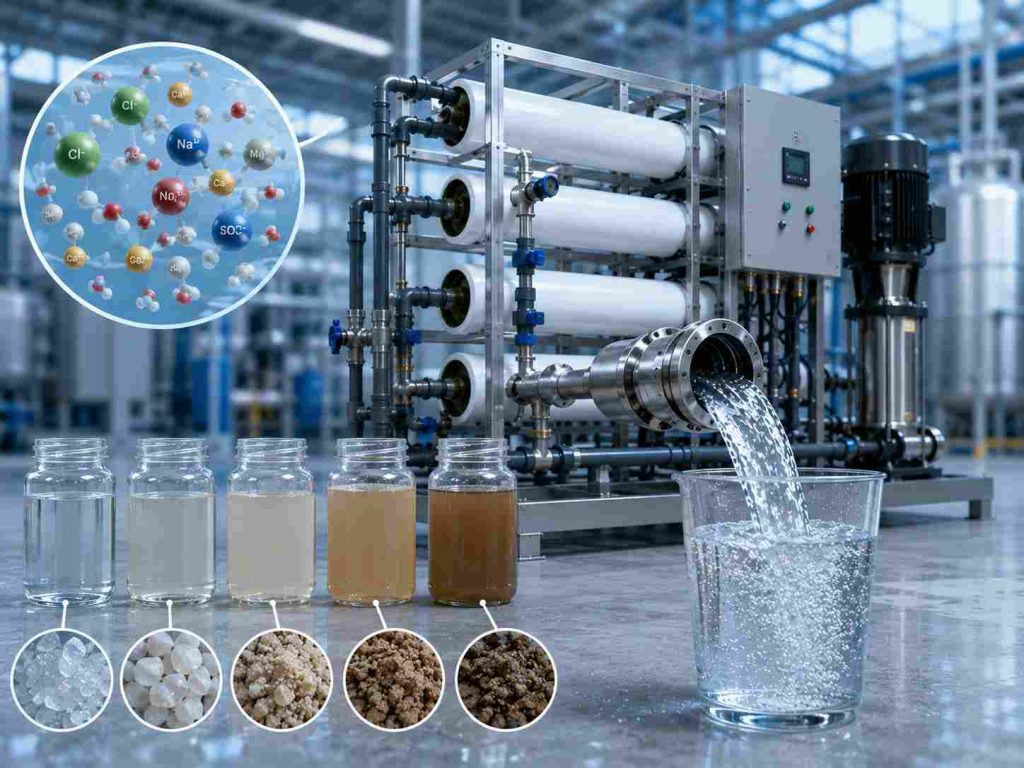
Yes, and it’s usually the most practical option. Reverse osmosis pushes water through a semi-permeable membrane. The membrane is permeable to water molecules, but not to most of the dissolved salts and ions. Modern RO membranes have rejection rates of salt of 95% to 99.7% depending upon the kind of membrane and its operational state.
Compared to other treatment technologies, reverse osmosis provides a practical balance of performance and operating cost for many high-TDS applications. Thermal distillation can handle very high TDS water, but it takes a lot more energy. Ion exchange is acceptable for low TDS water but the higher the concentration of dissolved salts the less inexpensive it becomes because the resin needs to be renewed more often. Nanofiltration removes some dissolved ions but typically has lower salt rejection than RO.
For these reasons reverse osmosis has become the main high TDS water treatment method for applications such as brackish groundwater treatment, saltwater desalination, industrial process water production and wastewater reuse.
What TDS Levels Can Different RO Systems Handle?
There is no TDS limit applicable to all RO systems. The TDS level that may be tolerated by reverse osmosis is a function of the kind of membrane, operating pressure, system setup and recovery goals. That said, there are some broadly recognized application ranges:
- Up to ~2000 mg/L. Standard low pressure RO membranes comfortably deal with this range. Typical of city tap water or slightly brackish sources. Pretreatment requirements are really straightforward.
- 2,000 to 10,000 mg/L. Brackish Water RO (BWRO) membranes are the standard for this range. They run from 10 to 30 bar and are commonly utilized in pharmaceutical industry, food and beverage production, power plants and industrial process water.
- 10,000 to 45,000 mg/L. Seawater RO (SWRO) membranes are developed for this range and the most challenging usual use is full seawater desalination (about. 35,000 mg/L). Typical operating pressures are 55-80 bar and recovery rates are normally kept at 35%-45% to reduce the possibility of scaling.
What’s important to understand is that as TDS increases within any of these ranges, the system responds: applied pressure goes up, recovery rate comes down, pretreatment becomes more aggressive, and concentrate management gets more involved. Treating “high-TDS RO” as a single category misses a lot of meaningful differences.
How to Design an RO System for High-TDS Water?
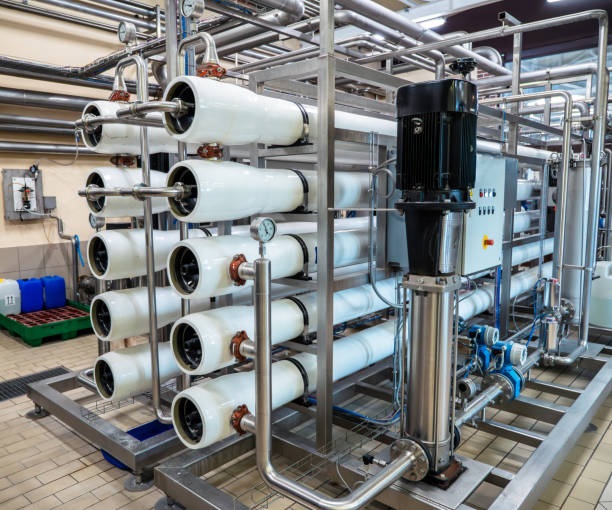
Reverse osmosis system design for high-TDS feeds involves a lot more than selecting a membrane. These are the factors that actually determine whether the system performs reliably over time:
1. Pretreatment
High-TDS water often contains higher concentrations of scale-forming minerals. The effective pretreatment usually comprises filtration of silt, antiscalant dosage and pH control. Softening or ultrafiltration may also be required upstream of the RO depending on feed water chemistry.
2. Membrane Selection
The choice between BWRO and SWRO membranes, and the specific flux and rejection specs, should be based on actual feed water analysis rather than rough estimates.
3. Operating Pressure
High-TDS feeds require high applied pressure. Undersizing the pump is a common design error that leads to inadequate permeate quality and shortened membrane life.
4. Recovery Rate
Higher recovery concentrates the brine side, accelerating scaling. As feed TDS increases, designers often lower the recovery rate to reduce scaling risk. The optimal recovery depends on feed water chemistry and membrane configuration rather than a fixed target.
5. Concentrate Management
Brine disposal is a regulatory and logistical challenge in many settings. This needs to be figured out before the system is commissioned, not after.
6. Monitoring and Maintenance
For high-TDS systems, where problems can escalate rapidly if not addressed, continuous conductivity monitoring, regular cleaning cycles, and frequent membrane inspections are very important.
When Is RO Alone Not Enough?
A well-designed RO system handles the majority of high-TDS applications without issue. But there are situations where a single-pass RO setup hits real constraints:
Very high TDS feeds, on the order of 45 000 to 50 000 mg/L or beyond, are beyond the reliable capability of conventional SWRO membranes.
High recovery targets for reuse of industrial wastewater may result in brine concentrations that make scaling inevitable with RO alone.
Strict laws governing the discharge of concentrate volume or salinity may necessitate extra treatment stages before the brine can be discharged.
For pharmaceutical or semiconductor manufacturing, ultra-pure water generally requires a second-pass RO stage or downstream EDI polishing to satisfy the conductivity standards.
High silica or carbonate scaling may limit RO recovery to commercially unsustainable levels without further treatment.
Typical solutions in such cases are multi stage RO, RO with EDI, thermal evaporation or the Zero Liquid Discharge (ZLD) systems. The ideal blend depends on the chemistry of the feed water, the quality of the water desired, and local discharge regulations.
Final Thoughts
High-TDS water treatment is a problem that can be solved but it is not plug and play. Reverse osmosis is an established and versatile technique, capable of managing a wide spectrum of TDS levels, providing the system is designed with the big picture in mind: not just the membrane, but pretreatment, pressure, recovery rate and concentrate handling.
At Molewater, we’ve been designing and building water treatment systems for pharmaceutical, industrial, and municipal clients for over 20 years. If you’re dealing with high-TDS source water and aren’t sure where to start, contact us to discuss your project and help you find a practical solution.