If your process needs water above 15 MΩ·cm, this is a decision you’ve probably already run into: electrodeionization (EDI) or mixed bed ion exchange? Both technologies produce ultrapure water, but they get there through very different mechanisms, and the differences show up directly in operating costs, maintenance schedules, and how much chemical handling falls on your team day to day.
Neither technology is simply the better option. Pharmaceutical plants, semiconductor fabs, and power stations all run one or the other successfully, and some run both side by side. The right pick depends on your flow rate, how continuously your system operates, and how much you want to manage on-site. The sections below break down what actually separates them.
How Does Electrodeionization (EDI) Work?
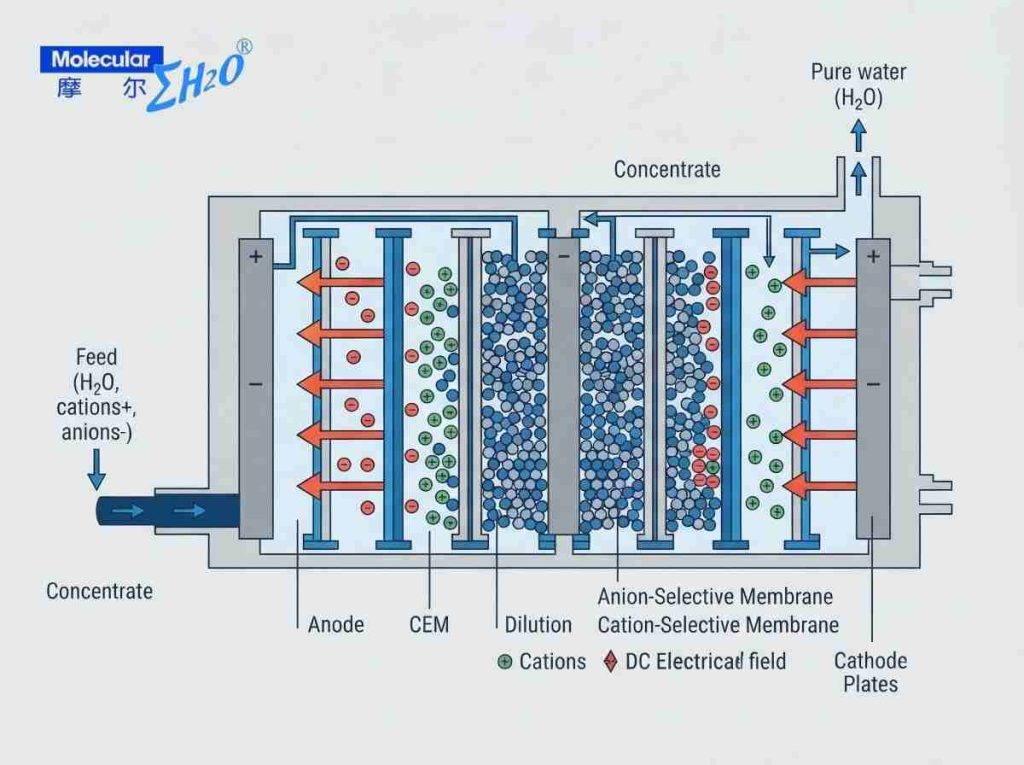
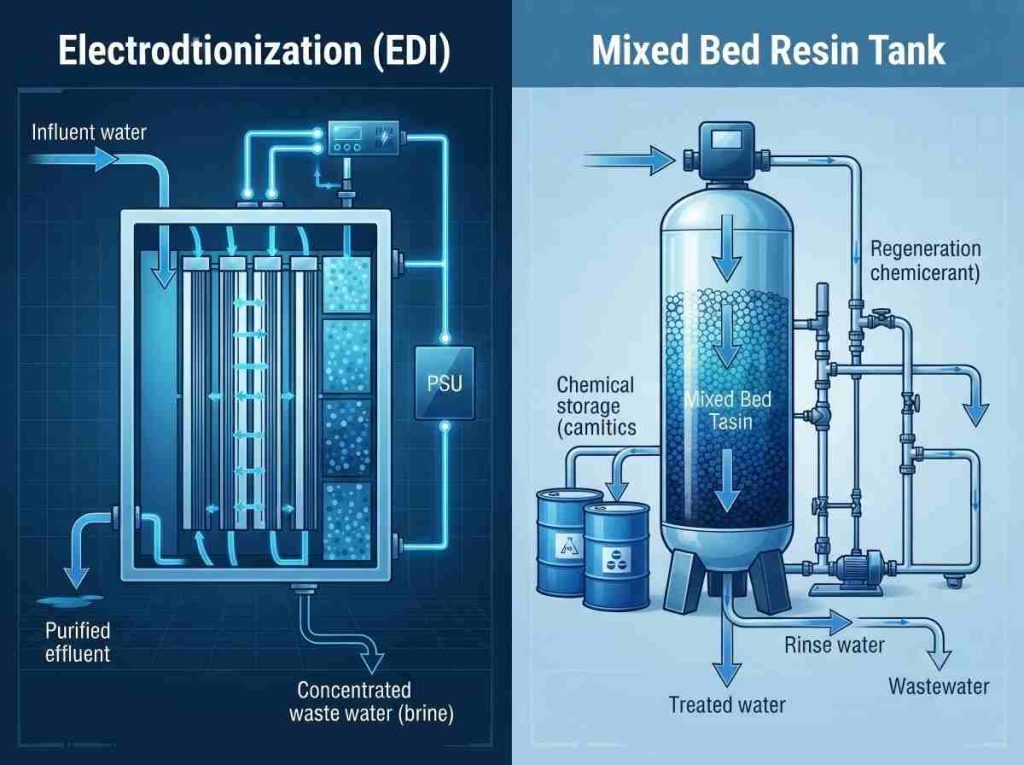
Electrodeionization combines ion exchange resin, ion-selective membranes, and a DC electrical current inside a single module. Water passes through chambers packed with resin, and as it does, a continuous electric field pulls cations toward the cathode and anions toward the anode, driving them through the membranes into a separate concentrate stream. The same electric field also splits water molecules into H+ and OH- ions, which continuously regenerate the resin in place.
That’s the key difference right there: the resin never gets exhausted the way it does in a mixed bed, because it’s being regenerated as the water flows through, not afterward in a separate batch process. No acid, no caustic soda, no regeneration downtime.
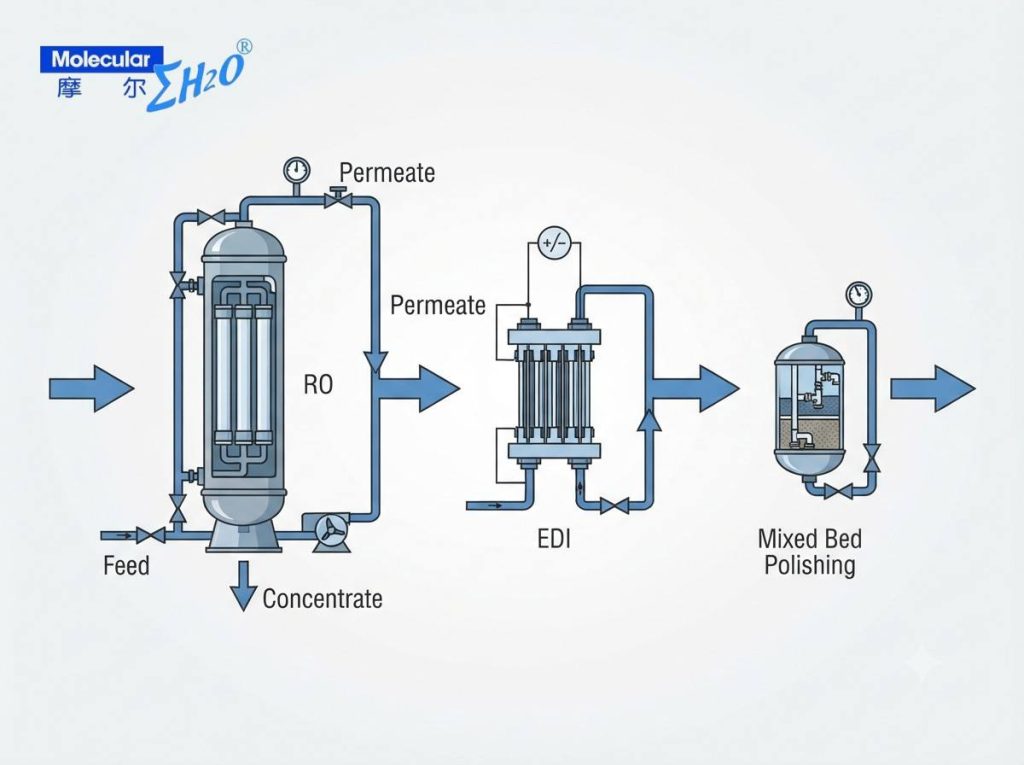
EDI always sits downstream of reverse osmosis. RO alone typically only removes 95 to 99 percent of dissolved ions, which isn’t enough for ultrapure applications, so EDI acts as a polishing stage that takes the water the rest of the way. Systems like our Molatom Ultrapure Water Machine and Molcell Ultrapure Water Machine are built around this RO-plus-EDI sequence for exactly this reason.
How Does Mixed Bed Ion Exchange Work?
Mixed bed resin combines cation and anion exchange resin in a single vessel, and it’s been the standard approach to ultrapure water for decades. There’s a reason it’s stuck around this long: water flows through the resin bed, dissolved ions trade places with hydrogen and hydroxide ions on the resin beads, and those H+ and OH- ions combine to form pure water.
The real contrast with EDI shows up once the resin runs out of exchange capacity. At that point it has to come offline for regeneration with strong acid and caustic soda, typically on a cycle of around 25 days depending on feed water quality and usage. As the resin ages, that cycle shortens, which means more frequent regeneration and operating costs that creep up over time. Water quality is usually excellent right after a regeneration, but it drifts a little as the cycle wears on, introducing some batch-to-batch variability that continuous systems simply don’t have.
EDI vs Mixed Bed Ion Exchange: Key Differences Compared
| Factor | EDI | Mixed Bed |
| Resistivity output | Up to 18.2 MΩ·cm | Up to 18.2 MΩ·cm |
| Water quality consistency | Stable, continuous | Fluctuates across regeneration cycle |
| Regeneration method | Electrochemical, in-place | Offline, chemical (acid/caustic) |
| Downtime | None | Required during regeneration |
| Chemical handling | None | Acid and caustic storage/handling required |
| Waste stream | Concentrate reject only | Neutralized acid/caustic wastewater |
| Upfront cost | Higher | Lower |
| Operating cost over time | Lower, no chemical purchases | Higher, ongoing chemical and disposal costs |
| Best suited flow range | Larger, continuous flows | Smaller-scale, intermittent use |
| Footprint | Compact | Larger, needs chemical storage space |
The upfront cost gap is real, and it’s usually the first objection people raise against EDI. But once you factor in chemical purchases, wastewater neutralization, and the labor involved in regeneration cycles, EDI tends to close that gap over a few years of operation, particularly at higher flow rates.
EDI or Mixed Bed: Which Is Right for Your Industry?
Pharmaceutical water for injection (WFI) pretreatment. Consistency matters more here than almost anywhere else, since USP and pharmacopeia standards call for documented, stable water quality. EDI’s continuous output makes validation and batch documentation easier to manage, and that’s a big part of why it’s become the default polishing step ahead of distillation in most modern WFI systems, including our own WFI Storage & Distribution System.
Semiconductor and microelectronics. Chip fabrication runs some of the tightest resistivity tolerances anywhere, often referencing ASTM D1193 Type I water standards. Facilities running 24/7 production tend to favor EDI as well, since even a brief quality dip during a mixed bed regeneration cycle can affect a wafer run. Smaller labs, though, still lean on mixed bed polishing for lower-volume, non-continuous needs.
Laboratory-grade ultrapure water. Mixed bed still holds its ground here more than anywhere else on this list. Labs typically don’t run continuously, demand is modest, and a full EDI setup is often more than what point-of-use volumes justify. Our Molelement Ultrapure Water Machine and Molresearch Pure Water Machine both build in mixed bed polishing suited to this kind of intermittent lab use.
Power plant boiler feedwater. Continuous, high-volume operation with strict conductivity limits, often under 0.3 µS/cm, makes EDI a natural fit, since unplanned regeneration downtime on a live boiler feed line is exactly what most operators are trying to avoid.
Intermittent or seasonal production. This case takes more thought than the others. EDI systems left idle for stretches, a weekend shutdown or a seasonal gap in production, can lose some performance stability once restarted. In these situations, a mixed bed system, or a compact on-demand exchange unit, sometimes handles variable demand more predictably than EDI does.
Can You Combine EDI and Mixed Bed for Ultrapure Water?
They’re not mutually exclusive, and at a fair number of facilities, they’re not even competing against each other. A common setup runs RO into EDI for the bulk deionization, then adds a small mixed bed polishing stage right before the point of use. That final stage catches any trace ions the EDI step leaves behind and pushes resistivity closer to the 18.2 MΩ·cm ceiling, which matters for applications like cell culture media prep or highly sensitive analytical instrumentation.
Our Laboratory Deionized Water System line is built around this same combination: EDI carrying the continuous load, mixed bed resin acting as the final check where precision matters most.
How to Choose Between EDI and Mixed Bed Ion Exchange?
A few questions tend to settle this faster than any comparison chart:
- How continuous is your demand? Round-the-clock operation favors EDI. Intermittent, lower-volume use often doesn’t justify the investment.
- How much chemical handling are you willing to take on? If keeping acid and caustic storage off-site is a priority, EDI takes that concern off the table.
- What’s your flow rate? Mixed bed tends to be the more cost-effective option at smaller scales; EDI’s economics improve as flow rates climb.
- Do your quality standards require documented consistency? Pharmaceutical and semiconductor operations lean EDI largely for this reason.
- Is upfront capital or long-term operating cost the tighter constraint? Mixed bed wins on day one; EDI usually comes out ahead over a multi-year horizon.
Neither technology has become outdated, and neither one is right in every case. The facilities that end up satisfied with their setup are usually the ones that matched the technology to how they actually run day to day, not to whatever looked strongest on a spec sheet. For a specific project, it’s worth going through feed water quality, flow requirements, and uptime needs with someone who can size the system properly, rather than picking a technology off resistivity numbers alone.