Where Should Industrial Water Reuse Start? 5 Wastewater Streams Worth Recovering First
Most factories are sitting on a water reuse opportunity they’ve never mapped. The water that leaves your facility every day through drains and discharge lines isn’t uniformly contaminated. Some of it is genuinely clean enough to recover with relatively straightforward treatment. The question is knowing where to look.
Water expenditures are increasing and water discharge rules are becoming more stringent in most areas. Plant managers and environmental engineers have long felt the push to cut freshwater use.
But industrial wastewater reuse tends to feel bigger and more complicated than it actually needs to be. Many facilities have low-contamination streams that can be reused with relatively simple treatment when the intended application and water quality requirements are clear.
This guide discusses how to find water reuse potential within a facility, what a useful industrial water reuse evaluation entails, and which five wastewater streams provide the most obvious beginning points.
How to Identify Water Reuse Opportunities in a Factory
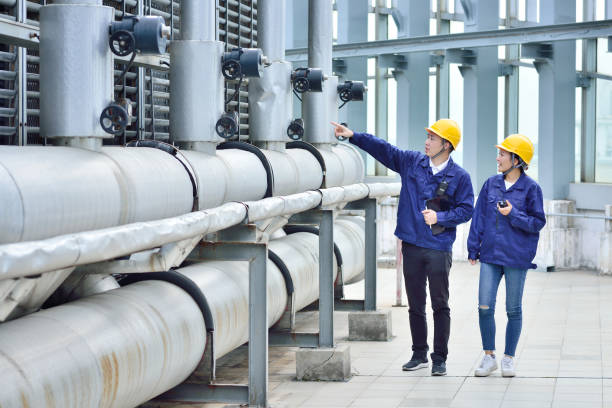
Before evaluating any treatment technology, it helps to map your water flows. Most industrial facilities have a water balance that was never fully documented, and the gaps in that picture are often where the best recovery options are hiding.
Trace the source, not just the drain. The natural instinct is to focus on what’s going out in your final discharge. A more useful approach is to work backwards: where is your cleanest incoming water being used, and where does it exit with the least contamination? Those exit points are your candidates for industrial wastewater recycling.
Measure volume and contamination. High-volume, low-contamination streams are the most valuable targets. A stream producing 50 m³/day with low dissolved solids and a neutral pH is far easier to work with than a small stream carrying a heavy chemical load.
Look for single-source streams. Mixed wastewater is harder to treat because its composition can vary significantly. Industrial water reuse is easier to implement when streams come from a single, stable source.
Conducting a Realistic Industrial Water Reuse Assessment
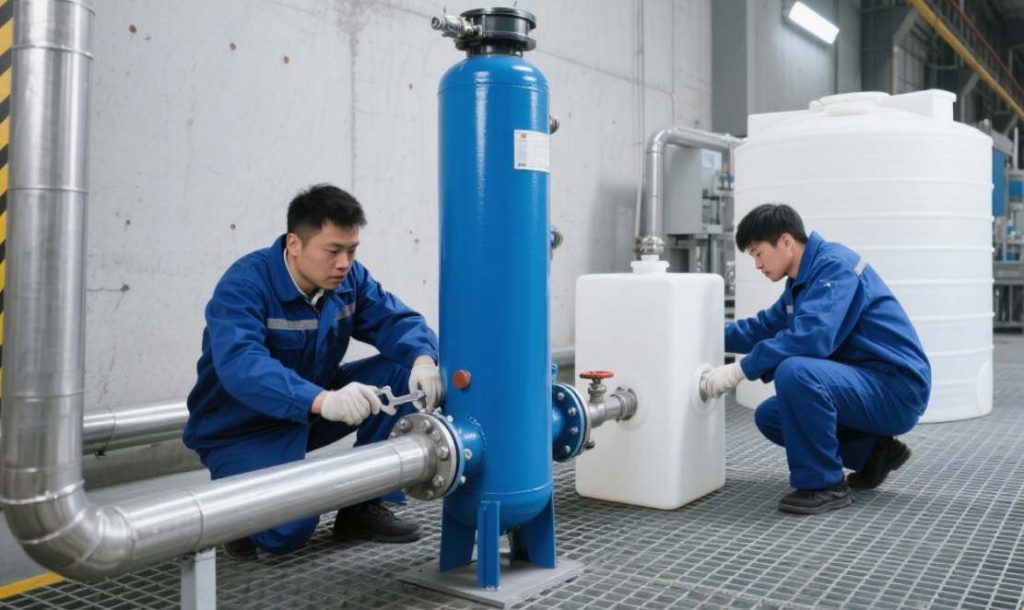
A solid industrial water reuse assessment doesn’t require months of study. It requires sampling the right points. Three parameters do most of the work at the initial screening stage:
- TDS (Total Dissolved Solids): An indicator of the quantity of dissolved material. High TDS limits which applications recovered water can serve.
- COD (Chemical Oxygen Demand): It indicates the quantity of organic materials in water. High COD means biological or advanced chemical treatment will likely be needed before reuse.
- pH: Determines if a stream is acidic or alkaline which directly affects treatment selection and downstream compatibility.
Further tests depend on the stream and its planned reuse and can include turbidity, suspended sediments, hardness, particular ions, residual chemicals, oil or microbiological purity.
With these numbers in hand for your priority streams, you can make informed, data-backed conclusions concerning industrial water reuse viability without over-engineering the analytical procedure.
5 Wastewater Streams Worth Recovering First
Not every wastewater stream is worth treating. Some are genuinely clean enough to recover with minimal effort, while others carry contamination levels that make the economics difficult to justify.
Based on experience across industrial facilities, these five streams tend to offer the most practical starting points for industrial wastewater reuse.
1. HVAC / Air Handler Condensate
If your company has air conditioning or large air-handling units, chances are condensate is travelling to a floor drain without your knowledge. This is something to revisit. HVAC condensate occurs when warm, humid air comes into contact with cold coil surfaces. Most of the dissolved solids are left behind in the process, resulting in water that is essentially very low in TDS.
Contamination is negligible unless there is microbial growth in the drain lines. HVAC condensate can be used for cooling tower makeup, toilet flushing or irrigation if filtered, disinfected and water quality monitored at the site adequately. Sometimes in buildings where the HVAC is run year-round, the overall volume is larger than expected.
2. Process Final Rinse Water
In food processing, electronics manufacturing, and metal finishing, products pass through multiple rinse stages. The final rinse is intentionally the cleanest in the sequence. Recovering it makes practical sense, and a counter-current rinsing design makes it even more effective:
- Counter-current flow: Feed recovered final rinse water back into earlier, dirtier rinse stages. This significantly reduces total freshwater consumption across the rinse sequence.
- Direct recirculation: Recovered final rinse water is often better suited for earlier rinse stages, pre-wash steps, or other lower-quality process uses. Reuse in the final rinse stage should only be considered where process specifications allow it.
Because final rinse water comes from a single, repeatable process step, its quality is stable and easy to monitor. It is a real advantage for long-term industrial wastewater reuse.
3. Cooling Tower Blowdown
Cooling towers work by allowing water to evaporate, which cools the remaining water. As evaporation continues, dissolved minerals concentrate in the system. To prevent scale buildup, a fraction of this concentrated water is periodically discharged. This discharged stream is known as blowdown.
Cooling tower blowdown may be reused after treatment, while it is generally released directly, if its salinity, chemical additions and the intended purpose are adequate. For facilities with big chiller systems, the ability to collect at least some of this stream can greatly reduce demand for freshwater makeup.
4. Boiler Blowdown Recovery
Boiler blowdown serves a similar purpose: controlling dissolved solids and reducing scale risk. But it comes with an added variable: temperature. Blowdown from high-pressure boilers is often discharged at 80°C or above, meaning there’s both recoverable heat and recoverable water in the same stream.
A flash tank or heat exchanger can recover thermal energy before the cooled water is evaluated for lower-grade reuse. Returning treated blowdown to boiler feed requires stricter water quality control. For facilities running continuous boiler operations, this can be a compelling opportunity to combine heat recovery with lower-grade water reuse.
5. Reverse Osmosis (RO) Reject Water
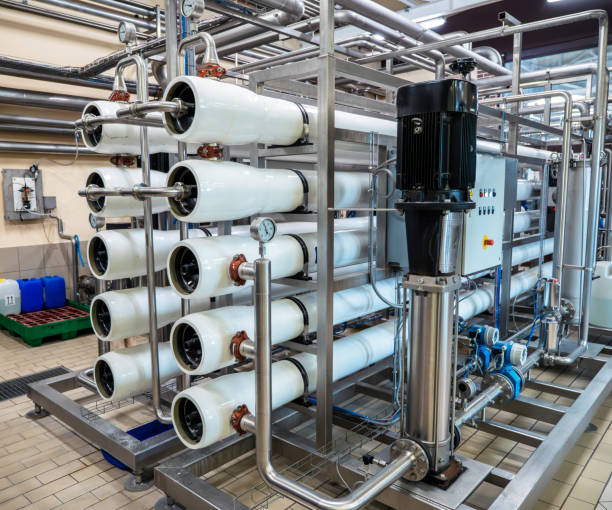
Reverse osmosis systems are standard equipment in industrial water treatment, producing high-purity water for sensitive processes. What many facilities do not realize is the reject (or concentrate) stream, generally 20 to 40% of the feed volume, which is released to drain as a matter of course.
RO reject is not inherently harmful, but its re-use potential is dependent on feed water quality and the pollutants which are concentrated during treatment. Where water quality allows, it may be reused for lower-grade applications. This is often the fastest, lowest-effort win in an industrial water reuse program.
The table below provides a quick comparison of these five streams to support an initial water reuse feasibility assessment:
| Wastewater Stream | Common Water Quality Concerns | Typical Treatment Need | Possible Reuse Applications | Key Reason to Prioritize It |
| HVAC / Air Handler Condensate | Potential microbial growth in drain lines | Filtration + disinfection | Cooling tower makeup, toilet flushing, irrigation | Low TDS and simple treatment |
| Process Final Rinse Water | Low residual process chemicals | Filtration, with RO polishing if needed | Counter-current rinse recirculation, pre-wash stages | Stable quality and easy process reuse |
| Cooling Tower Blowdown | Elevated TDS, scaling minerals | Softening or RO | Low-grade process water, equipment washing, or treated makeup water | High reuse volume potential |
| Boiler Blowdown | High temperature, elevated TDS | Flash tank + heat recovery + softening/RO | Low-grade process water, wash water, or other approved reuse applications | Water and heat recovery value |
| Reverse Osmosis Reject Water | Elevated TDS (relative to feed) | Minimal, or secondary RO for further recovery | Equipment washing, toilet flushing, or other lower-grade uses where water quality allows | Potential for quick reuse in lower-grade applications |
How to Prioritize Industrial Water Reuse Projects
Identifying recoverable streams is the first step. Deciding which project to act on first is a different kind of decision.
- Assess the true cost of water. The water bill is not what water actually costs your facility. Add in the energy to heat or cool the incoming supply, the cost of chemical treatment and the sewer discharge fees. Combine those and the economics of industrial wastewater recycling are typically far better than a basic cost-per-cubic-meter comparison would suggest.
- Evaluate treatment footprint. Projects that can fit within your current plant layout without major civil works will move faster through internal approval. Compact, modular treatment systems are worth prioritizing for this reason. They reduce both capital commitment and implementation time.
- Check regulatory compliance. If a specific stream is already pushing your facility close to local discharge limits, recovering it solves a compliance problem and a water supply problem at the same time. That dual benefit tends to accelerate internal buy-in and speed up project timelines considerably.
- Start with closed-loop wins. The simplest type of industrial wastewater reuse is to take water from one process and send it back to the same process after treatment. It prevents cross-contamination issues, makes quality control manageable and keeps project scope limited. This is where most successful programs start before expanding to cross-department or cross-process recycling.
Turn Wastewater Into a More Reliable Water Source
Industrial water reuse has moved well past the stage where it’s only considered by facilities with obvious water scarcity problems. Rising costs, tighter compliance requirements, and sustainability commitments are making it a practical operational priority across manufacturing sectors. The facilities that will be in the strongest position on all three fronts are the ones that started assessing their options sooner.
Molewater has supported industrial water treatment and wastewater recovery projects for over 20 years, working across pharmaceutical, food processing, power generation, and general industrial applications. If you’re ready to explore your site’s potential for industrial water reuse, contact us to figure out where to start.