Boiler feed water treatment companies supply the equipment, chemicals, engineering, and monitoring services needed to control scale, corrosion, and dissolved gases in industrial boiler systems. They range from chemical specialists and ongoing service contractors to equipment manufacturers and full-system integrators.
Which type of partner makes sense depends on your boiler pressure, feedwater source, and whether you need day-to-day chemical management, a one-time system build-out, or custom pre-treatment equipment designed around your specific water chemistry.
What Boiler Water Treatment Services Actually Include
Not every company in this space offers the same thing, and the category name does not make that obvious.
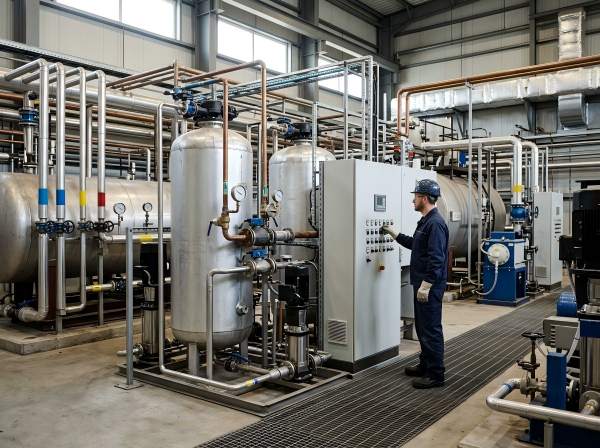
Some specialize in chemical supply and program management — they test your water regularly, adjust dosing, and keep your system running within acceptable parameters. Others manufacture and engineer the physical treatment equipment: softeners, deaerators, reverse osmosis units, chemical dosing systems, and membrane-based pre-treatment skids. A third group combines both, offering full-service contracts that cover equipment, chemicals, monitoring, and field technicians under one agreement.
The distinction matters because the right fit depends on what your boiler actually needs, not just who offers the most comprehensive brochure.
Top Boiler Feed Water Treatment Companies And How to Choose
Most of the well-known names in this industry fall into two broad camps: chemical-driven service providers and equipment or system manufacturers.
Ecolab (Nalco Water) is the largest chemical water treatment company in the world, with over 85 years of experience in boiler applications across power, food and beverage, manufacturing, and petrochemical industries. Their 3D TRASAR automation platform enables real-time chemical dosing and remote monitoring. For large facilities that run continuous operations and prefer a managed service model, Nalco is a strong option. The trade-off is cost, custom hardware and long-term service contracts come at a premium, and smaller or export-focused projects often fall outside their core focus.
Veolia Water Technologies covers a wide range of industrial water treatment needs, from pre-treatment to zero liquid discharge. They are well-positioned for large-scale infrastructure projects and have proprietary technologies including the Hydrex chemical series. Like most global giants, their response flexibility for mid-sized projects varies by region.
Evoqua Water Technologies (now part of Xylem) handles everything from rental and temporary water systems to permanent RO and demineralization installations. They are particularly strong in emergency response and short-term deployments, and carry a broad product range including ion exchange resins, activated carbon, and membrane systems.
ChemTreat and Chardon Laboratories represent the regional service contractor model, companies that focus on program management, on-site testing, and chemical treatment for commercial and industrial boilers. They are a practical fit for facilities that want hands-on local service rather than a large corporate contract.
Molewater takes a different approach. As a manufacturer of membrane-based pre-treatment systems including dual-pass reverse osmosis and continuous electrodeionization (EDI). Molewater focuses on the feedwater side of the equation. Rather than ongoing chemical management, the emphasis is on engineering the incoming water quality to a level that reduces downstream treatment demands. This makes Molewater a practical option for medium to high-pressure industrial boilers where water purity requirements are strict and chemical carryover into steam is a concern.
Boiler Water Treatment Systems: Chemical Programs vs. Membrane Pre-Treatment
This is where a lot of buyers get stuck, not because the concepts are complicated, but because most companies only explain their own approach.
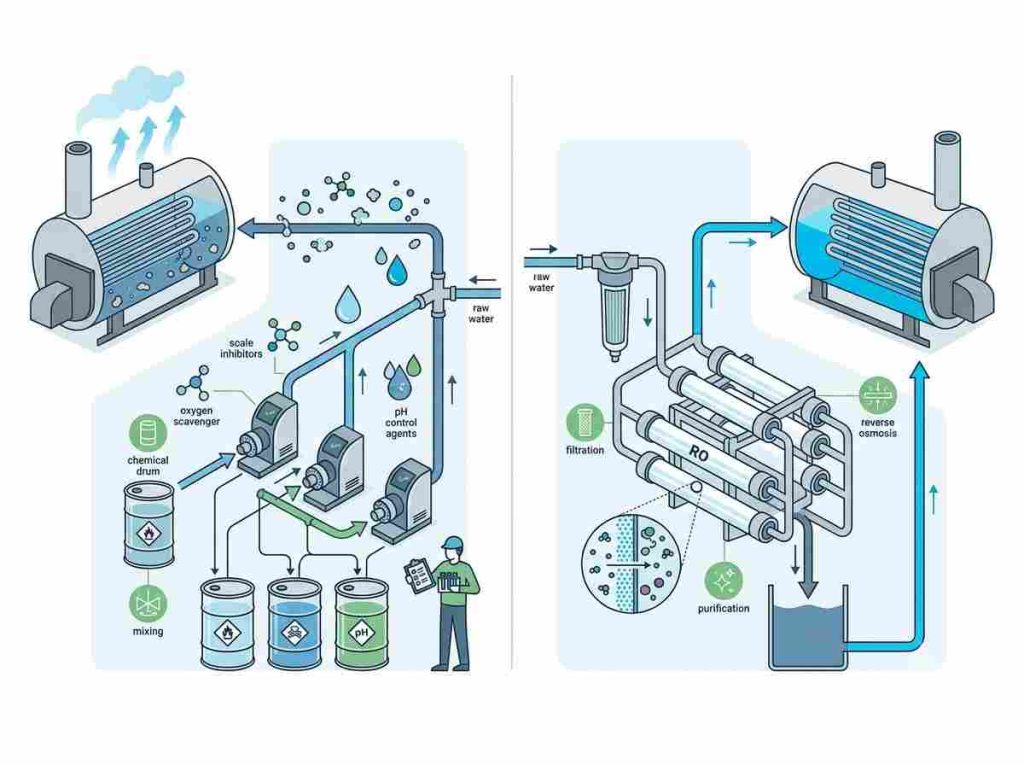
Chemical treatment adds reagents to the boiler feedwater to control pH, neutralize dissolved oxygen, prevent scale, and inhibit corrosion. It works well for low to medium-pressure systems and is relatively easy to implement and adjust. The limitation is that chemicals have to be added continuously, blowdown rates stay relatively high to manage accumulated solids, and in sensitive downstream applications such as food processing, pharmaceuticals, fine chemicals, steam purity becomes a real concern.
Membrane-based pre-treatment takes a different route. Technologies like reverse osmosis (RO) and electrodeionization (EDI) remove dissolved solids, silica, and ions from the feedwater before it ever enters the boiler. The result is higher-purity makeup water that reduces the boiler’s internal chemistry demands. Blowdown rates drop significantly which means less heat loss, lower water consumption, and reduced chemical input over time.
Neither approach is universally better. The right answer depends on what your boiler is running at, and what your downstream process can tolerate.
How to Choose a Boiler Water Treatment System Based on Boiler Pressure
Boiler operating pressure is probably the single most reliable indicator of what treatment technology you actually need. The higher the pressure, the stricter the water quality requirements, and the less chemical treatment alone can manage.
| Boiler Type / Pressure | Primary Risk | Target Water Quality | Recommended Approach |
| Low-pressure (< 200 psi) | Scale, hardness buildup | Hardness near zero | Ion exchange softener |
| Medium-pressure (200–600 psi) | Alkaline corrosion, silica scale | Low TDS, low conductivity | Single or dual-pass RO |
| High-pressure (> 600 psi) | Steam carryover, trace corrosion | Conductivity < 0.1 µS/cm, ultra-low silica | RO + EDI custom system |
For high-pressure and supercritical boilers, even trace levels of silica can form deposits that are extremely difficult to remove without taking the system offline. Standard softeners do not remove dissolved silica, a detail that catches many facilities off guard until they are dealing with an actual fouling problem.
Custom deionized water systems designed specifically for boiler feed applications address this gap. By combining RO with EDI, it is possible to achieve conductivity levels below 0.1 µS/cm and silica removal rates above 99%, which is the standard required by most high-pressure boiler manufacturers and referenced in ASME Boiler and Pressure Vessel Code guidelines.
Three Boiler Water Treatment Mistakes That Cost More Than the System Itself
Looking only at upfront equipment cost. A softener is cheaper to install than an RO system. But facilities running softened water typically operate at blowdown rates of 8–15%, which means continuously losing heated, treated water. Over the course of a year, the energy and water cost of that blowdown often exceeds the price difference between the two systems. The U.S. Department of Energy’s industrial boiler efficiency guidelines include blowdown heat loss as a primary efficiency factor for exactly this reason.
Underestimating dissolved silica. Hardness is the obvious target in most water treatment programs, but silica is the problem that tends to show up later and cause more damage. At higher pressures, silica volatilizes and deposits on turbine blades and heat exchange surfaces in a form that resists most chemical cleaning methods. If your raw water contains elevated silica and your boiler runs above 400 psi, that needs to be part of the conversation when you are evaluating treatment options.
Over-relying on chemical treatment in high-purity applications. Chemical overdosing can cause foaming and carryover, water droplets and dissolved solids carried into the steam distribution system. In industries where steam contacts the product directly, this creates contamination risk that is difficult and expensive to trace back. Membrane pre-treatment reduces the chemical load needed in the first place, which makes carryover events less likely.
What to Ask a Boiler Water Treatment Company Before You Sign Anything
The company you choose will have a significant influence on how your boiler performs over its service life. A few questions that tend to separate well-matched vendors from the rest:
- Does the company design and supply the treatment equipment, or only manage chemical programs?
- Can they size a system to your actual boiler pressure rating and daily feedwater volume?
- What blowdown rate should you expect with their recommended approach, and what does that cost annually?
- Do they provide on-site commissioning and post-installation technical support, or hand off after delivery?
- Can they provide references from facilities running similar boiler configurations and pressure ranges?
There is no single right answer to any of these but the responses will tell you quickly whether a vendor understands your application or is offering a generic program.
Molewater works with industrial facilities to design and size boiler feedwater pre-treatment systems based on actual raw water analysis and boiler operating requirements. If you have a water report and know your boiler pressure, contact us to receive a technical proposal.
FAQs
What is the difference between boiler water treatment services and boiler water treatment systems?
Boiler water treatment services refer to ongoing chemical management programs including regular water testing, dosing adjustments, and field service visits. Boiler water treatment systems are the physical equipment used to condition feedwater before it enters the boiler, such as softeners, reverse osmosis units, deaerators, and EDI systems. Many companies offer both, but some specialize in one or the other.
What do boiler water treatment companies typically charge for?
Pricing varies widely by scope. Chemical service contracts are typically billed monthly and priced based on boiler capacity and chemical consumption. Equipment purchases are priced per system based on flow rate, water quality requirements, and level of automation. Large turnkey projects involving engineering, supply, and installation are quoted on a project basis.
Do high-pressure boilers need deionized water instead of softened water?
For boilers operating above 600 psi, most manufacturer specifications and industry standards call for feedwater with conductivity below 0.1 µS/cm and silica levels in the parts-per-billion range, but targets that softening alone cannot meet. Custom deionized water solutions using RO combined with EDI are the standard approach for high-pressure and supercritical boiler feed applications.