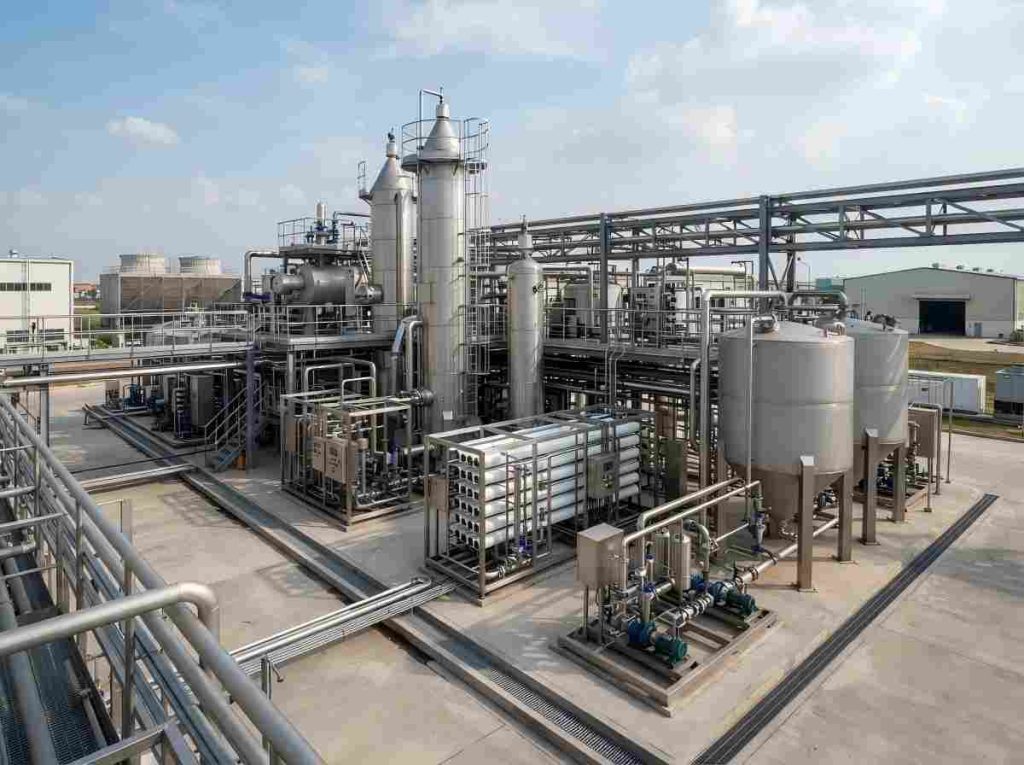
Zero liquid discharge, or ZLD, is a wastewater treatment process that recovers nearly all usable water from industrial effluent and converts what’s left into solid waste — nothing goes back into the environment as liquid. Reaching that point takes more than a single piece of equipment: a working ZLD plant typically chains together pretreatment, membrane filtration, evaporation, and crystallization, each stage configured around the specific chemistry of the wastewater coming in.
Adoption has picked up steadily over the past few years. Power generation, chemicals, mining, and semiconductor manufacturing are all facing tighter discharge limits, and in some regions permits now leave facilities with few alternatives to ZLD. Thermal-based systems still handle the bulk of installed capacity globally, largely because high-salinity streams push beyond what membranes can manage on their own.
For most facilities, the question isn’t whether ZLD is worth pursuing. It’s which company to trust with the project: one that can size the system correctly, deliver it on schedule, and keep it running without constant intervention afterward.
How to Choose a Zero Liquid Discharge Company?
Picking a ZLD provider isn’t straightforward — the technology is complex enough that two companies can quote the same project and deliver very different outcomes. A few factors are worth checking before the shortlist gets too short.
Technology breadth. Providers that only work with one process type — mechanical vapor recompression, for instance — will tend to apply it regardless of whether it’s the right fit. Wastewater with highly variable salinity or mixed contaminant loads generally needs a combination of membrane and thermal technologies, sized and sequenced for the specific influent. A provider with a narrower lineup will work around that constraint; one with broader capabilities won’t need to.
Industry-specific experience. Water chemistry varies significantly across industries — what comes out of a power plant cooling system looks nothing like textile dyeing effluent or lithium brine. Providers who have worked extensively in a particular sector tend to anticipate fouling patterns, scaling behavior, and pretreatment requirements that aren’t obvious from a lab report alone.
Delivery model. Some providers sell equipment only — installation and commissioning get handed off to a separate contractor. Others take on the full scope: design, fabrication, installation, and startup under one agreement. The practical difference shows up when something underperforms. With a single-contract arrangement, there’s one team accountable for the outcome; with a split model, responsibility tends to get passed around.
Aftermarket support. Thermal ZLD systems in particular require regular attention — scaling builds up, components wear, and performance drifts if maintenance isn’t consistent. It’s worth asking upfront whether a provider has service personnel in your region and how quickly replacement parts can be sourced. A system that runs well at commissioning but has no local support six months later creates a different kind of problem.
Project track record. Reference checks matter more in ZLD than in simpler treatment applications, because system performance is highly site-specific. A company’s general client list tells you less than two or three references from facilities with similar wastewater profiles and project scale.
Best Zero Liquid Discharge (ZLD) Companies
Veolia Water Technologies
Veolia’s ZLD work runs through its HPD® evaporation and crystallization technology, which handles everything from high-salinity brine concentration to recoverable salt extraction. The company operates at a scale that most others don’t — in early 2026 it took on a USD 95 million EPC contract for a 3,500 m³/day ZLD plant at a petrochemical complex in Jubail, Saudi Arabia, integrating RO, mechanical vapor recompression, and crystallization with a 98% water recovery target.
Best for: large industrial or petrochemical sites looking for a single contractor to own the full project scope.
Aquatech International
Aquatech has built its name around desalination and water reuse, with ZLD as a natural extension of that expertise. It offers both proprietary equipment and engineered systems, plus leased treatment options for facilities that don’t want to own equipment outright.
Best for: facilities that want flexibility between buying, leasing, or phasing in a ZLD system.
Alfa Laval
Alfa Laval built its reputation in heat transfer and separation technology, and its ZLD offering reflects that foundation, the focus is on energy-efficient evaporation and solid-liquid separation, with systems deployed across chemicals, power generation, and food processing. In July 2025 the company acquired Fives Cryogenics, adding advanced heat transfer and pump technologies that strengthen its thermal ZLD capabilities. Beyond equipment supply, Alfa Laval covers design, installation, and ongoing maintenance under the same umbrella, which suits facilities that expect to need consistent technical support over the system’s operating life rather than just at startup.
Best for: energy-conscious operations looking to lower long-term operating costs.
GEA Group
GEA is a German engineering firm with deep roots in food, beverage, and pharmaceutical processing, and its crystallizer and evaporator lineup extends naturally into ZLD applications. The company runs lab-scale testing for both crystallization and evaporation before committing to a full design, which reduces the risk of an underperforming system.
Best for: food, beverage, and pharma facilities where hygienic design standards matter as much as water recovery.
Aquarion AG
A Swiss water treatment group that has grown quickly through acquisitions, including Hager + Elsässer, Aquarion offers membrane, thermal, and hybrid ZLD systems with an emphasis on integrated project execution and post-sale support.
Best for: mid-to-large facilities that want one company managing the full technology stack.
Praj Industries
Based in India, Praj has carved out a strong position in Asia-Pacific with modular, skid-mounted ZLD units that can be deployed faster than a traditional stick-built plant. This approach has made it a common choice for smaller chemical parks and oilfield sites that can’t wait a year or more for commissioning.
Best for: facilities in Asia-Pacific needing faster deployment through modular or containerized systems.
Molewater
Molewater has been manufacturing water treatment systems in China since 2003, covering pharmaceutical, industrial, and wastewater applications. Its MOLECULAR™ ZLD systems run on a combination of membrane concentration and evaporation crystallization, and the company works with both MVR and multi-effect evaporation on the thermal side. The two technologies serve different wastewater profiles: MVR recovers and recycles steam energy, cutting operating costs on most high-salinity streams, while multi-effect evaporation is better suited to materials with particularly high boiling point elevation — calcium chloride, caustic soda, and similar compounds that MVR doesn’t handle as well. The system configuration follows the water chemistry, not the other way around.
Best for: industrial facilities dealing with complex, high-salinity or high-COD wastewater that needs a customized technology combination rather than a one-size-fits-all system.
Side-by-Side Comparison
| Company | Core Technology | Typical Project Scale | Delivery Model |
| Veolia | Thermal evaporation & crystallization | Large / EPC | Full turnkey |
| Aquatech | Membrane + thermal, desalination | Mid to large | Equipment, lease, or turnkey |
| Alfa Laval | Heat transfer, evaporation | Mid to large | Equipment + lifecycle service |
| GEA | Evaporation, crystallization | Mid to large | Equipment + lab testing |
| Aquarion AG | Membrane, thermal, hybrid | Mid to large | Full turnkey |
| Praj Industries | Modular/skid-mounted systems | Small to mid | Fast-deploy turnkey |
| Molewater | Membrane concentration + MVR/multi-effect evaporation | Small to mid | Design + installation |
If your wastewater falls into the more complex end of that spectrum, it’s worth talking to a team that will look at the actual chemistry before deciding on a technology path. You can learn more about Molewater’s ZLD systems or reach out directly to walk through your wastewater profile.