The theoretical limit for water purity – a resistance of 18.25 MΩ·cm at 25°C – is the gold standard for semiconductor, pharmaceutical, and high-tech laboratory environments. While technologies such as Reverse Osmosis (RO) and Electrodeionization (EDI) are able to do the bulk of the lifting, the most essential barrier to pure water is Ion Exchange Resin. Making the right choice of resin isn’t just a procurement task; it’s an engineering decision that balances capacity, kinetics and elution profile. Let’s look at how to choose the best resin system that will make sure your ultrapure water system is maintained at highest performance, stability and durability as time passes.
Understanding the Role of Mixed Bed Resin in UPW Systems
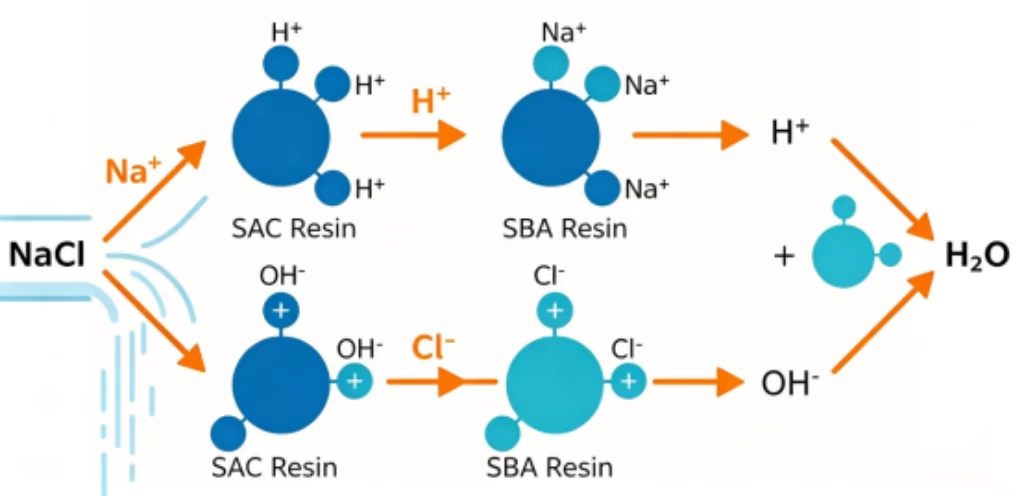
In the high-purity water (UPW) loop, the goal is to get rid of trace ionic contaminants that are left behind following RO as well as EDI processes. This is why Mixed Bed Ion Exchange excels. In contrast to separate beds, mixed bed systems mix solid acid cation (SAC) and strong base anion (SBA) resins within one vessel. This arrangement lets water go through numerous Ion exchange cycles in a sequence when it is circulating through the bed of resin efficiently “polishing” the water to get to that 18.25 MΩ·cm threshold. If your EDI unit is the mainstay, it is the mixed bed that acts as the skilled craftsman making sure every impurity molecule is absorbed.
Key Metrics for Selecting the Right Resin
All resins are not created to be the same. When choosing Ion Exchange resin for water purification, you should consider the following three benchmarks of a professional:
Pure Quality (Nuclear or Ultrapure Grade) – It is not negotiable. Industrial-grade resins are known to release organic compounds-Total Organic Carbon (TOC)-back into the water. Always choose “Nuclear Grade” or “Ultrapure Grade” resins that are pre-purified to reduce TOC leaching, and ensure that your system doesn’t add pollution while trying to eliminate it.
Kinetic Efficiency (Uniform particle Size) – The Uniform Particle Size (UPS) resins are more compact in size when compared with conventional resins. This reduces the pressure drop across the vessel and creates an increased surface area for exchange of ions which significantly improves the efficiency of the kinetics that the process.
Capacity and Regeneration – For systems requiring long operational cycles, high-capacity resins are essential. However, the ratio of cation-to-anion resin must be precisely tuned to your feed water chemistry, typically leaning toward a slight excess of anion resin to account for the slower kinetics of silicate and boron removal.
Recommended Combinations for 18.25 MΩ·cm Stability
For high-performance systems, such as the 15TPH configurations utilized in industrial ultrapure water treatments, a 1:1 or 1:1.5 (cation to anion) ratio is standard.
- For Laboratory/Medical Use: Focus on resins with ultra-low TOC elution. Even minor organic leakage can compromise sensitive analytical instruments.
- For Industrial/Electronic Use: Focus on high-capacity resins that can handle higher throughputs without premature exhaustion.
Troubleshooting: Why Your Resistivity Isn’t Hitting the Target
If your system is struggling to hit 18.25 MΩ·cm, the issue rarely lies in the technology alone; it is usually an environmental or maintenance failure:
Resin Contamination-Ion exchange resins are highly sensitive. If the upstream RO or EDI system has experienced a breakthrough, the resin bed acts as a sponge, absorbing those contaminants and exhausting its capacity prematurely.
The “Cold Storage” Trap-Resins should never be allowed to dry out or freeze. Improper storage can crack the resin beads, destroying their structural integrity and leading to “channeling,” where water passes through the bed without actually contacting the resin.
Improper Pre-treatment-The resin bed should be the final stage of purification. If you are relying on the resin to remove excessive levels of minerals, you are using the wrong tool for the job. Ensure your RO+EDI stages are running optimally to protect the resin’s longevity.
Strategic Selection: The Molewater Advantage
Procuring resin in isolation often leads to “system mismatch.” One of the core strengths of Molewater’s industrial ultrapure water systems (such as our 15TPH RO+EDI+Mixbed integrated solution) is the systemic optimization of resin performance. We don’t just supply resins; we engineer the bed dynamics to ensure the resin’s kinetics are perfectly matched to your flow rate and water chemistry.
When your water treatment system is designed as an integrated unit, the mixed bed filtration stage is calibrated to extend the service life of your resin, drastically reducing the frequency of downtime for maintenance and replacement.
Resin Performance for Ultrapure Water
| Feature | Industrial Grade Resin | Ultrapure/Nuclear Grade Resin |
| TOC Leaching | Moderate to High | Ultra-Low (Critical) |
| Purity Standard | General Processing | ASTM D1125 Compliance |
| Particle Uniformity | Standard | High (Optimized Kinetics) |
| Application | Softening/Desalination | 18.25 MΩ·cm UPW Systems |
| Service Life | Standard | Extended (Due to Purity) |
The choice of ion exchange resin is the definitive factor in the long-term sustainability of your high-purity water system. While the initial investment in high-grade, uniform-sized resins may be higher, the operational cost savings—realized through extended service life, reduced system stress, and the prevention of catastrophic water quality failure—are substantial. Do not compromise the integrity of your lab or industrial output for the sake of inferior filtration media.