
Freshwater is not a resource that industrial facilities can ignore. Costs for utilities are rising, there is a need to tighten regulation on discharges, and increasing ESG pressures are forcing manufacturers to think about how they manage and recycle water. Membrane technology is emerging as the most secure solution to this problem, allowing facilities to purify, recover and recycle wastewater in a manner that is compliant with the standards for compliance and process.
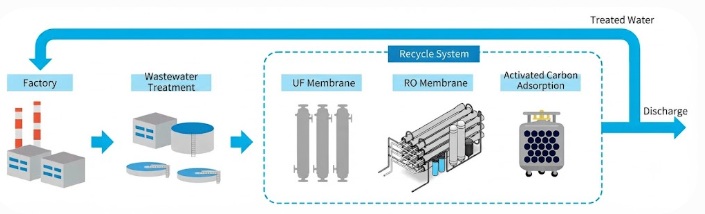
What Is Membrane Technology in Water Treatment?
How Membrane Filtration Works
Basically, a membrane behaves like a kinda selective shield that, under pressure, sort of filters water pollutants based on particle size charge, or even molecular weight. In most standard water treatment, people commonly lean on microfiltration, ultrafiltration, nanofiltration, reverse osmosis and also electrodialysis as the usual lineup. Once the water tries to cross that membrane, it effectively holds back a mix of stuff—from dissolved salts, and organics, all the way to bacteria and suspended solids. This way, you get clean permeate moving through, while you don’t really need chemical phase changes.
Key Membranes at a Glance
Each membrane type targets different contaminants: microfiltration is best at removing suspended solids and larger microorganisms; ultrafiltration captures colloids, viruses and macromolecules; nanofiltration rejects multivalent ions and organic matter while reverse osmosis provides near complete desalination – with the best combination depending on both influent water quality and the end-use application.
Why Membrane Technology Is Central to Industrial Water Reuse
Reducing Freshwater Intake and Discharge Volume
Just 0.01% of the planet’s total water is accessible to humans, given that the vast majority of fresh water is frozen or stored in remote aquifers. In this context membrane-based reclamation allows facilities to reuse water for production instead of continuously drawing water from groundwater or municipal sources, thereby reducing consumption and fees for discharge.
Meeting Zero Liquid Discharge (ZLD) and Environmental Compliance
Since traditional treatment methods have been unsuccessful in making water suitable for agricultural, industrial and household reuse membrane technology has now become the most preferred method of reclaiming water from a variety of water sources. For facilities that have rigid discharge limits or zero discharge goals for liquids membranes are usually the solution that bridges the gap between the raw effluent and reuseable water.
Lowering Long-Term Operating Costs. Traditional Treatment
While the initial cost of a membrane-based system could be higher than that of conventional clarification, its operating costs are improved over time. This includes less chemical dosage, a smaller footprint, and less fees for wastewater and freshwater. Facilities that incorporate reuse into their water balance typically have paybacks in a matter of years, particularly in water stressed regions.
Core Membrane Processes Used for Water Recycling
Ultrafiltration (UF) — Pretreatment & Suspended Solids Removal
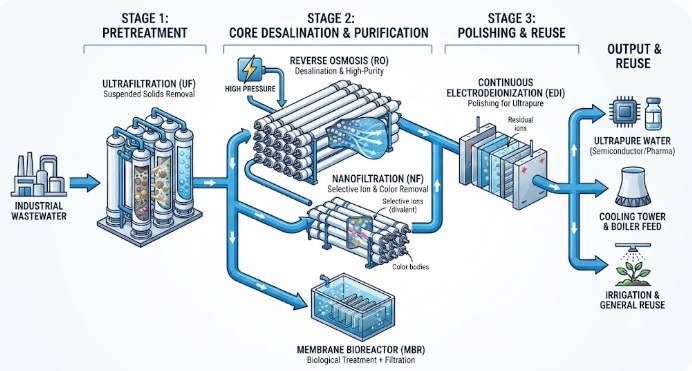
UF is often used in the pretreatment phase prior to of RO to protect downstream membranes from contamination by getting rid of suspensions of colloids, suspended solids and pathogens prior to the high-pressure desalination process starts.
Reverse Osmosis (RO) — Desalination & High-Purity Recovery
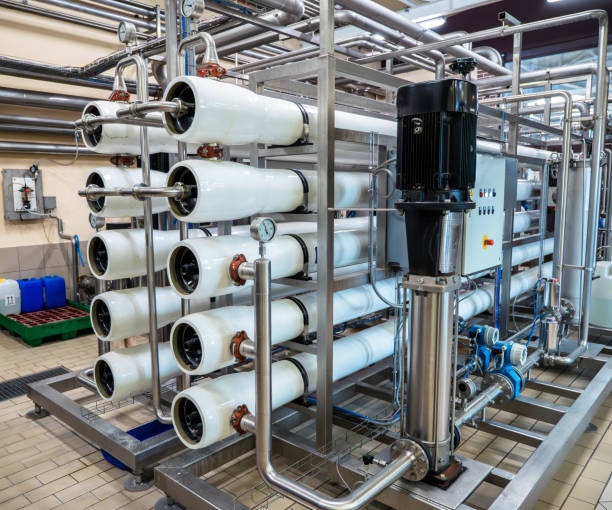
Of the membrane technology options available to purify water reverse osmosis has been the most popular choice because of its ease of use in operation and efficiency. however it is still confronted with issues with fouling and pressure needs. RO is the mainstay for making boiler feed water and cooling tower makeup as well as process grade purified water from industrial waste.
Nanofiltration (NF) — Selective Ion & Organic Removal
NF is located in between UF as well as RO in terms of selectivity, making it ideal for color removal, softening as well as partial desalination. In a case study, an NF90 membrane was able to treat the wastewater from manufacturing electronics to a level that was in line with the standards of cooling water circulation which demonstrated the value of NF in closed loop industrial reuse.
Membrane Bioreactor (MBR) — Biological Treatment Plus Filtration
MBR is a combination of the biological removal of organic pollutants and membrane separation in one step, creating effluents that are that is clean enough to be reused for cooling, irrigation or even further RO polishingAll with less footprint than traditional activated Sludge Systems.
EDI — Polishing for Ultrapure Water Applications
Electrodeionization is a process that removes any remaining ions from RO and produces the ultrapure water required for pharmaceutical, semiconductor and lab applications where conductivity as well as TOC standards are extremely strict.
Industrial Applications of Membrane-Based Water Reuse
Pharmaceutical & Biotech Manufacturing
Pharmaceutical facilities use Multi-strate membrane train (UF-RO-EDI) to ensure that they meet pharmaceuticalcopeia-grade pure water as well as Water for Injection requirements, as well as recycling rinse water whenever GMP allows.
Food & Beverage Processing
For food and beverage operations membrane systems support water recovery, so process water can be used again for wash downs and utilities. That means less fresh water is pulled from sources, even as sanitation rules stay strict and enforced without compromise.
Textile Wastewater Recycling
The textile dyeing effluent is known to be colored and salinity-rich RO and NF combinations are frequently used to recover the process water that can be reused and to reduce the cost of treating discharges.
Power Plant Boiler Feed & Cooling Water Reuse
Power generation sites use RO plus EDI to create low conductivity boiler feed water. At the same time, membrane conditioned reclaimed water is used as cooling tower makeup, which cuts the dependence on freshwater withdrawal, and keeps supply more stable overall.
Common Challenges and How to Overcome Them
Membrane Fouling and Scaling
Fouling is the most enduring problem for membrane systems. The ongoing research into the development of ceramic and polymeric design of membrane modules, fouling management strategies, and cleaning methods is expanding the avenues to reclaim water for potable or industrial reuse. In reality, a an effective pretreatment (coagulation or UF cartridge filtering) coupled with regular chemical cleaning like acid washesgreatly extends the life of membranes.
Energy Consumption and System Optimization
RO processes that are high-pressure require a lot of energy. Utilizing the most efficient recovery rates, energy recovery devices and adjusting systems according to the actual data on flow and water quality will significantly reduce operating costs.
Concentrate and Brine Management
Every membrane system generates a reject stream that must be managed responsibly, whether through further concentration, beneficial reuse, or ZLD crystallization — a factor that should be planned for at the design stage, not as an afterthought.
How to Choose the Right Membrane System for Your Facility
Key Factors: Water Quality, Flow Rate, and Reuse Goals
Start with a water quality analysis of your influent and a clear definition of your reuse target — cooling water, boiler feed, or potable-grade — since these determine which membrane combination and pretreatment train will actually work.
Turnkey vs. Modular System Considerations
Production facilities that fluctuate or have multiple sites can benefit from skid-mounted, modular systems that can scale the flow rate either up or down, whereas large continuous operations typically favor turnkey systems that are fully engineered.
Why Work with an Experienced Manufacturer
The primary benefit of membrane technology lies in its ability to provide consistent water quality because these methods are particularly effective in separating pathogens from contaminants for reuse applications that demand top-quality output. However, this is only if the system is properly designed and maintained. Partnering with a company that has extensive, hands-on experience with industrial, pharmaceutical and municipal projects minimizes the possibility of underperformance assists in navigating standards for accreditation, and offers ongoing support for the cleaning process, parts replacement and system improvement.
Membrane technology has evolved from a niche polishing process to become the core of an industrial water reuse strategies cutting intake of freshwater, allowing discharge requirements, and lowering the long-term cost of food and drink, pharmaceutical as well as the textile and power industries. The ideal mixture with UF, RO, NF, MBR, and EDI depends on your water’s chemistry and reuse needs that’s why expert design of the system is as crucial in the process itself.
If you’re evaluating a membrane-based water reuse solution for your facility, Molewater’s engineering team can review your water data and recommend a system tailored to your production line — get in touch for a free consultation and quote.