In October 2025, one New York City community cluster linked to contaminated cooling towers ended up with over a hundred confirmed Legionnaires’ disease cases , and several deaths. That same month, an Illinois nursing home traced its own outbreak directly back to a cooling tower. Neither facility had ignored maintenance entirely — the gaps were in dosing consistency and monitoring. Let’s break down exactly how cooling tower water treatment chemicals control Legionella, which chemical categories matter most, and what a genuinely compliant program looks like.
Why Cooling Towers Are a Natural Breeding Ground for Legionella
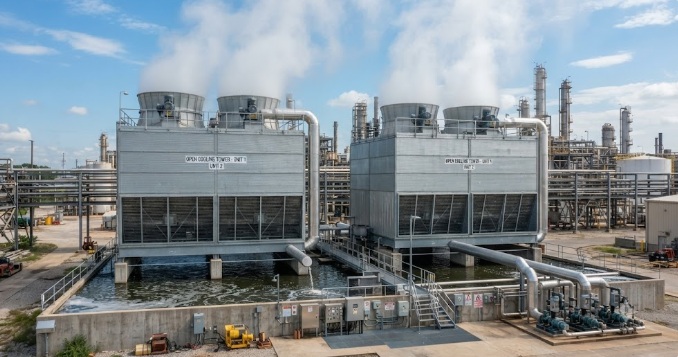
Cooling towers aren’t accidentally hospitable to Legionella — their basic physics make them ideal incubators. Cooling towers frequently operate within the temperature band that represents Legionella’s optimal growth range, and that warm, moist, aerosolized environment is difficult to avoid given how evaporative cooling works.
The layering on top of temperature is the issue of buildup. When water evaporates from a cooling tower it creates liquid solids that should, if not controlled and untreated, will form a layer on surfaces for heat exchange, decreasing effectiveness and creating rough minerals-scaled surfaces. Biofilm and scale serve as physical shelters and shield bacteria from disinfectants while giving Legionella an ideal surface on which to live on. This is the reason why chemical treatments aren’t a discretionary add-on that can be added to the list — it’s the main protection against danger that’s built into the cooling tower’s structure.
How Treatment Chemicals Actually Kill Legionella
Real Legionella control , mostly comes down to two chemical mechanisms that play together, not some one product that magically does everything. Kind of a team effort, even if the brochures talk like it’s a single silver bullet.
Oxidizing biocides are the front line. They work by chemically attacking bacterial cell walls, plus they oxidize the organic stuff floating around in the water. Sodium hypochlorite is the one you see most often in cooling tower water programs, because it’s fast and it works broadly on waterborne bacteria, Legionella included.
Then there are non-oxidizing biocides, and also biofilm penetrants. These cover the gaps where oxidizers often can’t quite get through. Once a mature biofilm has formed it acts like a physical shield, so bacteria living inside it can hide from the oxidizing chemicals. That’s why many treatment programs rotate non-oxidizing agents, to loosen that protective layer, and to reduce the chance that bacteria get used to just one chemical class over time.
None of this really works alone. Corrosion and scale inhibitors—things like phosphonates, polymeric dispersants, and metal protective agents—help stop mineral buildup and passivate steel and copper alloys. And that’s not a minor detail, because scaled or corroded surfaces are basically the perfect place for biofilm to grab on.
In short: biocides do the killing, while inhibitors keep the “real estate” out of reach so bacteria can’t hide as easily.
The Key Chemical Categories in a Legionella Control Program
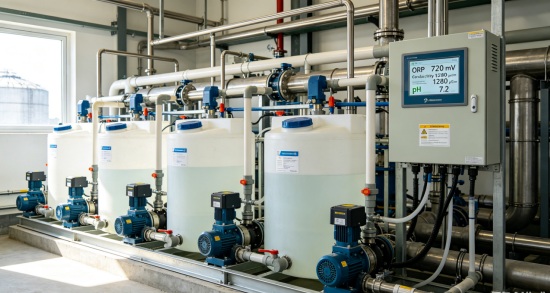
The complete program of cooling tower chemicals for water purification usually comprises four types:
- Biocides that oxidize (sodium hypochlorite bromine-based chemicals) – quick-acting and broad-spectrum bacterial controls
- Non-oxidizing biocides – rotated to penetrate the biofilm and thereby stop resistance
- Scale and corrosion inhibitors protect metal surfaces from corrosion and also prevent the buildup of minerals that can shelter bacteria
- Dispersants — keep biofilm and particulate fouling from settling and accumulating
Corrosion inhibitors remain the largest segment of the cooling water treatment chemicals market, holding a 32.5% share in 2024 — a reminder that scale and corrosion control is just as central to Legionella prevention as biocide dosing itself. This market is changing: the growth is driven by the growing demand for demands for cooling in data centers and an overall shift towards bio-based treatment chemistries that are carbon-negative that replace the phosphonate-based programs of the past which reflect the increasing security and environmental standards across the entire industry.
Chemicals Alone Aren’t Enough: Monitoring and Dosing Consistency
Chemistry only works if it’s delivered consistently. In both the New York and Illinois cases referenced earlier, the underlying failure wasn’t an absence of treatment protocols — it was a breakdown in execution: interrupted dosing, delayed corrective action, or monitoring intervals too wide to catch problems early.
This is the reason testing frequency is just as important as the selection of chemicals. Cooling towers Legionella testing frequency varies by region, but usually will require sampling of the culture at minimum every 90 days during the time the tower is in operation. Regulations are tightening –the NYC Local Law 159 will require monthly Legionella testing starting in May 2026. This is a significant leap from the 90-day standard that is currently in place elsewhere. Facilities are increasingly combining chemical dosing with real-time conductivity ORP and flow monitoring to ensure that a malfunctioning feed pump or gap in the delivery of chemicals will trigger an alert in just hours instead of months.
Compliance Framework: ASHRAE 188 and What It Requires
The most effective Legionella prevention requires maintenance, chemical treatment and monitoring, as well as the creation of a Water Management Plan aligned with ASHRAE 188. In reality this translates to chemical treatment is just one aspect of an overall accountability framework that includes risk assessment, clearly defined limit of control, schedules for sampling and documented corrective measures in the event that parameters are out of their range. Auditors and regulators don’t only need clean water- they also want a trail to prove that the water was kept in good condition throughout the year and that’s exactly the kind of record a well-run chemical plan that is backed by data from monitoring, is created to provide.
When Chemical Treatment Isn’t Enough: Source Water Quality Matters Too
Chemical dosing addresses the microbial and mineral load already circulating in the system, but it doesn’t control what enters the system in the first place. Makeup water carrying high hardness, suspended solids, or organic content raises the baseline scaling and fouling burden on a cooling tower, forcing higher biocide and inhibitor consumption just to hold the line — and giving biofilm more raw material to work with.
This is where pretreatment becomes a practical complement to chemical dosing rather than a separate conversation. Reducing hardness and suspended solids before water ever reaches the tower lowers the scaling and biofilm risk that chemicals are then asked to manage, which can meaningfully reduce both chemical consumption and Legionella risk over time. It’s a two-part strategy: chemistry manages what’s circulating, while pretreatment reduces what needs managing in the first place — the combination that well-run industrial and data center cooling systems increasingly rely on.
Building a Complete Legionella Prevention Strategy
- Maintain consistent oxidizing and non-oxidizing biocide dosing to prevent bacterial resistance
- Control scale and corrosion — the surfaces biofilm depends on to survive treatment
- Improve makeup water quality to reduce the fouling load chemicals must offset
- Follow an ASHRAE 188-aligned Water Management Plan with documented monitoring
- Use real-time monitoring to catch dosing interruptions before they become outbreaks
Legionella outbreaks tied to cooling towers are rarely caused by a single missing chemical — they’re caused by gaps between chemical treatment, water quality, and monitoring discipline. Closing those gaps costs far less than the remediation, regulatory fines, and downtime that follow an outbreak. If your facility’s makeup water quality is adding unnecessary load to your chemical treatment program, it may be worth evaluating pretreatment options alongside your existing water treatment strategy — contact us to discuss what a combined approach could look like for your system.