Industrial wastewater is one of the most pressing environmental challenges facing manufacturers today. Whether you run a pharmaceutical plant, a semiconductor fab, or a food processing facility, the wastewater your operation generates carries contaminants that cannot simply be sent down the drain. Discharge regulations are tightening globally, water costs are rising, and the pressure to demonstrate environmental responsibility has never been greater.
This guide covers everything you need to make informed decisions about industrial wastewater treatment, from understanding what goes into your wastewater, to selecting the right combination of technologies, to knowing what questions to ask a system supplier.
What Is Industrial Wastewater Treatment?
Definition and Treatment Objectives
Industrial wastewater treatment refers to the process of removing contaminants from water generated by manufacturing, processing, and other industrial activities before it is discharged, reused, or further concentrated.
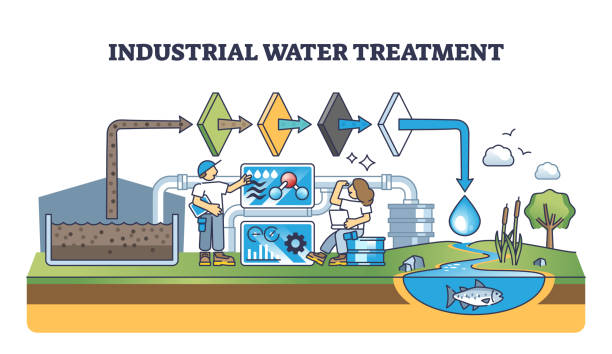
Rather than relying on a single piece of equipment, most treatment systems combine multiple technologies. Each stage targets specific contaminants, and the overall process is designed according to wastewater quality and treatment goals.
Most industrial facilities focus on one of three objectives:
- Regulatory compliance – meeting discharge limits before releasing wastewater to a sewer system or natural water body.
- Water reuse – recovering treated water for reuse within industrial operations to reduce freshwater consumption.
- Zero Liquid Discharge (ZLD) – eliminating liquid waste by recovering water and converting the remaining contaminants into solid residues.
Industrial Wastewater vs. Municipal Wastewater
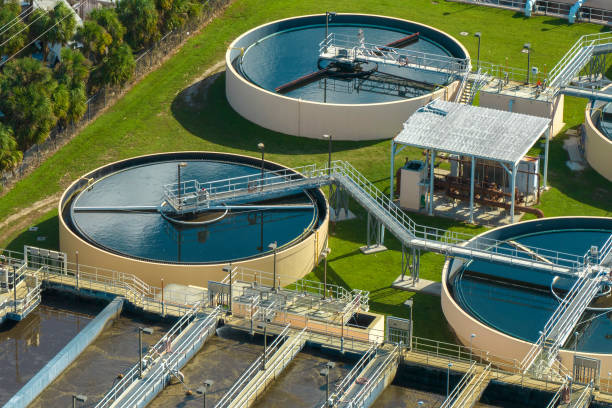
Industrial wastewater is generally more complex and variable than municipal wastewater. While municipal wastewater mainly contains organic matter from households and commercial buildings, industrial wastewater can contain dissolved salts, heavy metals, oils, chemicals, or high-strength organic pollutants depending on the production process.
Because wastewater characteristics vary significantly between industries and even between facilities in the same industry—treatment systems must be designed around site-specific water quality rather than using a standard, one-size-fits-all approach.
How Industrial Wastewater Treatment Works: A Step-by-Step Overview
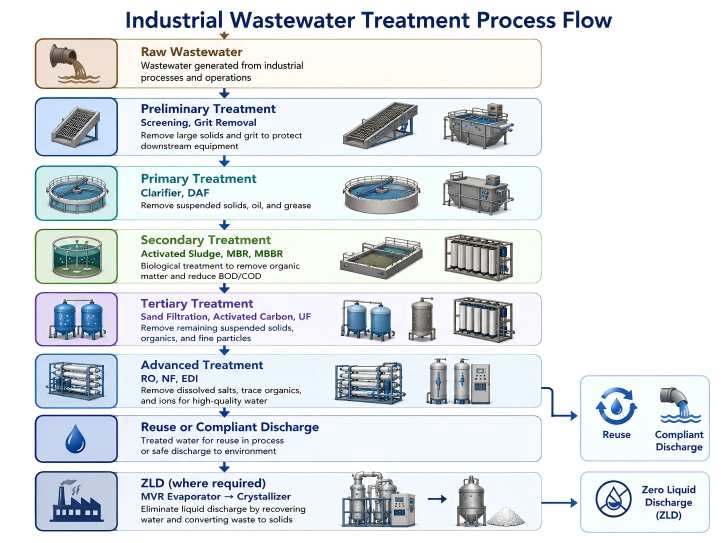
A full treatment train rarely involves just one technology. Instead, it builds through stages, with each step conditioning the water for the next. Here is how a typical system progresses from raw wastewater to clean effluent or reusable water.
Step 1: Preliminary Treatment
Before any serious treatment can begin, large solids need to be removed, otherwise they damage equipment downstream. Screens and bar racks capture debris, while grit chambers allow sand and heavy particles to settle out. This step is straightforward, but skipping or undersizing it creates operational problems that ripple through the entire system.
Step 2: Primary Treatment
Primary treatment uses physical separation to remove suspended solids and free-floating oils and greases. Clarifiers allow particles to settle under gravity, while dissolved air flotation (DAF) systems work in the opposite direction, generating fine bubbles that carry oil and low-density particles to the surface for skimming.
DAF is particularly effective in food processing, petrochemical, and other industries where oil and grease in the wastewater is a significant concern. For streams with heavy oil loading, it is often the first meaningful treatment step after preliminary screening.
Step 3: Secondary Treatment (Biological)
Secondary treatment is where the bulk of organic contaminants — measured as BOD and COD — are removed. Microorganisms break down biodegradable compounds, reducing the organic load to levels that allow further treatment or compliant discharge.
The most common biological approach is the activated sludge process, where bacteria are maintained in an aeration tank and the resulting biomass is settled out in a secondary clarifier. Membrane bioreactors (MBR) combine biological treatment with ultrafiltration in a single unit, producing a cleaner effluent in a smaller footprint. Moving Bed Biofilm Reactors (MBBR) offer another alternative, particularly where existing infrastructure needs to be upgraded without large civil works.
Biological treatment is cost-effective for high-BOD wastewater, but it has limits. Streams containing high concentrations of heavy metals, salts, or toxic organics can inhibit or kill the microbial population, which is why pre-treatment sequencing matters.
Step 4: Tertiary Treatment
After biological treatment, the water still contains residual suspended solids, trace organics, and color. Tertiary treatment polishes the effluent to meet discharge standards or to prepare it for membrane-based advanced treatment.
Sand filtration is the workhorse at this stage, removing fine particles that carry over from secondary clarifiers. Activated carbon filtration handles residual organics and color. Ultrafiltration (UF) membranes provide an even higher level of solids removal and act as a reliable barrier before reverse osmosis systems — protecting the RO membranes from fouling.
Step 5: Advanced Treatment for Water Reuse
When the goal is water reuse rather than just discharge compliance, reverse osmosis (RO) becomes the central technology. RO membranes reject dissolved salts, trace organics, and microorganisms, producing a permeate stream clean enough for many industrial applications.
For applications requiring very high purity water, such as boiler feedwater or semiconductor rinse water, electrodeionization (EDI) is added after RO. EDI uses ion exchange resin and an electric field to continuously remove the remaining trace ions without the need for chemical regeneration — making it a cleaner and more consistent alternative to traditional mixed-bed ion exchange polishing.
The combination of UF → RO → EDI is now a standard configuration for high-recovery water reuse systems in power, pharmaceutical, and electronics applications.
Step 6: Zero Liquid Discharge (When Required)
When discharge is not an option, either due to regulations, water scarcity, or the economics of high-volume brine disposal, ZLD becomes the target. At this stage, the concentrated reject streams from RO are fed into thermal evaporation systems, most commonly mechanical vapor recompression (MVR) evaporators, which concentrate the brine further. A crystallizer then converts the remaining liquid into a solid salt cake for disposal or recovery.
MVR technology reuses the latent heat of evaporation to reduce energy consumption significantly compared to traditional multi-effect evaporation, which makes it the more practical choice for large-scale ZLD applications.
ZLD is not the right solution for every facility, the capital and operating costs are substantial, but for industries with no viable discharge pathway, or those targeting full water circularity, it is increasingly the direction of travel.
Industrial Wastewater Treatment Technologies: How They Compare
Physical Treatment Technologies
Physical methods rely on mechanical forces — gravity, pressure, and filtration — rather than chemical reactions or biological activity. They are reliable, relatively low-cost, and effective for removing solids, oil, and suspended matter. Their limitation is that they cannot address dissolved contaminants, which is why they almost always serve as a front-end stage rather than a complete solution.
Key technologies: screening, sedimentation, DAF, multimedia filtration.
Chemical Treatment Technologies
Chemical treatment uses reagents to change the form of contaminants — converting dissolved metals into precipitable solids, breaking emulsions, or oxidizing persistent organic compounds. Coagulation and flocculation work by destabilizing suspended particles and aggregating them into settleable flocs. Chemical precipitation is the primary method for heavy metal removal. Advanced oxidation processes (AOP), using combinations of ozone, hydrogen peroxide, or UV, can break down compounds that biological treatment cannot handle.
The main drawback of chemical treatment is operational cost, reagent consumption, pH management, and sludge generation all add to ongoing expenses.
Biological Treatment Technologies
Biological treatment is the most cost-effective way to reduce high organic loads. Aerobic processes where bacteria consume organics in the presence of oxygen are the most widely used, while anaerobic digestion handles very high-strength streams and has the advantage of generating biogas as a recoverable byproduct.
MBR systems are increasingly preferred over conventional activated sludge in industrial applications because they combine biological treatment and membrane filtration in a single step, produce a consistently high-quality effluent, and require less space.
However, biological systems require careful management. They are sensitive to toxic influent, temperature swings, and hydraulic shock loads, all of which are common in industrial settings.
Membrane Treatment Technologies
Membrane technologies cover a spectrum of separation performance, defined by the pore size of the membrane and the type of pressure applied.
| Technology | Pore Size | What It Removes | Typical Application |
| Microfiltration (MF) | 0.1–10 µm | Suspended solids, bacteria | Pre-UF or pre-RO |
| Ultrafiltration (UF) | 0.01–0.1 µm | Colloids, macromolecules, viruses | Pre-RO treatment |
| Nanofiltration (NF) | 0.001–0.01 µm | Multivalent ions, organics | Partial desalination |
| Reverse Osmosis (RO) | <0.001 µm | Dissolved salts, TDS | Water reuse, ZLD feed |
RO is the technology that makes high-recovery water reuse economically viable. A well-designed RO system can recover 70–85% of the feed water as usable permeate, with the remainder concentrated into a brine stream for further treatment or disposal.
Thermal Treatment Technologies
Evaporation and crystallization are the technologies of last resort, applied when liquid streams are too concentrated or too contaminated for membrane treatment to handle. MVR evaporators use mechanical compression to recycle vapor energy, significantly reducing the steam consumption compared to traditional evaporation. Crystallizers take the concentrated brine from evaporation and drive it to the point where dissolved salts precipitate out as solids.
These technologies carry the highest capital and energy costs in the treatment train, which is why careful upstream treatment to minimize the volume reaching this stage is always worthwhile.
Types of Industrial Wastewater Treatment Systems
Conventional Physical-Chemical Systems
These systems combine screening, clarification, coagulation/flocculation, and sand filtration. They are the lowest-cost option to build and operate, and they are appropriate when wastewater composition is relatively straightforward and discharge limits are not particularly stringent. They do not provide the dissolved solids removal needed for water reuse, and they may struggle with highly variable or complex influent streams.
Biological and Membrane Hybrid Systems
Combining MBR or MBBR biological treatment with downstream UF provides a compact, high-performance solution for wastewater with high organic loading. The membrane barrier eliminates the need for a secondary clarifier and produces an effluent consistently clean enough for non-potable reuse applications. This configuration is increasingly common in food, beverage, and pharmaceutical facilities where land is limited and discharge standards are strict.
Membrane-Based Water Reuse Systems
Where water reuse is the primary goal, the core treatment train is UF → RO, often with EDI added for high-purity applications. These systems are engineered around maximizing water recovery typically 75–85% while managing the concentration of contaminants in the reject stream. Pre-treatment quality is critical: RO membranes are sensitive to fouling, scaling, and oxidants, and a poorly designed pre-treatment stage leads to shortened membrane life and higher operating costs.
Zero Liquid Discharge Systems
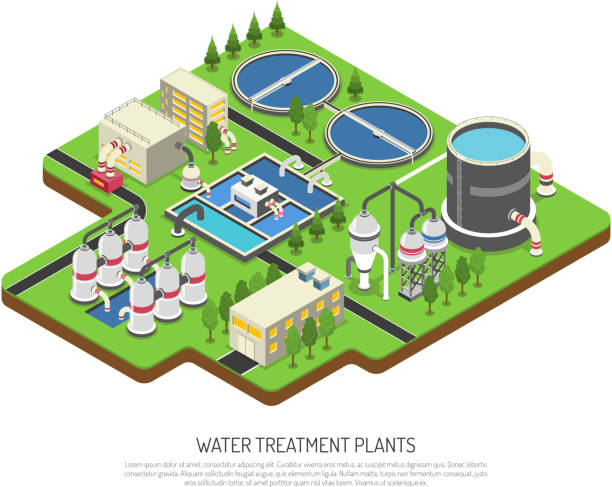
ZLD systems extend the membrane-based reuse configuration with thermal concentration and crystallization at the back end. The full train — biological or chemical pre-treatment → UF → RO → MVR evaporator → crystallizer — is the most complex and capital-intensive option, but it achieves complete elimination of liquid discharge. ZLD is most prevalent in the chemical, textile, and power generation sectors, and is increasingly required in water-stressed regions of China, India, and the Middle East. According to a Global Water Intelligence market report, ZLD adoption in industrial sectors has grown steadily as regional environmental agencies tighten discharge standards.
Industry Applications: Which Treatment Approach Fits Your Sector
| Industry | Main Challenges | Typical Treatment Process |
| Chemical | High TDS, heavy metals | Precipitation → UF → RO |
| Pharmaceutical | Organic contaminants | Biological → UF → RO |
| Food & Beverage | High BOD, FOG | DAF → Biological → UF |
| Power Plant | Blowdown, high purity requirements | UF → RO → EDI |
| Semiconductor | Water reuse, heavy metals | UF → RO → EDI |
| Textile | Color, salinity, COD | AOP → Biological → RO → ZLD |
While treatment requirements vary by facility, the process configurations above represent the most common approaches used across each industry.
How to Choose the Right Industrial Wastewater Treatment System
The best wastewater treatment system is not necessarily the most advanced one—it is the one that matches your wastewater characteristics, treatment goals, and regulatory requirements.
Step 1: Analyze Your Wastewater
Start by understanding what you need to treat. Key parameters include flow rate, TDS, COD, BOD, pH, suspended solids, and heavy metals. For complex wastewater streams, a treatability study or pilot test can help ensure the selected technology is suitable.
Step 2: Define Your Treatment Objective
Determine whether your goal is discharge compliance, water reuse, or Zero Liquid Discharge (ZLD). Different objectives require different treatment technologies, costs, and system configurations.
Step 3: Review Regulatory Requirements
Discharge standards vary by industry and location. Understanding current and future regulatory requirements early in the design process helps avoid costly system modifications later.
Step 4: Consider Total Cost of Ownership
Do not focus only on initial investment. Evaluate long-term operating costs, including energy consumption, chemical usage, maintenance, membrane replacement, and labor requirements.
Step 5: Plan for Future Growth
Production demands and regulations can change over time. Modular and scalable systems provide greater flexibility and make future capacity expansions easier and more cost-effective.
What Drives the Cost of an Industrial Wastewater Treatment System?
There is no fixed price for an industrial wastewater treatment system. Costs vary widely depending on wastewater characteristics, treatment goals, and system capacity. For most industrial projects, treatment objectives and wastewater quality have a greater impact on cost than system size alone.
Wastewater Volume and Flow Rate
Larger flow rates require bigger tanks, pumps, membranes, and supporting infrastructure, increasing overall project costs. However, larger systems often achieve lower treatment costs per cubic meter through economies of scale.
Contaminant Type and Concentration
Wastewater containing high TDS, heavy metals, or complex organic compounds typically requires additional treatment stages. As contaminant levels increase, both capital investment and operating costs rise.
Treatment Goal: Discharge, Reuse, or ZLD
The required water quality has a major influence on system design. A discharge-focused system is usually far less expensive than a water reuse or ZLD solution, which requires advanced treatment and higher recovery rates.
Technology Selection
Different technologies offer different balances between capital and operating costs. For example, membrane systems generally require higher initial investment but can improve water recovery and reduce long-term operating expenses.
Cost Influence Summary
| Factor | Relative Cost Impact |
| Flow rate above 100 m³/h | High |
| High TDS (>5,000 mg/L) | High |
| ZLD requirement | Very High |
| Water reuse target (>75% recovery) | Medium–High |
| Heavy metals or persistent organics | High |
| Automation and remote monitoring | Medium |
| Modular vs. fully custom design | Medium |
Ready to Design a System for Your Facility?
Industrial wastewater treatment is not a product you purchase off the shelf, it is a system you engineer around your specific water quality, your operational constraints, and your discharge or reuse objectives. Getting the configuration right from the start saves significant cost and operational headache over the life of the system.If you have a specific discharge challenge or water reuse target in mind, contact our team for a consultation based on your actual water quality data and operational requirements.