If you’ve ever looked into water softeners or industrial water purification, you’ve probably come across the term “ion exchange resin.” It sounds technical, but the underlying concept is fairly straightforward and understanding it can help you make better decisions about water treatment, whether you’re managing a facility or simply trying to understand what’s inside your home softener.
This article covers what ion exchange resin is, how the process works, the main types available, and where they’re actually used.
What Is Ion Exchange Resin?
Ion exchange resin is a solid, bead-like material that removes dissolved ions from water by swapping them with other ions of the same electrical charge. It doesn’t chemically react with the water itself, it acts more like a highly selective sponge that captures unwanted ions and releases harmless ones in their place.
The resin is made from a cross-linked polymer matrix, usually polystyrene, with charged chemical groups (called functional groups) attached throughout its structure. These functional groups are what give the resin its ion-capturing ability. Depending on the type of resin, those groups will attract either positively charged ions (cations) or negatively charged ions (anions).
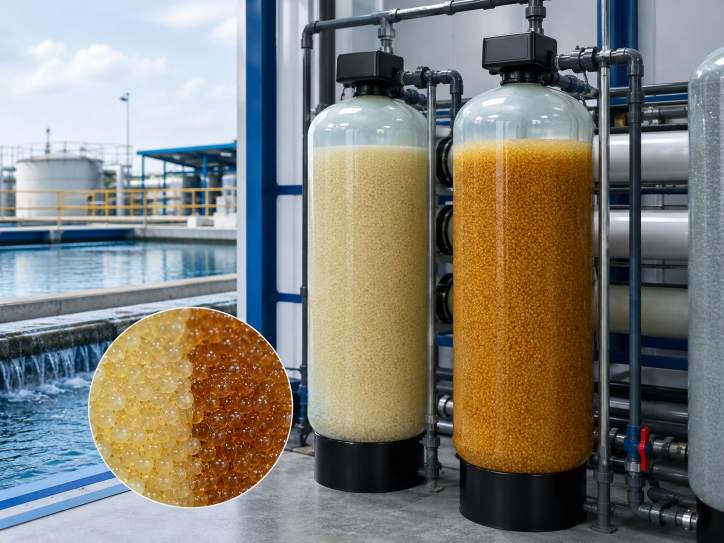
Physically, most resins look like tiny, smooth beads typically between 0.25 and 1.25 millimeters in diameter. They’re packed into a column or tank, and water flows through the resin bed during treatment.
For a closer look at how this process applies to everyday water softening, see how ion exchange resins convert hard water to soft water.
How Does Ion Exchange Resin Work?
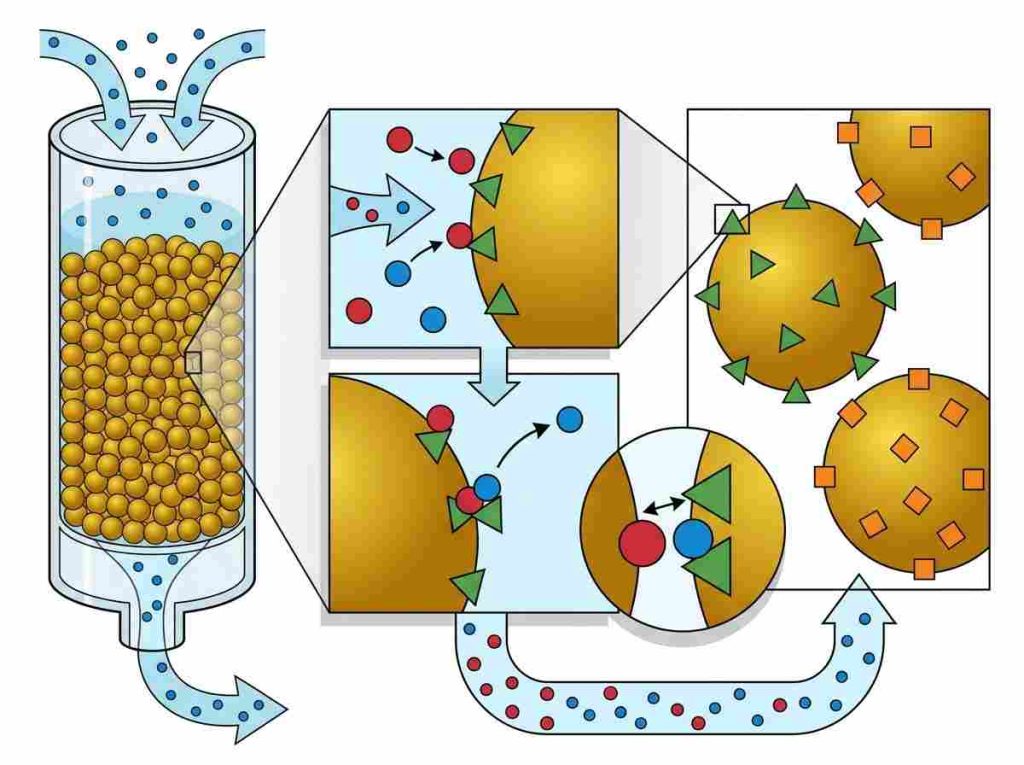
The core mechanism is a reversible chemical exchange. When water containing unwanted ions flows through the resin bed, the resin’s functional groups attract those ions and hold onto them, while simultaneously releasing different ions back into the water.
Here’s a simple breakdown of what happens during a treatment cycle:
Water enters the resin column and passes through millions of tiny resin beads. As it moves through, dissolved ions in the water come into contact with the functional groups on the resin surface. If the resin has a stronger attraction to those ions than to the ones it’s currently holding, a swap occurs. The unwanted ions bond to the resin, and the previously held ions are released into the treated water stream.
Take water softening as a practical example. Hard water contains calcium (Ca²⁺) and magnesium (Mg²⁺) ions, the minerals responsible for scale buildup in pipes and appliances. In a softening system, the resin is pre-loaded with sodium ions (Na⁺). Because the resin has a stronger affinity for calcium and magnesium than for sodium, those hardness ions displace the sodium when the water flows through. The result: softened water exits the system, with calcium and magnesium left behind on the resin.
This process continues until most of the resin’s exchange sites are occupied, at which point the resin needs to be regenerated.
What Are the Main Types of Ion Exchange Resin?
Not all resins work the same way. The right type depends on what you’re trying to remove from the water and under what conditions. There are four main categories:
Strong Acid Cation (SAC) resin is the most widely used type. It operates across a broad pH range and is effective at removing positively charged ions like calcium, magnesium, sodium, and heavy metals. It’s the standard choice for water softening and demineralization.
Weak Acid Cation (WAC) resin is more selective and works best in higher-pH water. It has a high affinity for hardness ions associated with alkalinity and is often used in combination with SAC resin to reduce regenerant consumption.
Strong Base Anion (SBA) resin targets negatively charged ions, including chloride, sulfate, nitrate, and silica. It functions across a wide pH range and is a key component in full demineralization systems.
Weak Base Anion (WBA) resin is used primarily to remove strong mineral acids (like hydrochloric and sulfuric acid) from water. Unlike the other types, it doesn’t carry exchangeable ions, it absorbs acids directly.
Within each category, resins also come in two structural forms. Gel resin beads are translucent, have high exchange capacity, and work well in clean water applications. Macroporous resins are opaque and more physically robust, making them better suited for water with higher contamination levels or where organic fouling is a risk.
How Is Ion Exchange Resin Used in Water Treatment?
Ion exchange resin has a wide range of applications in water treatment, and the specific use case determines which resin type is appropriate.
Water softening is the most familiar application. Municipalities, hotels, food manufacturers, and households use cation exchange resin to remove hardness ions and prevent scale accumulation in pipes, boilers, and equipment.
Demineralization takes the process further by removing nearly all dissolved salts from water. This level of purity is required in power generation (to protect steam turbines and boilers), semiconductor manufacturing, and pharmaceutical production where even trace contaminants can affect product quality.
Heavy metal removal is another important use, particularly in industrial and mining wastewater. Specialty resins including chelating resins can selectively target metals like lead, copper, chromium, and mercury that standard filtration cannot capture. The U.S. EPA recognizes ion exchange as an established technology for removing contaminants such as nitrate, arsenic, and radium from drinking water.
Food and beverage production relies on ion exchange for decolorization, deacidification, and flavor stabilization in products like fruit juice, wine, and dairy. The resins used in these applications must meet food-contact safety standards.
In each of these settings, the core advantage of ion exchange over standard filtration is the same: it removes dissolved ionic contaminants that physical filters simply cannot catch.
How Does an Ion Exchange Column Work?
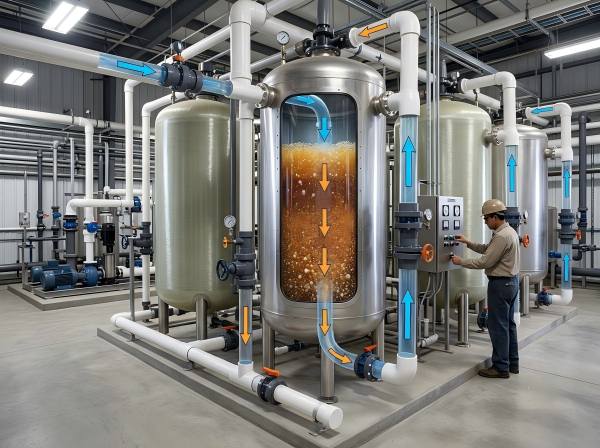
The ion exchange column sometimes called a resin bed or vessel is where the actual treatment happens. Understanding the column setup helps clarify how the process is managed in practice.
A typical column is a cylindrical tank filled with resin beads. Water enters from the top (or bottom, depending on the system design) and flows through the packed resin bed. As it passes through, ion exchange occurs across the surface of millions of individual beads. Treated water exits from the opposite end.
The depth and volume of the resin bed determine how much contact time the water has with the resin ,and therefore how thoroughly ions are removed. Systems treating large volumes of water or targeting very low ion concentrations typically use deeper beds or multiple columns in series.
In continuous-use environments, dual-column or multi-bed designs are common. While one column is in active service, another can be regenerating offline, ensuring a consistent supply of treated water without interruption. Mixed-bed systems, which combine cation and anion resins in a single vessel, are used when ultra-high purity water is required, such as in electronics manufacturing or laboratory settings.
What Is Ion Exchange Resin Regeneration?
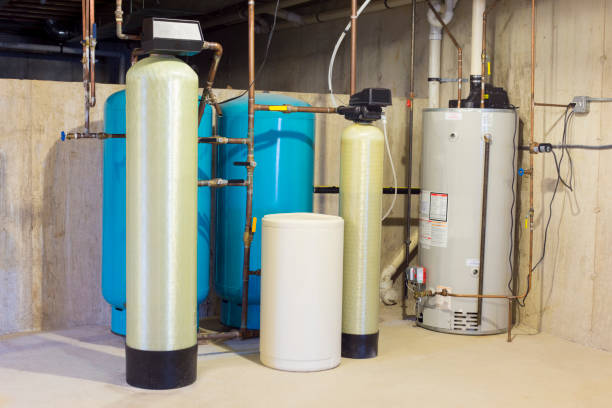
Resin doesn’t last indefinitely in a single cycle. Once all the available exchange sites are occupied by captured ions, the resin is considered exhausted and can no longer treat water effectively. This is where regeneration comes in.
Regeneration reverses the ion exchange reaction by flushing the resin with a concentrated solution, typically salt brine (NaCl) for cation resin, or a caustic or acid solution for anion resin. The high concentration of ions in the regenerant displaces the captured contaminants from the resin, which are then flushed out as waste. After rinsing, the resin is restored and ready for the next treatment cycle.
How often regeneration is needed depends on several factors: the volume of water treated, the concentration of ions in the source water, and the capacity of the resin bed. In a residential softener, regeneration might occur every few days. In industrial systems, it can be triggered by conductivity monitoring or treated water volume counters.
One thing to keep in mind is that the regeneration process produces a concentrated waste stream containing the displaced ions. This effluent needs to be properly managed to avoid environmental impact: discharged to a treatment system, or handled according to local regulations.
Ion Exchange Resin vs. Other Water Treatment Methods
Ion exchange is a powerful technology, but it’s not always the right tool for every situation. It’s worth understanding where it stands compared to the alternatives.
Reverse osmosis (RO) uses pressure to push water through a semi-permeable membrane, rejecting a broad range of contaminants including ions, bacteria, and some organic compounds. RO can achieve high purity levels, but it generates significant wastewater, has higher energy costs, and requires membrane replacement over time. Ion exchange tends to be more cost-effective when the goal is targeted ion removal rather than broad-spectrum purification.
Standard filtration (sand, carbon, cartridge) removes suspended particles, sediment, and some organic compounds but it cannot remove dissolved ions. If the problem is hardness, nitrate, heavy metals, or total dissolved solids, filtration alone won’t solve it. Ion exchange fills that gap.
Electrodialysis uses an electric current to drive ion movement across membranes, which can work well for desalination at scale. However, it’s generally less flexible than IX resin systems when it comes to targeting specific contaminants, and the technology carries higher upfront and maintenance costs.
In practice, ion exchange is often used alongside other technologies rather than as a standalone solution. A common configuration pairs RO with a mixed-bed polishing system, where the IX resin handles residual ions that the membrane couldn’t fully remove.
FAQs
What is the difference between cation and anion exchange resin?
Cation exchange resin removes positively charged ions (such as calcium, magnesium, sodium, and heavy metals) and releases other positive ions in return. Anion exchange resin targets negatively charged ions (such as chloride, sulfate, and nitrate). In a full demineralization system, both types are used together to remove essentially all dissolved salts.
How long does ion exchange resin last?
With proper regeneration and maintenance, quality resin typically lasts 5 to 15 years. Lifespan depends on water quality, operating conditions, and how well the regeneration process is managed. Exposure to chlorine, heavy fouling, or improper regenerant concentrations can shorten resin life.
Can ion exchange resin be reused?
Yes, this is one of its key practical advantages. Resin can be regenerated and reused hundreds of times before it needs to be replaced. This makes it a more economical option over the long term compared to single-use filtration media.
What is the ionic exchange process, exactly?
The ionic exchange process refers to the reversible transfer of ions between a liquid (typically water) and a solid resin. Ions in the water are attracted to oppositely charged sites on the resin and held there, while the resin releases other ions of the same charge type into the water. This exchange continues until the resin’s capacity is reached, at which point regeneration restores it for further use.
What is the difference between gel resin and macroporous resin?
Gel resins are translucent, have a higher exchange capacity per volume, and perform well in clean water with predictable ion concentrations. Macroporous resins are more physically durable and resistant to fouling, making them a better choice when the feed water contains organics, oils, or other materials that could coat or degrade a gel-type resin over time.