
A softener that suddenly stops making soft water is rarely as broken as it seems. In most plants, the cause is one of four: untreated water slipping past the resin; regeneration that doesn’t fully restore capacity; a system operating out of design conditions; or resin that has lost performance. Each leaves different marks on your data. When you place the order, they will be checked by an experienced technician to find the real cause before you replace resin, or the whole unit, unnecessarily.
Start With the Data: Is Hardness Really Getting Through?
Check the problem before you touch a valve. Many calls about “failing softener” are actually a stale sample line or test method that can’t reliably read low hardness.
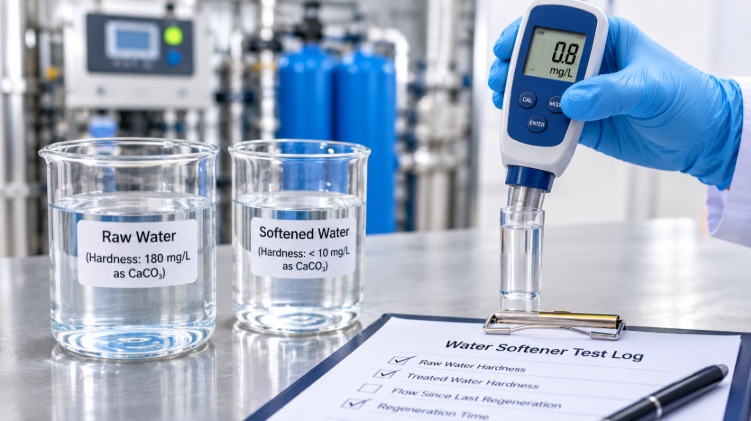
Draw samples from one dedicated port, flush the port first, and test both raw and softened water at the same time, using the same method each time. Make sure your test kit has the right range for near-zero results. Some kits are for screening only.
Start a simple log: raw hardness, treated hardness, volume treated since last regeneration, and regeneration time. Make sure units are consistent. Hardness is typically given in mg/L as CaCO3. One grain per gallon is 17.1 mg/L. For context the USGS considers water above 180 mg/L to be very hard , and lists scaling of equipment as one of the primary reasons utilities avoid it . But your own target is from your boiler, process or RO system, not from a general scale.
If treated hardness is on target but downstream equipment still scales, hardness may not be the problem. Our article on why RO membranes still scale after a water softener covers that case.
Read the Pattern: When Does the Hardness Show Up?
The timing of the problem narrows your search. It won’t hand you a diagnosis, since one symptom can have several causes, but it tells you where to look first.
| What you see | Check first |
| Hardness creeps up over weeks or months | Changes in raw water or demand, falling resin capacity, incomplete regeneration |
| Hardness is high right after regeneration | Brine system, control valve and cycle, bypass leakage, resin condition |
| High at startup, normal after some flow | Stagnant sample line, rinse completeness, system design |
| Still high after program changes | Bypass, resin fouling, channeling, undersized capacity |
The sections below run from quick, low-risk checks to jobs that need a technician and a depressurized vessel, so work through them in order.
Rule Out Untreated Water Reaching the Outlet
Start here because it costs the least. If raw water finds a path around the resin, no amount of regeneration tuning will help.
Look at the bypass valve first and confirm it sits fully in the service position. Then compare raw and treated hardness. Treated water that tracks raw water closely, or swings with no clear pattern, points to a leak path. Also ask whether recent piping work or parallel units created a connection nobody intended.
Worn seals or damaged parts inside the control valve can cause the same thing. Opening a valve on a pressurized system is a job for a qualified technician. The fix is usually a repaired valve, a new seal or corrected piping, not new resin.
Check Whether Regeneration Is Restoring Capacity
If water isn’t bypassing, ask whether each regeneration really gets the resin ready for the next run. For the full cycle and the role of salt, see our guide to why industrial water softeners need salt.
Brine Supply and Draw Problems
A salt bridge, a low salt level, or a blocked brine line or injector can leave the resin only partly regenerated. Watch a regeneration: is brine actually drawn from the tank, and does the level drop as expected? Clear bridges, clean lines and injectors, and use salt that meets the manufacturer’s requirements.
Control Valve and Cycle Settings
A program that no longer matches demand, or a valve that skips or shortens a stage, gives the same result. Compare the settings with the design documents and watch each stage (backwash, brine draw, rinse) run. Resist the urge to simply regenerate more often. That can hide a fault while raising salt and water use.
Compare Today’s Conditions With the Original Design
Sometimes nothing is broken. The softener is just being asked to do a different job than the one it was built for.
Raw Water Hardness and Demand Have Changed
A new water source, seasonal swings or added production can push hardness or daily volume beyond what the unit was sized for. The telltale sign is hardness breaking through earlier between regenerations as demand rises. Compare current raw hardness and peak flow with the design basis, and use your log as evidence. If throughput per cycle has outgrown capacity, a program adjustment may help for a while, but a lasting fix may need more capacity.
Flow Rate and Distribution Problems
Flow above the vessel’s design range gives hardness less contact time with the resin. Uneven distribution means part of the bed does most of the work while the rest sits idle. Compare actual flow with nameplate or design data and watch the pressure drop. Distributor problems inside the vessel need a technician.
Evaluate the Resin and Bed Condition
Suspect the resin once the earlier checks come up clean, not before. Sampling or replacing resin means opening the vessel, so plan it with qualified help.
Iron and Other Foulants
Iron coats resin beads and blocks exchange sites, so capacity falls even when regeneration is perfect. Supplier guidance commonly puts the trouble zone for standard resin at roughly 1 to 3 ppm of dissolved iron, though the real tolerance depends on the resin and its manufacturer. Test iron in your feed water, ask your resin supplier about cleaning options, and consider upstream iron removal if levels stay high.
Resin Aging and Oxidation
Resin doesn’t last forever, and feed-water chemistry shapes how long it does. DuPont, for example, recommends its highly crosslinked AmberLite IRC200 Na for industrial softening where oxidant levels or resin temperatures are high. A capacity test on a resin sample tells you far more than the calendar does.
Channeling and Poor Bed Contact
If water finds low-resistance paths through the bed, part of the resin never meets the hardness. A technician can inspect the bed and internals for channeling, fines or disturbed distribution.
Decide the Next Step: Adjust, Service or Reassess
What Operators Can Check, and What Needs a Technician
| Operator-level checks | Qualified technician |
| Re-verify sampling and test results | Opening or rebuilding the control valve |
| Confirm bypass position | Resin sampling, cleaning or replacement |
| Check salt level, bridging and brine draw | Inspecting distributors and bed condition |
| Compare settings and flow with the design | Recalculating capacity or redesigning the system |
| Keep the hardness log up to date | Any work on pressurized vessels |
If the cause is a setting, a salt bridge or a bypass, adjust and monitor. If resin or internals are involved, schedule service. If hardness keeps outrunning capacity even though everything works as designed, reassess sizing instead of treating symptoms.
When to Talk to Molewater
If you’ve worked through these checks and hardness still isn’t under control, or your water or demand has changed, a design review is a sensible next step. Send raw and treated hardness data, flow and regeneration records, and the unit’s model information.
Molewater’s industrial water softeners are ion exchangers with automatic control valves and a salt regeneration system, and the product page cites treated hardness below 0.03 mmol/L. Actual results always depend on raw water, design and operation. For steam systems, see the boiler feed water treatment plant page.